>>>
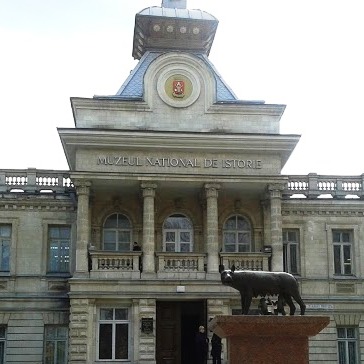
Bronze cauldrons of the Scythian time are rare in the Northern Black Sea region, especially on its western borders. Therefore, those few items found on the territory of the Republic of Moldova occupy a worthy place in the collection of the National Museum of History of Moldova (NMHM). In particular, in the archaeological exhibition, two bronze cauldrons are displayed, discovered near the village of Nicolscoe in 1988 in burial mounds no. 14 and 15. In addition, in 2020, two bronze cauldrons without any accompanying documents were found in the collection of NMHM; however, they were visually identified as coming from various excavations in the Low Dniester region, such as burial mound no. 45 near Dubăsari and burial mound no. 1 near the Răscăieții Noi village.
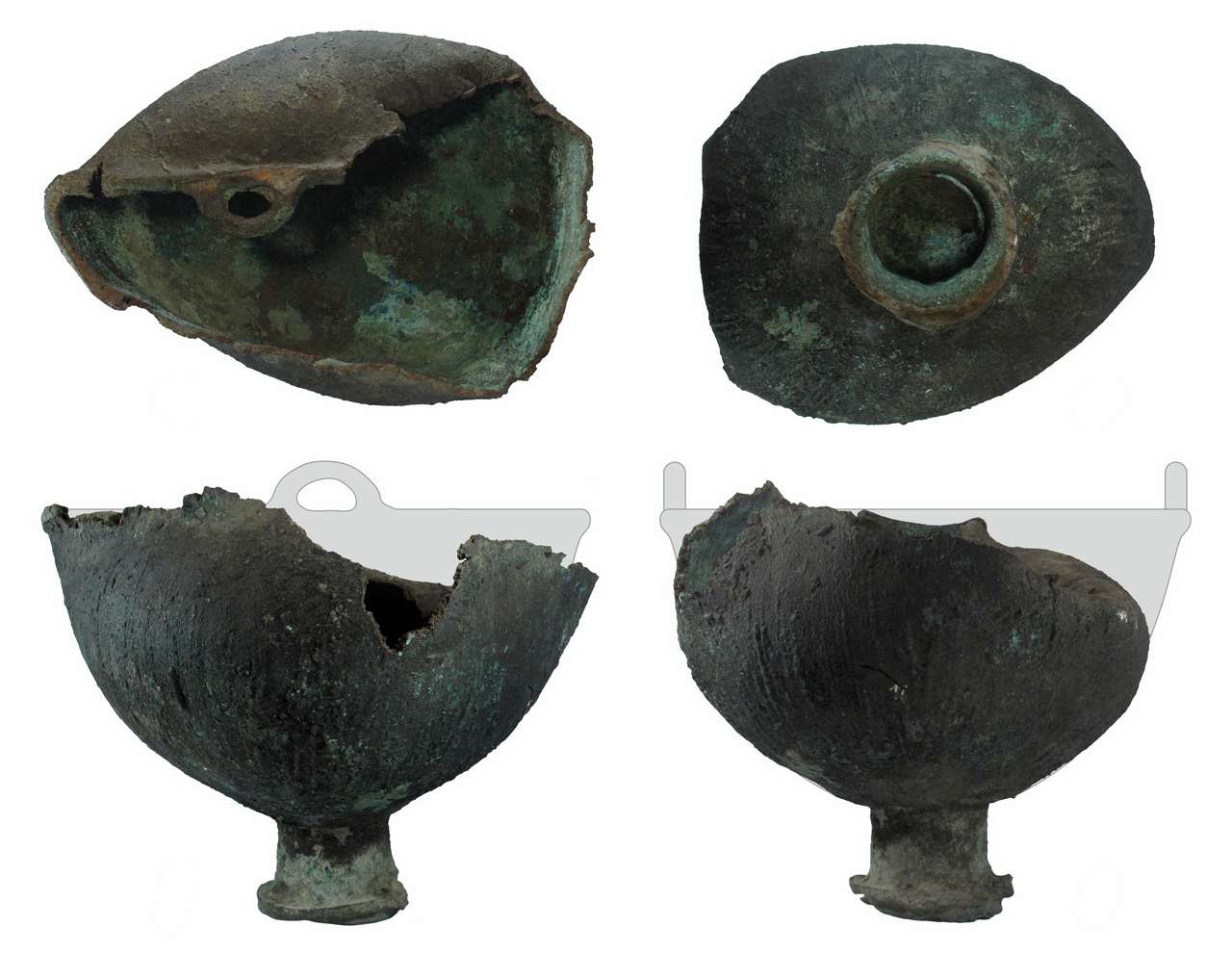
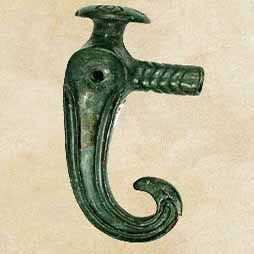
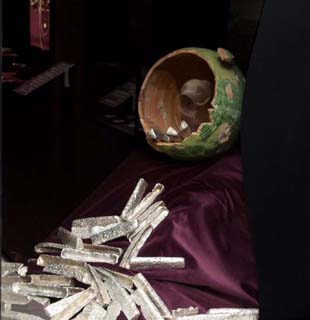
The object presented as the exhibit of the month is a little-known find discovered in 1979 in barrow 1 near the village of Răscăieții Noi in the Ștefan Vodă district. In addition to its outstanding size (about 10 m high), this mound is known for discovering a cast bronze finial in the Scythian animal style on its surface in 1953. However, by the beginning of excavations, the locals had damaged part of the mound and a Scythian cast bronze cauldron was found near it. The cauldron was seriously damaged by mechanical impact, as a result of which the rim was deformed, and the walls, with one preserved vertical handle, were bent inwards. Fragments in the upper part of the body and one handle have been lost. The total reconstructed height of the cauldron is 24 cm (excluding the handles), the reconstructed diameter of the hemispherical cauldron is 30 cm, and the weight is 6.5 kg. In 2020, data on the chemical composition of the bronze cauldron alloy were obtained, revealing that it was cast from an alloy of almost 95 per cent copper. Unfortunately, due to the loss of information on the context of the discovery of the cauldron at Răscăieții Noi, it is impossible to link its discovery with one or another Scythian burial of the barrow. Moreover, the grave goods of other Scythian burials of Barrow 1 do not allow them to date below the 4th century BC. However, the cauldron with vertical handles from Răscăieții Noi most likely belongs earlier. This may be indicated by a bronze finial from the first half of the 5th century BC, which was found on this barrow in 1953. In addition, burial 7 from the nearest excavated barrow 2 at Răscăieții Noi, containing a plaque depicting a rolled predator (a copy of which is also on display at the NMHM), belongs to the mid- 5th century BC. Thus, there is a high probability that the cauldron from Barrow 1 at Răscăieții Noi is associated with the late Middle Scythian period or the mid-5th century BC.
Scythian bronze cauldrons in the west area are concentrated in three main regions: Bukovina-Podolia, the Lower Danube, and the Lower Dniester. Some Scythian cauldrons have no reliable archaeological context. Nevertheless, in combination with the same "stray" finds like the Scythian statues, the finds of Scythian cauldrons mark the Scythian presence, most likely not earlier than the late 6th century or even the turn of the 6th-5th centuries BC. The cauldrons first appeared in Bukovina, where they have been known since the middle of the 7th century BC. Bronze cauldrons (with their carriers) entered the steppe region 150-200 years later, and the "military" burials that appeared in the western steppe regions were no earlier than the middle of the 5th century BC. Most burials with cauldrons (and, apparently, the stray finds) are dated back to the second half of the 5th century BC. Then, in the early 4th century BC, their quantity was reduced, and after the first quarter of the 4th century BC, they completely disappeared from the cultural practice of the population of the steppes of the North-Western Black Sea region.



























 31 August 1989 St., 121 A, MD 2012, Chisinau, Republic of Moldova