EN RO


#Exhibit of the Month

>>>

The grapevine plant, now widespread across the globe, traces its origins back to the Upper Cretaceous geological period, when species of Vitis Linn appeared on Earth (Mesozoic era), followed later by Vitis vinifera L., the latter already classified among cultivated agricultural plants. Most researchers link the origin of the cultivated grapevine (Vitis vinifera L.) to the wild forest species Vitis sylvestris Gmel. Thickets of Vitis sylvestris Gmel. can still sporadically be found in the groves along the Prut and Dniester floodplains.

During the Precucuteni III - Trypillia A period (ca. 4750-4600 BC), the presence of cultivated grape seeds was clearly documented on pottery from the settlement of Ruseştii Noi I, layer I, kiln A, consisting of a seed impression on a ceramic fragment, with the elongated beak characteristic of the domesticated species Vitis vinifera L. Another seed impression of Vitis vinifera L. was recorded at the settlement of Vărvăreuca VIII, identified on the wall of a painted vessel from the Cucuteni B - Trypillia CI stage (3800-3500/3300 BC). 
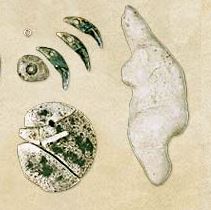
In October, on the occasion of the National Wine Day, the National Museum of History of Moldova presents to your attention a unique relic in Southeastern Europe. The exhibit originates from the settlement Brînzeni VIII "Sâiece," belonging to the Cucuteni-Trypillia culture and dated to the Cucuteni AB2 - Trypillia B2 phase (ca. 4050-3800 BC), located in Brînzeni village, Edineț district. The site lies 2 km southwest of the locality, in a triangle formed by the confluence of the Racovăț and Drobiște streams and the local road L36 Bădragii Vechi-Brînzeni. Positioned on land 25-30 meters above the valley, it was discovered in 1966 by archaeologist Nicolaie Chetraru and investigated through excavations between 1978-1980 by Vsevolod Marchevici. 
The October exhibit is a grapevine leaf impression discovered in 1980. It comes from pit no. 5, partially investigated, with a maximum depth of 155 cm. From the same archaeological complex near dwelling no. 1, several grape seeds were also recovered, as noted in the excavation report. The grapevine leaf impression appears on a coarse clay lump, fired and vitrified due to secondary burning, reddish in color, with an irregular rectangular, flattened shape. The outer surface is uneven and rough. The impression surface is smoothed, with the leaf veins clearly highlighted. Measuring 99 mm in length, 110 mm in width, and 28-31 mm in thickness, the exhibit presents in full splendor an authentic grapevine leaf impression. Some researchers attribute it to the domesticated grapevine Vitis vinifera L., while others, more skeptical, consider it a wild species. Nevertheless, being discovered in a well-documented archaeological context, together with grape seeds near a dwelling, it provides evidence that grapevine was part of Cucuteni community life 6,000 years ago. These findings allow us to affirm that the process of domestication and the creation of table grapes was already underway. The diversity of Cucuteni ceramic forms, as well as the painting on some vessels, undoubtedly suggests their use as containers for various liquids. Accordingly, the emergence of wine among Cucuteni communities can be taken into consideration.

Virtual Tour


Exhibitions

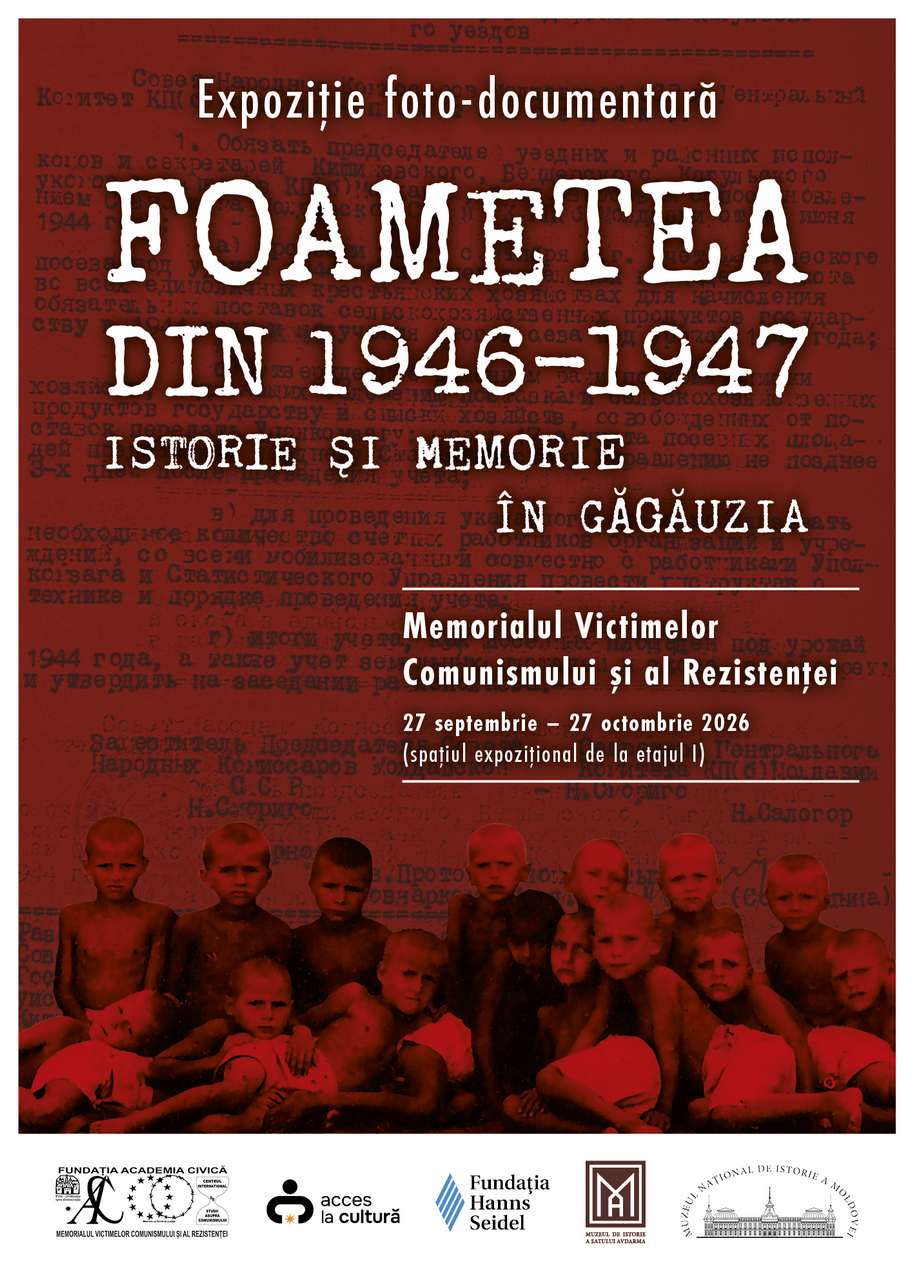
‟The Famine of 1946–1947. History and Memory in Gagauzia”

Memorial to the Victims of Communism and to the Resistance in Sighet (Romania)

September 27 – October 27, 2026

Between September 27 - October 27, 2026, the National Museum of History of Moldova, in cooperation with the Museum of History of the Village of Avdarma, the Civic Academy Foundation (Bucharest), and the Hanns Seidel Foundation - Republic of Moldova, is presenting the photo-documentary exhibition "The Famine of 1946-1947. History and Memory in Gagauzia" at the Memorial to the Victims of Communism and to the Resistance in Sighet, Romania.

The exhibition is dedicated to one of the most tragic chapters in the history of the totalitarian-communist regime. Through documents, images, and testimonies, it highlights the premises, causes, and dramatic consequences of the famine in the southern part of the Moldavian Soviet Socialist Republic, contributing to a deeper understanding of this calamity within Gagauz communities and to the preservation of the memory of its victims.

The famine of 1946-1947 was caused by both natural and political factors. Severe droughts in 1945-1946 destroyed harvests and drastically reduced grain production. However, the decisive role was played by the repressive economic policies of the Soviet regime, which imposed compulsory deliveries of agricultural products from peasant households to the state.

The consequences were catastrophic: approximately 200,000 people lost their lives, representing about 10% of the republic's population. Beginning in the autumn and winter of 1946, rural and urban localities in southern Moldova recorded daily deaths caused by dystrophy and physical exhaustion. The situation reached alarming proportions - in Vulcănești district, for example, 70 people died in just 15 days in December 1946, while in January 1947 the number of victims rose to nearly 900. In Ceadâr-Lunga district, 15 deaths were recorded in Tomai, 25 in Chiriet-Lunga, 13 in Beșghioz, and 21 in Gaidai. In January 1947, the toll increased dramatically: 893 in Vulcănești, 825 in Congaz, 567 in Taraclia, and 770 in Ceadâr-Lunga. On February 11, 1947, an official report on the situation in Cahul county noted that in villages with Gagauz populations, up to 30% of inhabitants had perished in January and February, prompting urgent calls for measures to prevent further loss of life.

The exhibition brings to public attention testimonies, photographs, and documents - many presented for the first time - drawn from the collections of the National Museum of History of Moldova, the Museum of History of the Village of Avdarma, and the National Archives Agency.

"The Famine of 1946-1947. History and Memory in Gagauzia" aims the recovering of collective memory and is an act of symbolic justice dedicated to the victims of the Great Famine in the Moldavian SSR. Their memory has been commemorated in Gagauz localities since 2019, on October 19. Beginning in 2022, Moldovan society marks this tragedy on the third Saturday of April.

The exhibition "The Famine of 1946-1947. History and Memory in Gagauzia" will be open to visitors between September 27 - October 27, 2026, in the exhibition space on the first floor of the Memorial to the Victims of Communism and of the Resistance in Sighet (4 Corneliu Coposu Street, Sighetu Marmației, Romania).

***

The exhibition was realized within the project "The Famine of 1946-1947. History and Memory in Gagauzia", initiated by the Museum of History of the Village of Avdarma in collaboration with the National Museum of History of Moldova, as part of the National Program "Access to Culture - 2025" of the Ministry of Culture of the Republic of Moldova.


Independent Moldova
Moldavian Soviet Socialist Republic
Bessarabia and MASSR between the Two World Wars
Bessarabia and Moldavian Autonomous Soviet Socialist Republic in the Period between the Two World Wars
Revival of National Movement
Time of Reforms and their Consequences
Abolition of Autonomy. Bessarabia – a New Tsarist Colony
Period of Relative Autonomy of Bessarabia within the Russian Empire
Phanariot Regime
Golden Age of the Romanian Culture
Struggle for Maintaining of Independence of Moldova
Formation of Independent Medieval State of Moldova
Era of the
Great Nomad Migrations
Early Middle Ages
Iron Age and Antiquity
Bronze Age
Aeneolithic Age
Neolithic Age
Palaeolithic Age


Come to Museum! Discover the History!
  
Visit museum
Visit museum
Summer schedule: daily
10am – 6pm.

Winter schedule: daily
10am – 5pm.
Closed on Mondays.
Entrance fees:  adults - 50 MDL, Pensioners, students - 20 lei, pupils - 10 MDL. Free access: enlisted men (...)

WiFi Free Wi-Fi Zone in the museum: In the courtyard of the National History Museum of Moldova there is Wi-Fi Internet access for visitors.


#Exhibit of the Month

The grapevine plant, now widespread across the globe, traces its origins back to the Upper Cretaceous geological period, when species of Vitis Linn appeared on Earth (Mesozoic era), followed later by Vitis vinifera L., the latter already classified among cultivated agricultural plants. Most researchers link the origin of the cultivated grapevine (Vitis vinifera L.) to the wild forest species Vitis sylvestris Gmel...

Read More >>


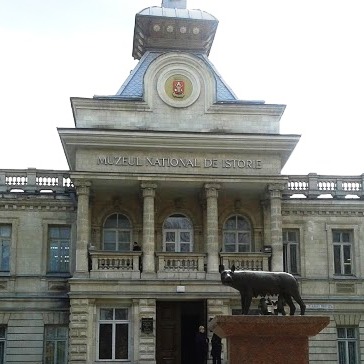
The National Museum of History of Moldova takes place among the most significant museum institutions of the Republic of Moldova, in terms of both its collection and scientific reputation.
©2006-2026 National Museum of History of Moldova
Visit museum 31 August 1989 St., 121 A, MD 2012, Chisinau, Republic of Moldova
Phones:
Secretariat: +373 (22) 24-43-25
Department of Public Relations and Museum Education: +373 (22) 24-04-26
Fax: +373 (22) 24-43-69
E-mail: office@nationalmuseum.md
Technical Support: info@nationalmuseum.md
Web site administration and maintenance: Andrei EMILCIUC


The National Museum of History of Moldova takes place among the most significant museum institutions of the Republic of Moldova, in terms of both its collection and scientific reputation.
©2006-2026 National Museum of History of Moldova
Visit museum 31 August 1989 St., 121 A, MD 2012, Chisinau, Republic of Moldova
Phones:
Secretariat: +373 (22) 24-43-25
Department of Public Relations and Museum Education: +373 (22) 24-04-26
Fax: +373 (22) 24-43-69
E-mail: office@nationalmuseum.md
Technical Support: info@nationalmuseum.md
Web site administration and maintenance: Andrei EMILCIUC

menu
The National Museum of History of Moldova takes place among the most significant museum institutions of the Republic of Moldova, in terms of both its collection and scientific reputation.
©2006-2026 National Museum of History of Moldova
Visit museum 31 August 1989 St., 121 A, MD 2012, Chisinau, Republic of Moldova
Phones:
Secretariat: +373 (22) 24-43-25
Department of Public Relations and Museum Education: +373 (22) 24-04-26
Fax: +373 (22) 24-43-69
E-mail: office@nationalmuseum.md
Technical Support: info@nationalmuseum.md
Web site administration and maintenance: Andrei EMILCIUC