EN RO


#Exhibit of the Month

>>>

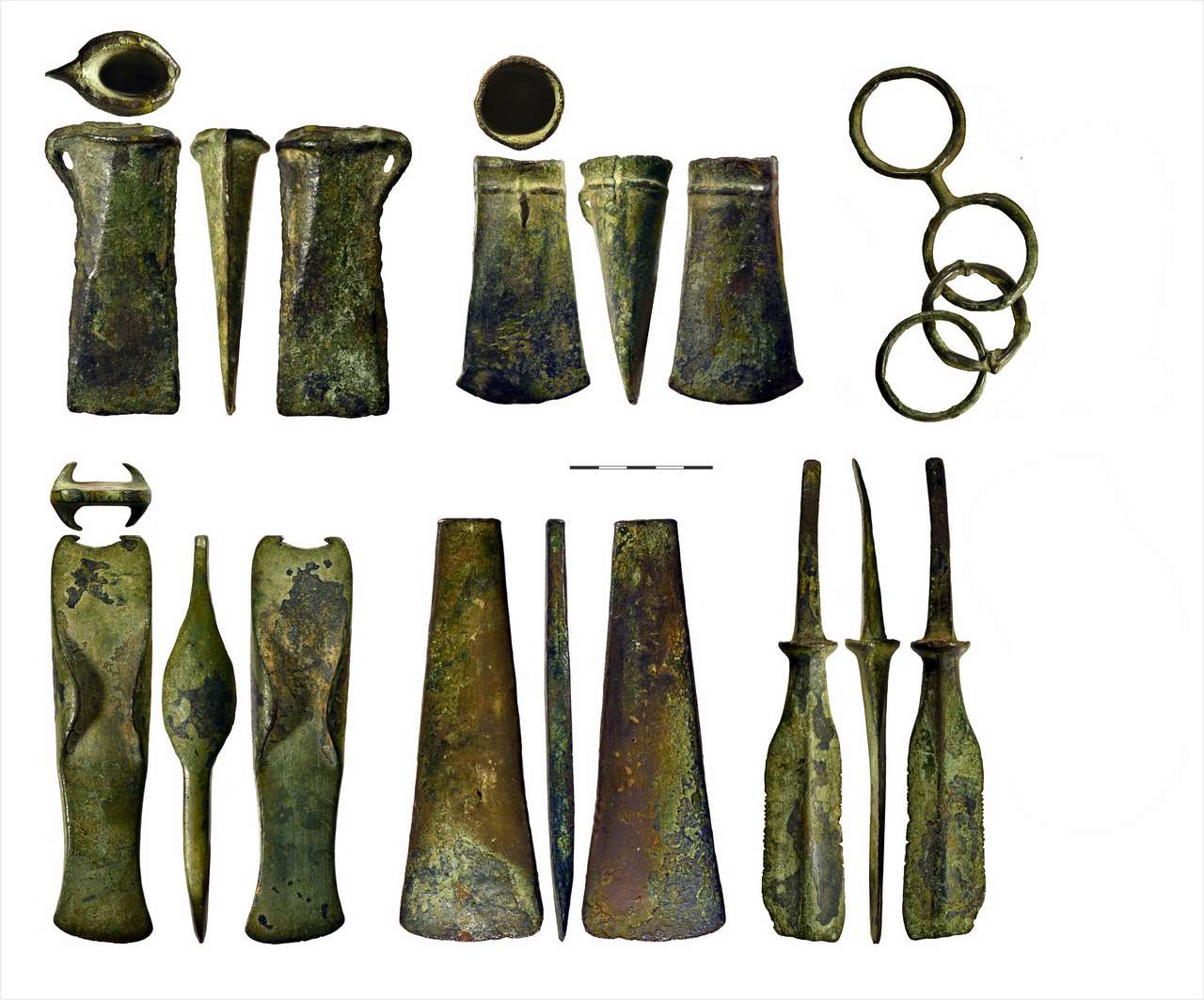
The bronze hoard was discovered on the territory of Mîndrești village, Telenești district, in 1968. It was identified accidentally by a group of students from the village school, and the materials later came to the attention of specialists at the Institute of History of the Academy of Sciences. According to documentary records, the hoard was composed of ten pieces: four socketed axes (celts), a dagger fragment, a sword fragment, a sickle, a winged axe, an adze-axe, and a chain consisting of four links.
Currently, of the mentioned assemblage, six objects are preserved in the collections of the National Museum of History of Moldova: two socketed axes (celts), the winged axe, the adze-axe, the dagger fragment, and the chain made of four links.- Socketed axe (celt) with one loop. Dimensions: Length - 10.2 cm; Weight - 186 g.
- Socketed axe (celt) with one frontal loop. Dimensions: Length - 8.4 cm; Width: 33-46 mm; Weight - 124 g.
- Winged axe. Dimensions: Length - 14.0 cm; Width - 2.5-3.4 cm; Weight - 285 g.
- Adze-axe. Dimensions: Length - 14.8 cm; Width - 2.3-5.0 cm; Weight - 286 g.
- Dagger fragment. Dimensions: Length - 16.5 cm; Blade length - 9.8 cm; Blade width - 2.8 cm; Weight - 81 g.
- Chain formed of four links. Dimensions: Length - 17.1 cm; Link diameter - 3.8; Weight - 32 g.The bronze hoard of Mîndrești is important due to the association of objects that find analogies in the regional repertoire with pieces that show clear analogies in Central Europe and the Carpathian Basin. The assemblage reflects a zone of contact and interaction where metallic forms of different origins and traditions circulated and were integrated into the repertoire of local communities.
Chronologically, the bronze hoard of Mîndrești is attributed to the Early Hallstatt period - HaA1, being dated to 1200-1100 BC.

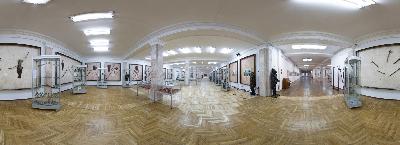
Virtual Tour


Events Archive

International scientific-practical seminar “Memorial Peloton: exchange of best practices in historical knowledge and the educational valorization of the memory of the totalitarian past”

30–31 August 2026

On 30-31 August 2026, the National Museum of History of Moldova, in partnership with the Embassy of the Republic of Lithuania in Moldova and the Hanns Seidel Foundation - Republic of Moldova, organized the international scientific-practical seminar "Memorial Peloton: exchange of best practices in historical knowledge and the educational valorization of the memory of the totalitarian past." The event was dedicated to commemorating the victims of totalitarian regimes and the dramatic consequences experienced in Central and Eastern Europe following the signing of the secret additional protocol to the Ribbentrop-Molotov Pact on 23 August 1939 by Nazi Germany and the USSR.

The seminar provided a platform for dialogue among experts in history, museography, and education from Poland, Latvia, Lithuania, Estonia, Germany, and the Republic of Moldova. It fostered the exchange of best practices and offered an interdisciplinary perspective on the difficult legacy of the totalitarian past, the strengthening of intergenerational memory, and the rapprochement of competing memory communities. The experiences shared by partner institutions facilitated public access to historical knowledge and encouraged the involvement of younger generations in integrating Moldova's historical memory into the broader European culture of remembrance.

A central moment of the seminar was the international commemorative action "Peloton of Memory" - an initiative launched in 2017 by the Sybir Memorial Museum in Białystok (Poland) and expanded after 2022 to countries marked by the consequences of the Molotov-Ribbentrop Pact. "The purpose of the Peloton is to share history with future generations, as well as with people from other continents who may not know this history. We want the memory of Siberia, of the Katyn massacre, and of Stalinist deportations to be carried beyond the borders of Poland and Europe," emphasized Prof. Wojciech Śleszyński, Director of the Sybir Memorial Museum.

In Chișinău, the commemorative action - now at its third edition - included visits to sites of memory dedicated to the victims of Soviet occupation and to the fighters for freedom under the totalitarian-communist regime. This initiative provided an opportunity to make Moldova's history heard in the European dialogue, contributing to the consolidation of solidarity among communities and to the integration of historical memory into European culture. "We join the initiative of the Sybir Memorial Museum with the conviction that museums can be more than guardians of national heritage - they are active voices in promoting solidarity, civic responsibility, and cooperation across borders and generations," stated Assoc. Prof. Ludmila Cojocaru, Head of the Museum of Victims of Deportations and Political Repressions at NMHM.


Organizers and Partners:

• National Museum of History of Moldova
• Embassy of the Republic of Lithuania in Chișinău
• Hanns Seidel Foundation - Republic of Moldova
• Institute of History of the State University of Moldova
• NGO Institute Pro Memoria
• Sybir Memorial Museum, Białystok, Poland
• Center for the Study of Genocide and Resistance, Lithuania
• Museum of the Occupation, Latvia
• Vabamu Museum of Occupations and Freedom, Estonia
• Association of Former Deportees and Political Prisoners of the Republic of Moldova


Independent Moldova
Moldavian Soviet Socialist Republic
Bessarabia and MASSR between the Two World Wars
Bessarabia and Moldavian Autonomous Soviet Socialist Republic in the Period between the Two World Wars
Revival of National Movement
Time of Reforms and their Consequences
Abolition of Autonomy. Bessarabia – a New Tsarist Colony
Period of Relative Autonomy of Bessarabia within the Russian Empire
Phanariot Regime
Golden Age of the Romanian Culture
Struggle for Maintaining of Independence of Moldova
Formation of Independent Medieval State of Moldova
Era of the
Great Nomad Migrations
Early Middle Ages
Iron Age and Antiquity
Bronze Age
Aeneolithic Age
Neolithic Age
Palaeolithic Age


Come to Museum! Discover the History!
  
Visit museum
Visit museum
Summer schedule: daily
10am – 6pm.

Winter schedule: daily
10am – 5pm.
Closed on Mondays.
Entrance fees:  adults - 50 MDL, Pensioners, students - 20 lei, pupils - 10 MDL. Free access: enlisted men (...)

WiFi Free Wi-Fi Zone in the museum: In the courtyard of the National History Museum of Moldova there is Wi-Fi Internet access for visitors.


#Exhibit of the Month

The bronze hoard was discovered on the territory of Mîndrești village, Telenești district, in 1968. It was identified accidentally by a group of students from the village school, and the materials later came to the attention of specialists at the Institute of History of the Academy of Sciences...

Read More >>


The National Museum of History of Moldova takes place among the most significant museum institutions of the Republic of Moldova, in terms of both its collection and scientific reputation.
©2006-2026 National Museum of History of Moldova
Visit museum 31 August 1989 St., 121 A, MD 2012, Chisinau, Republic of Moldova
Phones:
Secretariat: +373 (22) 24-43-25
Department of Public Relations and Museum Education: +373 (22) 24-04-26
Fax: +373 (22) 24-43-69
E-mail: office@nationalmuseum.md
Technical Support: info@nationalmuseum.md
Web site administration and maintenance: Andrei EMILCIUC


The National Museum of History of Moldova takes place among the most significant museum institutions of the Republic of Moldova, in terms of both its collection and scientific reputation.
©2006-2026 National Museum of History of Moldova
Visit museum 31 August 1989 St., 121 A, MD 2012, Chisinau, Republic of Moldova
Phones:
Secretariat: +373 (22) 24-43-25
Department of Public Relations and Museum Education: +373 (22) 24-04-26
Fax: +373 (22) 24-43-69
E-mail: office@nationalmuseum.md
Technical Support: info@nationalmuseum.md
Web site administration and maintenance: Andrei EMILCIUC

menu
The National Museum of History of Moldova takes place among the most significant museum institutions of the Republic of Moldova, in terms of both its collection and scientific reputation.
©2006-2026 National Museum of History of Moldova
Visit museum 31 August 1989 St., 121 A, MD 2012, Chisinau, Republic of Moldova
Phones:
Secretariat: +373 (22) 24-43-25
Department of Public Relations and Museum Education: +373 (22) 24-04-26
Fax: +373 (22) 24-43-69
E-mail: office@nationalmuseum.md
Technical Support: info@nationalmuseum.md
Web site administration and maintenance: Andrei EMILCIUC