EN RO


#Exhibit of the Month

>>>

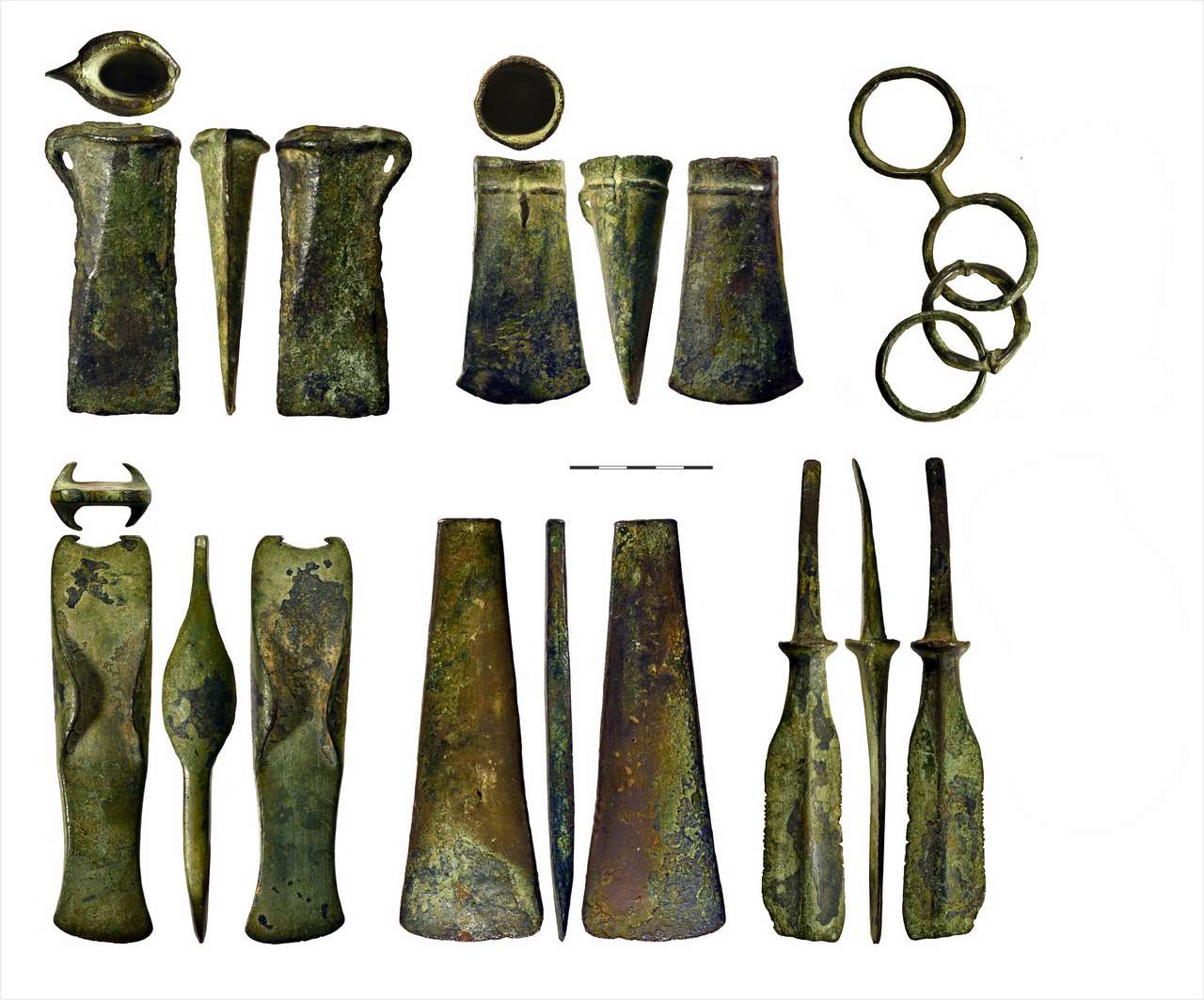
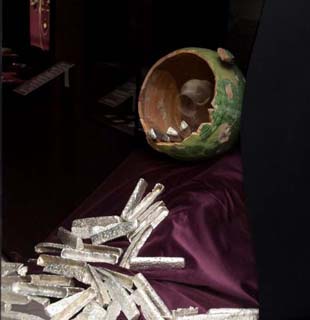
The bronze hoard was discovered on the territory of Mîndrești village, Telenești district, in 1968. It was identified accidentally by a group of students from the village school, and the materials later came to the attention of specialists at the Institute of History of the Academy of Sciences. According to documentary records, the hoard was composed of ten pieces: four socketed axes (celts), a dagger fragment, a sword fragment, a sickle, a winged axe, an adze-axe, and a chain consisting of four links.
Currently, of the mentioned assemblage, six objects are preserved in the collections of the National Museum of History of Moldova: two socketed axes (celts), the winged axe, the adze-axe, the dagger fragment, and the chain made of four links.- Socketed axe (celt) with one loop. Dimensions: Length - 10.2 cm; Weight - 186 g.
- Socketed axe (celt) with one frontal loop. Dimensions: Length - 8.4 cm; Width: 33-46 mm; Weight - 124 g.
- Winged axe. Dimensions: Length - 14.0 cm; Width - 2.5-3.4 cm; Weight - 285 g.
- Adze-axe. Dimensions: Length - 14.8 cm; Width - 2.3-5.0 cm; Weight - 286 g.
- Dagger fragment. Dimensions: Length - 16.5 cm; Blade length - 9.8 cm; Blade width - 2.8 cm; Weight - 81 g.
- Chain formed of four links. Dimensions: Length - 17.1 cm; Link diameter - 3.8; Weight - 32 g.The bronze hoard of Mîndrești is important due to the association of objects that find analogies in the regional repertoire with pieces that show clear analogies in Central Europe and the Carpathian Basin. The assemblage reflects a zone of contact and interaction where metallic forms of different origins and traditions circulated and were integrated into the repertoire of local communities.
Chronologically, the bronze hoard of Mîndrești is attributed to the Early Hallstatt period - HaA1, being dated to 1200-1100 BC.

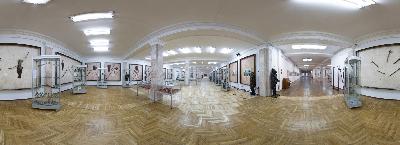
Virtual Tour


Events Archive

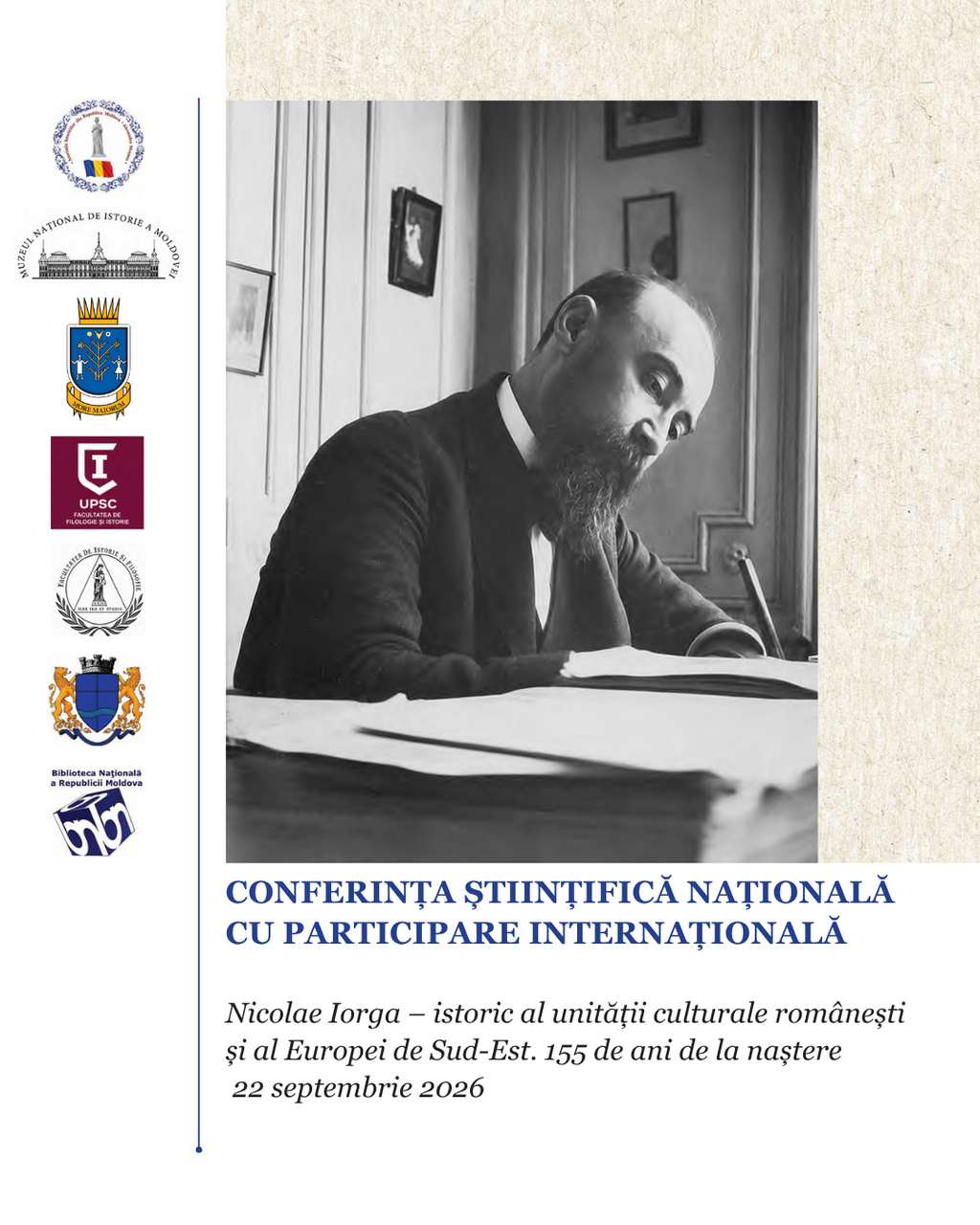
National Scientific Conference with International Participation “Nicolae Iorga – Historian of Romanian Cultural Unity and of South Eastern Europe. 155 Years Since His Birth”

September 22, 2026

On Tuesday, September 22, 2026, the National Museum of History of Moldova hosted the National Scientific Conference with international participation "Nicolae Iorga - Historian of Romanian Cultural Unity and of South Eastern Europe. 155 Years Since His Birth." The event was organized by the Association of Historians of the Republic of Moldova "Alexandru Moșanu," in partnership with the National Museum of History of Moldova, the National Museum of Ethnography and Natural History, Moldova State University, "Ion Creangă" State Pedagogical University of Chișinău, the Brăila Museum "Carol I" (Romania), the National Library of the Republic of Moldova, and Lexon Prim Publishing House.

The official opening was delivered by Prof. Anatol Petrencu, PhD habil., President of the Association of Historians of the Republic of Moldova "Alexandru Moșanu." Welcome addresses followed from Alexandru Argint (MNIM), Sergiu Gurin (Ministry of Education and Research of the Republic of Moldova), Liliana Condraticova (Academy of Sciences of Moldova), Petru Vicol (National Museum of Ethnography and Natural History), Costin Croitoru (Brăila Museum "Carol I"), and Igor Bercu (Moldova State University).

Plenary presentations were delivered by Acad. Andrei Eșanu, Dr. habil. Alina Felea, Dr. Costin Croitoru, and Fatme Nistoroi, highlighting Nicolae Iorga's contributions to European historiography, the study of everyday life, and the history of Brăila.

The conference continued with thematic sessions featuring researchers and professors from institutions such as Moldova State University, "Ion Creangă" State Pedagogical University, the Brăila Museum "Carol I," "Ștefan cel Mare" University of Suceava, the National Library of the Republic of Moldova, and the National Museum of History of Moldova. Presentations explored Iorga's intellectual legacy, the history of Bessarabia, Romanian Ottoman relations, industrial heritage, and the role of museums in promoting cultural identity.


A highlight of the event was the gesture of the Director of the Brăila Museum "Carol I," who offered sets of commemorative medals dedicated to Nicolae Iorga and the Brăila Museum to the Association of Historians of the Republic of Moldova "Alexandru Moșanu," the National Museum of History of Moldova, and the National Museum of Ethnography and Natural History - a symbol of academic friendship and recognition.

The conference brought together historians and researchers from Moldova, Romania, and other countries in an academic dialogue dedicated to the memory and legacy of Nicolae Iorga. The event demonstrated the enduring relevance of the great historian's work for the study of Romanian and European history and culture.


Independent Moldova
Moldavian Soviet Socialist Republic
Bessarabia and MASSR between the Two World Wars
Bessarabia and Moldavian Autonomous Soviet Socialist Republic in the Period between the Two World Wars
Revival of National Movement
Time of Reforms and their Consequences
Abolition of Autonomy. Bessarabia – a New Tsarist Colony
Period of Relative Autonomy of Bessarabia within the Russian Empire
Phanariot Regime
Golden Age of the Romanian Culture
Struggle for Maintaining of Independence of Moldova
Formation of Independent Medieval State of Moldova
Era of the
Great Nomad Migrations
Early Middle Ages
Iron Age and Antiquity
Bronze Age
Aeneolithic Age
Neolithic Age
Palaeolithic Age


Come to Museum! Discover the History!
  
Visit museum
Visit museum
Summer schedule: daily
10am – 6pm.

Winter schedule: daily
10am – 5pm.
Closed on Mondays.
Entrance fees:  adults - 50 MDL, Pensioners, students - 20 lei, pupils - 10 MDL. Free access: enlisted men (...)

WiFi Free Wi-Fi Zone in the museum: In the courtyard of the National History Museum of Moldova there is Wi-Fi Internet access for visitors.


#Exhibit of the Month

The bronze hoard was discovered on the territory of Mîndrești village, Telenești district, in 1968. It was identified accidentally by a group of students from the village school, and the materials later came to the attention of specialists at the Institute of History of the Academy of Sciences...

Read More >>


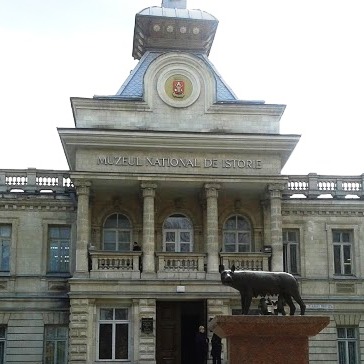
The National Museum of History of Moldova takes place among the most significant museum institutions of the Republic of Moldova, in terms of both its collection and scientific reputation.
©2006-2026 National Museum of History of Moldova
Visit museum 31 August 1989 St., 121 A, MD 2012, Chisinau, Republic of Moldova
Phones:
Secretariat: +373 (22) 24-43-25
Department of Public Relations and Museum Education: +373 (22) 24-04-26
Fax: +373 (22) 24-43-69
E-mail: office@nationalmuseum.md
Technical Support: info@nationalmuseum.md
Web site administration and maintenance: Andrei EMILCIUC


The National Museum of History of Moldova takes place among the most significant museum institutions of the Republic of Moldova, in terms of both its collection and scientific reputation.
©2006-2026 National Museum of History of Moldova
Visit museum 31 August 1989 St., 121 A, MD 2012, Chisinau, Republic of Moldova
Phones:
Secretariat: +373 (22) 24-43-25
Department of Public Relations and Museum Education: +373 (22) 24-04-26
Fax: +373 (22) 24-43-69
E-mail: office@nationalmuseum.md
Technical Support: info@nationalmuseum.md
Web site administration and maintenance: Andrei EMILCIUC

menu
The National Museum of History of Moldova takes place among the most significant museum institutions of the Republic of Moldova, in terms of both its collection and scientific reputation.
©2006-2026 National Museum of History of Moldova
Visit museum 31 August 1989 St., 121 A, MD 2012, Chisinau, Republic of Moldova
Phones:
Secretariat: +373 (22) 24-43-25
Department of Public Relations and Museum Education: +373 (22) 24-04-26
Fax: +373 (22) 24-43-69
E-mail: office@nationalmuseum.md
Technical Support: info@nationalmuseum.md
Web site administration and maintenance: Andrei EMILCIUC