EN RO


#Exhibit of the Month

>>>

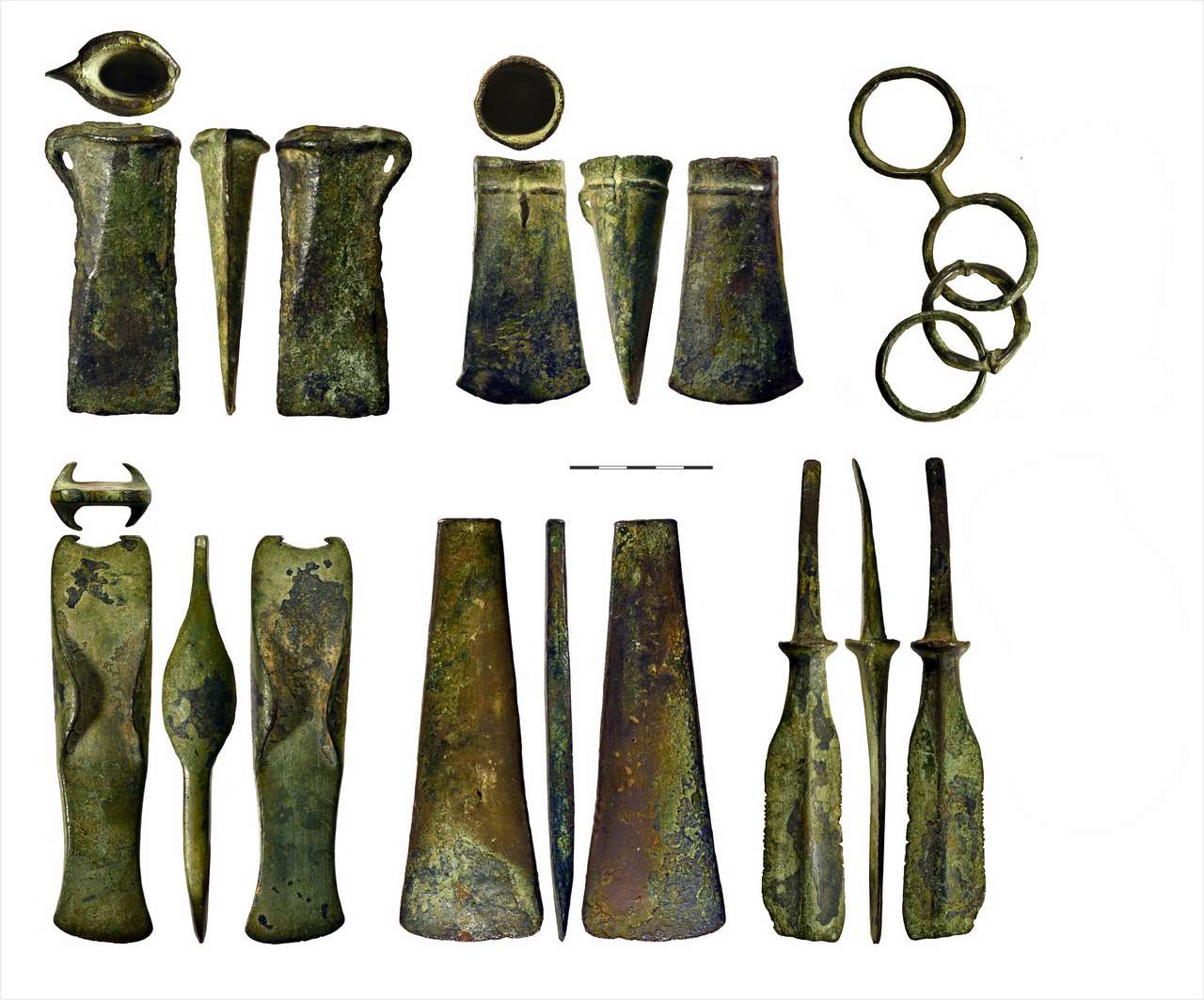
The bronze hoard was discovered on the territory of Mîndrești village, Telenești district, in 1968. It was identified accidentally by a group of students from the village school, and the materials later came to the attention of specialists at the Institute of History of the Academy of Sciences. According to documentary records, the hoard was composed of ten pieces: four socketed axes (celts), a dagger fragment, a sword fragment, a sickle, a winged axe, an adze-axe, and a chain consisting of four links.
Currently, of the mentioned assemblage, six objects are preserved in the collections of the National Museum of History of Moldova: two socketed axes (celts), the winged axe, the adze-axe, the dagger fragment, and the chain made of four links.- Socketed axe (celt) with one loop. Dimensions: Length - 10.2 cm; Weight - 186 g.
- Socketed axe (celt) with one frontal loop. Dimensions: Length - 8.4 cm; Width: 33-46 mm; Weight - 124 g.
- Winged axe. Dimensions: Length - 14.0 cm; Width - 2.5-3.4 cm; Weight - 285 g.
- Adze-axe. Dimensions: Length - 14.8 cm; Width - 2.3-5.0 cm; Weight - 286 g.
- Dagger fragment. Dimensions: Length - 16.5 cm; Blade length - 9.8 cm; Blade width - 2.8 cm; Weight - 81 g.
- Chain formed of four links. Dimensions: Length - 17.1 cm; Link diameter - 3.8; Weight - 32 g.The bronze hoard of Mîndrești is important due to the association of objects that find analogies in the regional repertoire with pieces that show clear analogies in Central Europe and the Carpathian Basin. The assemblage reflects a zone of contact and interaction where metallic forms of different origins and traditions circulated and were integrated into the repertoire of local communities.
Chronologically, the bronze hoard of Mîndrești is attributed to the Early Hallstatt period - HaA1, being dated to 1200-1100 BC.

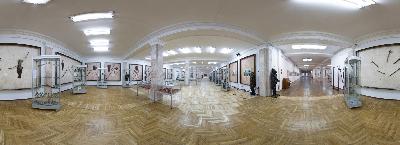
Virtual Tour


Events Archive

Opening of the exhibition “From Grapes to Wine, From Earth to Food”

6 October 2026

The vineyard, the harvest, and the family gathered around the table are the themes of the exhibition "From Grapes to Wine, From Earth to Food", opened at the National Museum of History of Moldova (NMHM). Organized under the patronage of the Food and Agriculture Organization of the United Nations (FAO), the exhibition was launched in the context of National Wine Day and marks World Food Day, celebrated on 16 October.

On display are paintings by Lotta Teale, a British artist based in Chișinău and winner of the British Artist of the Year award, and Daniela Mereuță, a young Moldovan painter inspired by traditional culture. The exhibition is enriched by eight paintings from the Museum's collection, created by Aurelia Roman, Tatiana Nicolaidi, and Chiril Novac, together with traditional textiles - blouses, headscarves, and handwoven towels with vegetal and grape motifs - and ceramic and glass objects from the 20th century. Together, they trace the journey of food from the earth to the table and highlight Moldova's viticultural and agro-food heritage.

This legacy naturally connects with the theme of this year's World Food Day, "Water is life, water is food. Leave no one behind." Innovation is not only about technology: traditional knowledge of farmers, combined with new solutions, can ensure food for future generations.

Many of the works depict women harvesting, working in the fields, and sitting at the table - a natural link with the International Year of the Woman Farmer, marked in 2026.

On 6 October, NMHM and FAO organized the opening for partners and guests. The event brought together representatives of public institutions, diplomatic missions, and development partners, alongside artists and local grape producers. In a space dedicated to history, art opened a conversation about food, tradition, and the future of agriculture. Speeches were given by Alexandru Argint from the Museum, Yesim Oruc, UN Resident Coordinator in Moldova, and Tudor Robu, Assistant FAO Representative in Moldova, while a table grape farmer shared insights into the work behind each harvest. Partners emphasized the importance of art and agriculture for our people and invited guests to savor the imagined delights of traditional dishes, table grapes, and Moldovan wine. These reflections came naturally against the backdrop of FAO's priority to support grape value chain development through investment and innovation under the global program "One Country, One Priority Product."


The Republic of Moldova became a member of FAO in 1995 and since then has benefited from the Organization's expertise and assistance programs. The number of projects and beneficiaries grew significantly after the opening of the FAO Representation in 2014. Between 2022 and 2025 alone, more than 25,000 farmers and their families received agricultural inputs and extensive knowledge on resilient and sustainable farming.

The exhibition is open to the public from 1 October until 30 October 2026 at the National Museum of History of Moldova (121A, 31 August 1989 Street, 2nd floor, Chișinău).


Independent Moldova
Moldavian Soviet Socialist Republic
Bessarabia and MASSR between the Two World Wars
Bessarabia and Moldavian Autonomous Soviet Socialist Republic in the Period between the Two World Wars
Revival of National Movement
Time of Reforms and their Consequences
Abolition of Autonomy. Bessarabia – a New Tsarist Colony
Period of Relative Autonomy of Bessarabia within the Russian Empire
Phanariot Regime
Golden Age of the Romanian Culture
Struggle for Maintaining of Independence of Moldova
Formation of Independent Medieval State of Moldova
Era of the
Great Nomad Migrations
Early Middle Ages
Iron Age and Antiquity
Bronze Age
Aeneolithic Age
Neolithic Age
Palaeolithic Age


Come to Museum! Discover the History!
  
Visit museum
Visit museum
Summer schedule: daily
10am – 6pm.

Winter schedule: daily
10am – 5pm.
Closed on Mondays.
Entrance fees:  adults - 50 MDL, Pensioners, students - 20 lei, pupils - 10 MDL. Free access: enlisted men (...)

WiFi Free Wi-Fi Zone in the museum: In the courtyard of the National History Museum of Moldova there is Wi-Fi Internet access for visitors.


#Exhibit of the Month

The bronze hoard was discovered on the territory of Mîndrești village, Telenești district, in 1968. It was identified accidentally by a group of students from the village school, and the materials later came to the attention of specialists at the Institute of History of the Academy of Sciences...

Read More >>


The National Museum of History of Moldova takes place among the most significant museum institutions of the Republic of Moldova, in terms of both its collection and scientific reputation.
©2006-2026 National Museum of History of Moldova
Visit museum 31 August 1989 St., 121 A, MD 2012, Chisinau, Republic of Moldova
Phones:
Secretariat: +373 (22) 24-43-25
Department of Public Relations and Museum Education: +373 (22) 24-04-26
Fax: +373 (22) 24-43-69
E-mail: office@nationalmuseum.md
Technical Support: info@nationalmuseum.md
Web site administration and maintenance: Andrei EMILCIUC


The National Museum of History of Moldova takes place among the most significant museum institutions of the Republic of Moldova, in terms of both its collection and scientific reputation.
©2006-2026 National Museum of History of Moldova
Visit museum 31 August 1989 St., 121 A, MD 2012, Chisinau, Republic of Moldova
Phones:
Secretariat: +373 (22) 24-43-25
Department of Public Relations and Museum Education: +373 (22) 24-04-26
Fax: +373 (22) 24-43-69
E-mail: office@nationalmuseum.md
Technical Support: info@nationalmuseum.md
Web site administration and maintenance: Andrei EMILCIUC

menu
The National Museum of History of Moldova takes place among the most significant museum institutions of the Republic of Moldova, in terms of both its collection and scientific reputation.
©2006-2026 National Museum of History of Moldova
Visit museum 31 August 1989 St., 121 A, MD 2012, Chisinau, Republic of Moldova
Phones:
Secretariat: +373 (22) 24-43-25
Department of Public Relations and Museum Education: +373 (22) 24-04-26
Fax: +373 (22) 24-43-69
E-mail: office@nationalmuseum.md
Technical Support: info@nationalmuseum.md
Web site administration and maintenance: Andrei EMILCIUC