EN RO


#Exhibit of the Month

>>>

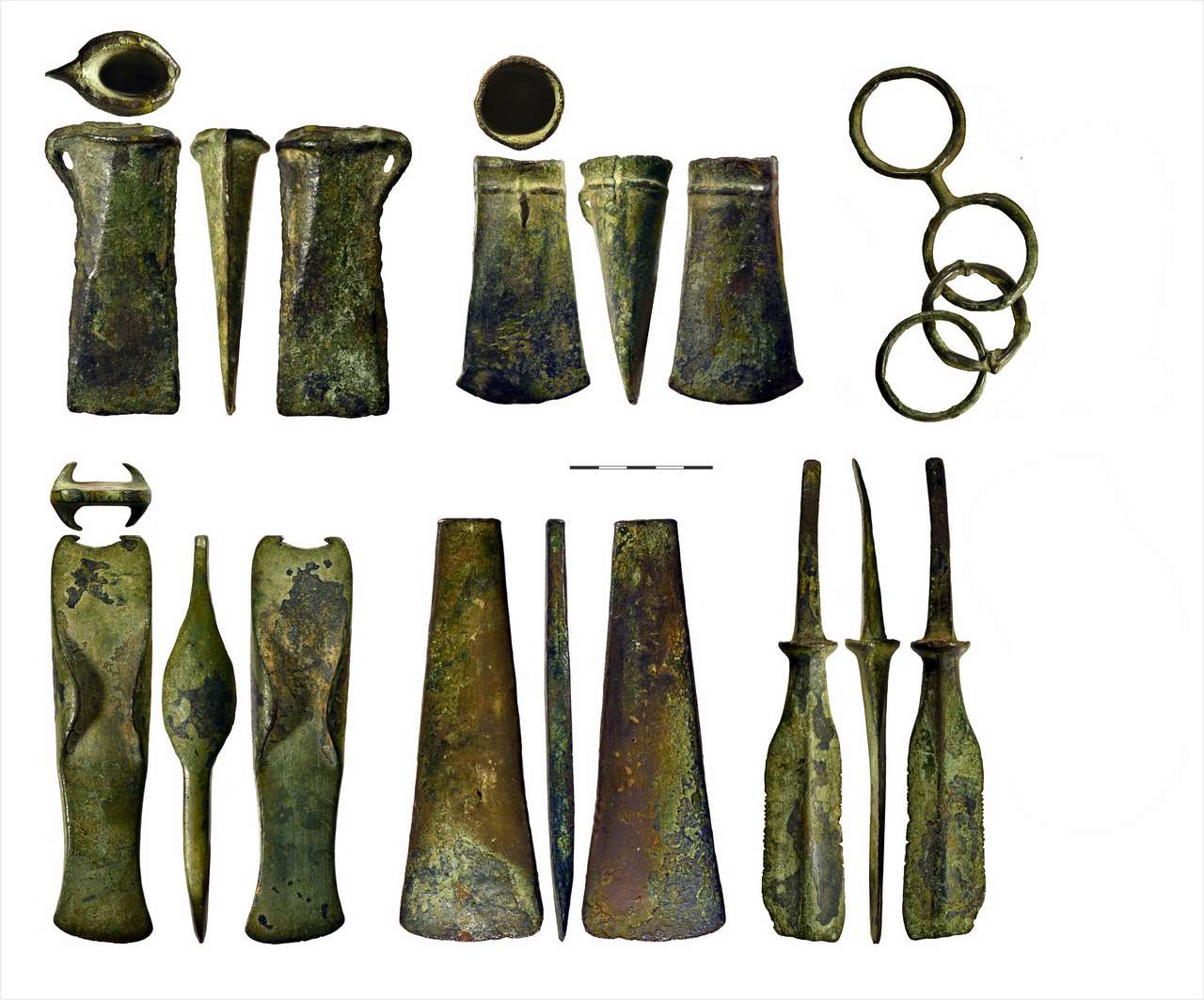
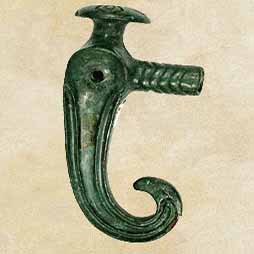
The bronze hoard was discovered on the territory of Mîndrești village, Telenești district, in 1968. It was identified accidentally by a group of students from the village school, and the materials later came to the attention of specialists at the Institute of History of the Academy of Sciences. According to documentary records, the hoard was composed of ten pieces: four socketed axes (celts), a dagger fragment, a sword fragment, a sickle, a winged axe, an adze-axe, and a chain consisting of four links.
Currently, of the mentioned assemblage, six objects are preserved in the collections of the National Museum of History of Moldova: two socketed axes (celts), the winged axe, the adze-axe, the dagger fragment, and the chain made of four links.- Socketed axe (celt) with one loop. Dimensions: Length - 10.2 cm; Weight - 186 g.
- Socketed axe (celt) with one frontal loop. Dimensions: Length - 8.4 cm; Width: 33-46 mm; Weight - 124 g.
- Winged axe. Dimensions: Length - 14.0 cm; Width - 2.5-3.4 cm; Weight - 285 g.
- Adze-axe. Dimensions: Length - 14.8 cm; Width - 2.3-5.0 cm; Weight - 286 g.
- Dagger fragment. Dimensions: Length - 16.5 cm; Blade length - 9.8 cm; Blade width - 2.8 cm; Weight - 81 g.
- Chain formed of four links. Dimensions: Length - 17.1 cm; Link diameter - 3.8; Weight - 32 g.The bronze hoard of Mîndrești is important due to the association of objects that find analogies in the regional repertoire with pieces that show clear analogies in Central Europe and the Carpathian Basin. The assemblage reflects a zone of contact and interaction where metallic forms of different origins and traditions circulated and were integrated into the repertoire of local communities.
Chronologically, the bronze hoard of Mîndrești is attributed to the Early Hallstatt period - HaA1, being dated to 1200-1100 BC.

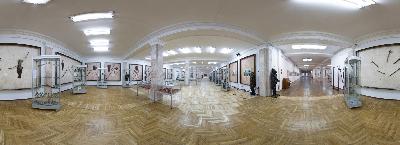
Virtual Tour


Events Archive

Opening of the International Biennial of Decorative Art, 8th Edition

September 10, 2026

On September 10, 2026, the National Museum of History of Moldova hosted the opening of the International Biennial of Decorative Art - Chișinău 2026, 8th Edition, one of the major events dedicated to professional contemporary decorative art.

The exhibition brings together eighty works presented by artists from the Republic of Moldova and Romania, offering the public a broad perspective on the diversity of expression in contemporary decorative art. Artistic ceramics, tapestry, textiles, jewelry, artistic processing of wood and metal, object art, and mixed techniques converge in a shared exhibition space, where material becomes a bearer of ideas, experimentation, and artistic expression.

Held under the theme "Matter in Becoming", this year's edition reflects on the transformation of matter through the creative gesture and on how traditional techniques of decorative arts open up to contemporary languages and trends. The Biennial also marks the 70th anniversary of the birth of ceramist Vlad Bolboceanu (1956-2004), a prominent figure in Moldova's decorative art.

The official opening featured speeches by Alexandru Argint, Deputy Director of the National Museum of History of Moldova; Florina Breazu, President of the Union of Plastic Artists of Moldova; Ștefan Bîlbă, project coordinator and President of the Decorative Arts Section of UAP; Ecaterina Mărghidan, President of the Biennial Jury, PhD in Visual Arts and artist; and Elena Frunze, curator of the Biennial and moderator of the opening. They were joined by jury members, artists, art critics, representatives of specialized institutions, and the public eager to discover the exhibition.

A highlight of the opening was the awards ceremony. The Biennial Trophies and Excellence Diplomas were presented to artists Victor Ciobanu, Severin-Bogdan Hojbotă, Violeta Sterea, and Olga Roșca, while the Jury Prize was awarded to Anatolie Tomoianu.

The Diplomas of Merit of the Union of Plastic Artists were granted to Natalia Lazăr, Ramona Biciușcă, Nicu Dumitrescu, Ilona Lencauțan, Anatolie Railean, and Vasile Grama, while the Special Mentions of the Decorative Arts Section of UAP went to Mihai Hlihor, Ștefan Pavlov, Irina Șuh, and Tatiana Jabinschi.

The opening brought together artists from different generations and fields in an atmosphere of dialogue and professional exchange, reaffirming the Biennial's role as a platform for the promotion, research, and valorization of contemporary decorative art.

The International Biennial of Decorative Art - Chișinău 2026 can be visited at the National Museum of History of Moldova between September 10-30, 2026.


Independent Moldova
Moldavian Soviet Socialist Republic
Bessarabia and MASSR between the Two World Wars
Bessarabia and Moldavian Autonomous Soviet Socialist Republic in the Period between the Two World Wars
Revival of National Movement
Time of Reforms and their Consequences
Abolition of Autonomy. Bessarabia – a New Tsarist Colony
Period of Relative Autonomy of Bessarabia within the Russian Empire
Phanariot Regime
Golden Age of the Romanian Culture
Struggle for Maintaining of Independence of Moldova
Formation of Independent Medieval State of Moldova
Era of the
Great Nomad Migrations
Early Middle Ages
Iron Age and Antiquity
Bronze Age
Aeneolithic Age
Neolithic Age
Palaeolithic Age


Come to Museum! Discover the History!
  
Visit museum
Visit museum
Summer schedule: daily
10am – 6pm.

Winter schedule: daily
10am – 5pm.
Closed on Mondays.
Entrance fees:  adults - 50 MDL, Pensioners, students - 20 lei, pupils - 10 MDL. Free access: enlisted men (...)

WiFi Free Wi-Fi Zone in the museum: In the courtyard of the National History Museum of Moldova there is Wi-Fi Internet access for visitors.


#Exhibit of the Month

The bronze hoard was discovered on the territory of Mîndrești village, Telenești district, in 1968. It was identified accidentally by a group of students from the village school, and the materials later came to the attention of specialists at the Institute of History of the Academy of Sciences...

Read More >>


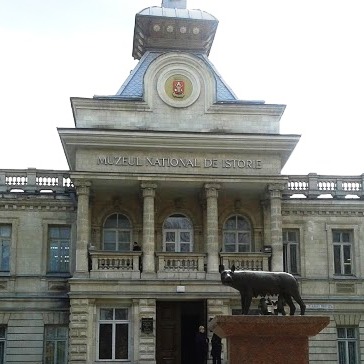
The National Museum of History of Moldova takes place among the most significant museum institutions of the Republic of Moldova, in terms of both its collection and scientific reputation.
©2006-2026 National Museum of History of Moldova
Visit museum 31 August 1989 St., 121 A, MD 2012, Chisinau, Republic of Moldova
Phones:
Secretariat: +373 (22) 24-43-25
Department of Public Relations and Museum Education: +373 (22) 24-04-26
Fax: +373 (22) 24-43-69
E-mail: office@nationalmuseum.md
Technical Support: info@nationalmuseum.md
Web site administration and maintenance: Andrei EMILCIUC


The National Museum of History of Moldova takes place among the most significant museum institutions of the Republic of Moldova, in terms of both its collection and scientific reputation.
©2006-2026 National Museum of History of Moldova
Visit museum 31 August 1989 St., 121 A, MD 2012, Chisinau, Republic of Moldova
Phones:
Secretariat: +373 (22) 24-43-25
Department of Public Relations and Museum Education: +373 (22) 24-04-26
Fax: +373 (22) 24-43-69
E-mail: office@nationalmuseum.md
Technical Support: info@nationalmuseum.md
Web site administration and maintenance: Andrei EMILCIUC

menu
The National Museum of History of Moldova takes place among the most significant museum institutions of the Republic of Moldova, in terms of both its collection and scientific reputation.
©2006-2026 National Museum of History of Moldova
Visit museum 31 August 1989 St., 121 A, MD 2012, Chisinau, Republic of Moldova
Phones:
Secretariat: +373 (22) 24-43-25
Department of Public Relations and Museum Education: +373 (22) 24-04-26
Fax: +373 (22) 24-43-69
E-mail: office@nationalmuseum.md
Technical Support: info@nationalmuseum.md
Web site administration and maintenance: Andrei EMILCIUC