

EN RO


#Exhibit of the Month

>>>

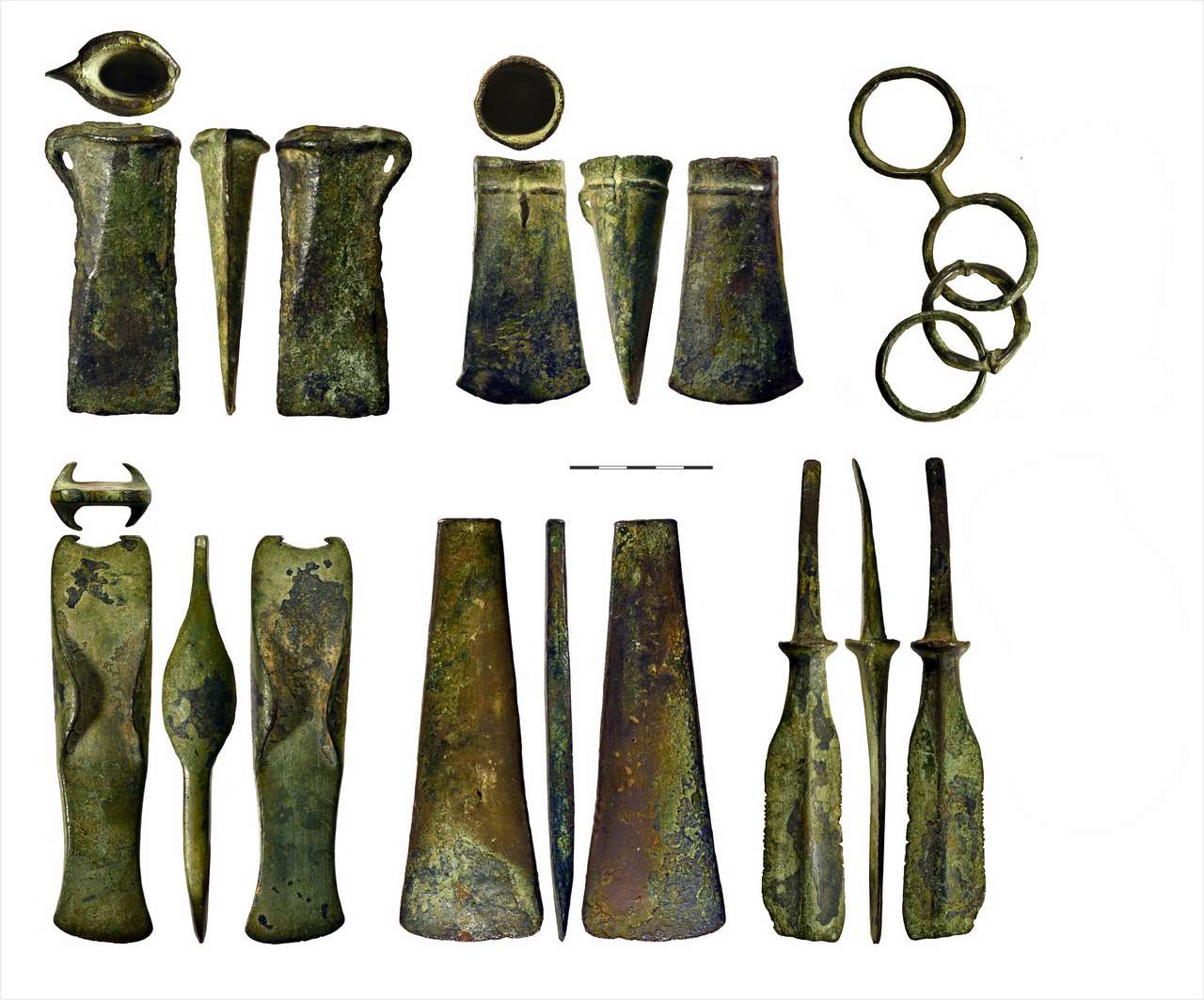
The bronze hoard was discovered on the territory of Mîndrești village, Telenești district, in 1968. It was identified accidentally by a group of students from the village school, and the materials later came to the attention of specialists at the Institute of History of the Academy of Sciences. According to documentary records, the hoard was composed of ten pieces: four socketed axes (celts), a dagger fragment, a sword fragment, a sickle, a winged axe, an adze-axe, and a chain consisting of four links.
Currently, of the mentioned assemblage, six objects are preserved in the collections of the National Museum of History of Moldova: two socketed axes (celts), the winged axe, the adze-axe, the dagger fragment, and the chain made of four links.- Socketed axe (celt) with one loop. Dimensions: Length - 10.2 cm; Weight - 186 g.
- Socketed axe (celt) with one frontal loop. Dimensions: Length - 8.4 cm; Width: 33-46 mm; Weight - 124 g.
- Winged axe. Dimensions: Length - 14.0 cm; Width - 2.5-3.4 cm; Weight - 285 g.
- Adze-axe. Dimensions: Length - 14.8 cm; Width - 2.3-5.0 cm; Weight - 286 g.
- Dagger fragment. Dimensions: Length - 16.5 cm; Blade length - 9.8 cm; Blade width - 2.8 cm; Weight - 81 g.
- Chain formed of four links. Dimensions: Length - 17.1 cm; Link diameter - 3.8; Weight - 32 g.The bronze hoard of Mîndrești is important due to the association of objects that find analogies in the regional repertoire with pieces that show clear analogies in Central Europe and the Carpathian Basin. The assemblage reflects a zone of contact and interaction where metallic forms of different origins and traditions circulated and were integrated into the repertoire of local communities.
Chronologically, the bronze hoard of Mîndrești is attributed to the Early Hallstatt period - HaA1, being dated to 1200-1100 BC.

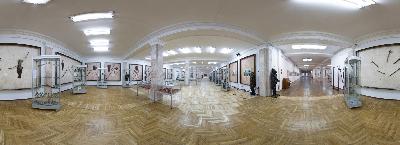
Virtual Tour


Events Archive

Scientific Lecture – “Genomics of Ancient Humans and Pathogens: Paleogenetic Research on European Hunter-Gatherers and Plague Pandemics”

September 23, 2026

On September 23, 2026, the National History Museum of Moldova had the honor of hosting in the Blue Hall a lecture delivered by Prof. Dr. Cosimo Posth, a renowned researcher in paleogenetics, professor at the University of Tübingen and the Senckenberg Centre for Human Evolution and Paleoenvironment (Germany). The topic of the presentation was "Genomics of Ancient Humans and Pathogens: Paleogenetic Research on European Hunter-Gatherers and Plague Pandemics."

The lecture offered the audience a fascinating insight into how the analysis of ancient DNA contributes to reconstructing the history of human populations and understanding the evolution of pathogens. Prof. Posth presented recent findings showing, among other things, that early modern humans and Neanderthals interbred more than 200,000 years ago-much earlier than previously believed. He also highlighted the genetic transformations of European hunter-gatherers during the last Ice Age, as well as the ways in which plague pathogen genomes can be reconstructed to better understand their impact on past human communities.


Another particularly interesting aspect of the presentation was the connection between human migrations and the spread of infectious diseases. Paleogenetic research demonstrates that the mobility of populations during the Bronze Age facilitated not only cultural exchanges but also the transmission of pathogens, profoundly influencing the evolution of societies. Thus, ancient DNA becomes an essential resource for understanding not only the biological history of humans but also the complex interactions between environment, culture, and health.

The event took place in the context of discussions regarding possible future collaborations between the National History Museum of Moldova and the University of Tübingen, aimed at developing joint projects in the field of historical and archaeological research. This perspective opens new opportunities for integrating paleogenetic research into the study of Moldova's cultural and historical heritage.


Independent Moldova
Moldavian Soviet Socialist Republic
Bessarabia and MASSR between the Two World Wars
Bessarabia and Moldavian Autonomous Soviet Socialist Republic in the Period between the Two World Wars
Revival of National Movement
Time of Reforms and their Consequences
Abolition of Autonomy. Bessarabia – a New Tsarist Colony
Period of Relative Autonomy of Bessarabia within the Russian Empire
Phanariot Regime
Golden Age of the Romanian Culture
Struggle for Maintaining of Independence of Moldova
Formation of Independent Medieval State of Moldova
Era of the
Great Nomad Migrations
Early Middle Ages
Iron Age and Antiquity
Bronze Age
Aeneolithic Age
Neolithic Age
Palaeolithic Age


Come to Museum! Discover the History!
  
Visit museum
Visit museum
Summer schedule: daily
10am – 6pm.

Winter schedule: daily
10am – 5pm.
Closed on Mondays.
Entrance fees:  adults - 50 MDL, Pensioners, students - 20 lei, pupils - 10 MDL. Free access: enlisted men (...)

WiFi Free Wi-Fi Zone in the museum: In the courtyard of the National History Museum of Moldova there is Wi-Fi Internet access for visitors.


#Exhibit of the Month

The bronze hoard was discovered on the territory of Mîndrești village, Telenești district, in 1968. It was identified accidentally by a group of students from the village school, and the materials later came to the attention of specialists at the Institute of History of the Academy of Sciences...

Read More >>


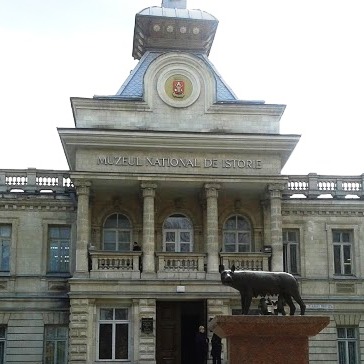
The National Museum of History of Moldova takes place among the most significant museum institutions of the Republic of Moldova, in terms of both its collection and scientific reputation.
©2006-2026 National Museum of History of Moldova

Visit museum 31 August 1989 St., 121 A, MD 2012, Chisinau, Republic of Moldova
Phones:
Secretariat: +373 (22) 24-43-25
Department of Public Relations and Museum Education: +373 (22) 24-04-26
Fax: +373 (22) 24-43-69
E-mail: office@nationalmuseum.md
Technical Support: info@nationalmuseum.md
Web site administration and maintenance: Andrei EMILCIUC



The National Museum of History of Moldova takes place among the most significant museum institutions of the Republic of Moldova, in terms of both its collection and scientific reputation.
©2006-2026 National Museum of History of Moldova
Visit museum 31 August 1989 St., 121 A, MD 2012, Chisinau, Republic of Moldova
Phones:
Secretariat: +373 (22) 24-43-25
Department of Public Relations and Museum Education: +373 (22) 24-04-26
Fax: +373 (22) 24-43-69
E-mail: office@nationalmuseum.md
Technical Support: info@nationalmuseum.md
Web site administration and maintenance: Andrei EMILCIUC
menu
The National Museum of History of Moldova takes place among the most significant museum institutions of the Republic of Moldova, in terms of both its collection and scientific reputation.
©2006-2026 National Museum of History of Moldova
Visit museum 31 August 1989 St., 121 A, MD 2012, Chisinau, Republic of Moldova
Phones:
Secretariat: +373 (22) 24-43-25
Department of Public Relations and Museum Education: +373 (22) 24-04-26
Fax: +373 (22) 24-43-69
E-mail: office@nationalmuseum.md
Technical Support: info@nationalmuseum.md
Web site administration and maintenance: Andrei EMILCIUC