Events Archive
“The Republic of Moldova at 35 Years of Independence: ‘The Russian Lesson’ in Public Dialogue”
August 26, 2026
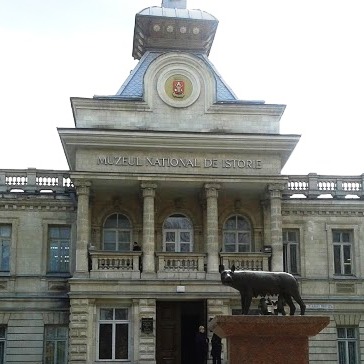
On the occasion of the 35th anniversary of the proclamation of the Independence of the Republic of Moldova, the Romanian Cultural Institute "Mihai Eminescu" in Chișinău, in partnership with the National Museum of History of Moldova, organized on August 26 the conference "The Republic of Moldova at 35 Years of Independence: ‘The Russian Lesson' in Public Dialogue."
The event took as its starting point the novel "The Russian Lesson" by writer Maria Pilchin, which provided the framework for an interdisciplinary discussion at the intersection of literature, history, psychology, and philology.
The conference addressed essential themes for understanding Moldova's recent dramatic past and the identity challenges faced by society: the memory of Soviet-era tragedies, deportations, denationalization, organized famine, the assault on the Romanian language and identity through falsification of history, and the role of literature in recovering and reinterpreting historical experiences.
Maria Pilchin, writer and researcher, explored the theme of feminine memory in the post-totalitarian period, showing how women's experiences under the regime and their traces in individual and collective memory contribute to broader reflections on identity and the persistence of the past in the present.
Zinaida Bolea, researcher and Doctor Habilitated in Psychology, delivered the lecture "The Contribution of Literature to the ‘Trauma Process' in the Case of Deportations from the Moldavian SSR: The Novel The Russian Lesson by Maria Pilchin." She examined the psychological and psychosocial consequences of deportations and how traumatic experiences remain active in collective memory, transmitted across generations, with literature as a space for understanding and recovery.
Elena Ungureanu, philologist, researcher, and Doctor Habilitated in Philology, offered a linguistic perspective in her lecture "Maria Pilchin's The Russian Lesson: A Novel about the Power and Wounds of ‘Learning' and ‘Unlearning.'" She analyzed the relationship between language, memory, and identity, and the meanings of "learning" and "unlearning" in the historical and cultural context reflected in the novel. Ion Negrei, historian, contributed the historical dimension, discussing deportations and the symbolism of the cattle wagon in freight trains as an expression of uprooting and collective trauma.
The conference was moderated by Monica Babuc, Director of the Romanian Cultural Institute "Mihai Eminescu" in Chișinău, who also read excerpts from the novel and emphasized that the "Russian lesson," as described by Pilchin, was "taught" to those between the Prut and Dniester alongside the extermination of intellectuals and farmers, deportations to Siberia and Kazakhstan, deprivation of freedom, and the inoculation of irreparable fear. She also spoke about the adoption of the Declaration of Independence of the Republic of Moldova and its foundational importance.
In the context of the 35th anniversary of Independence, the historical perspective deepened dialogue on the memory of the past and the democratic transformations Moldova has undergone since 1991.
The academic component was complemented by an artistic moment presented by actress Nina Lefter, who performed a dramatic reading from "The Russian Lesson." The reading highlighted the emotional dimension of the text and offered the audience a closer connection to the literary universe of the author.
By bringing together voices from different fields, the event created a framework for reflection on the relationship between history, memory, language, and identity. Discussions emphasized the importance of recovering historical memory and fostering cultural dialogue for a deeper understanding of the experiences that have shaped Moldovan society.
The organization of the conference was part of the series of events dedicated to the 35th anniversary of Moldova's Independence and reflects the Romanian Cultural Institute "Mihai Eminescu" in Chișinău's commitment to supporting projects that encourage intellectual and cultural dialogue, valorize literary and historical heritage, and strengthen ties between Romanian and Moldovan cultural communities.
|

















 31 August 1989 St., 121 A, MD 2012, Chisinau, Republic of Moldova