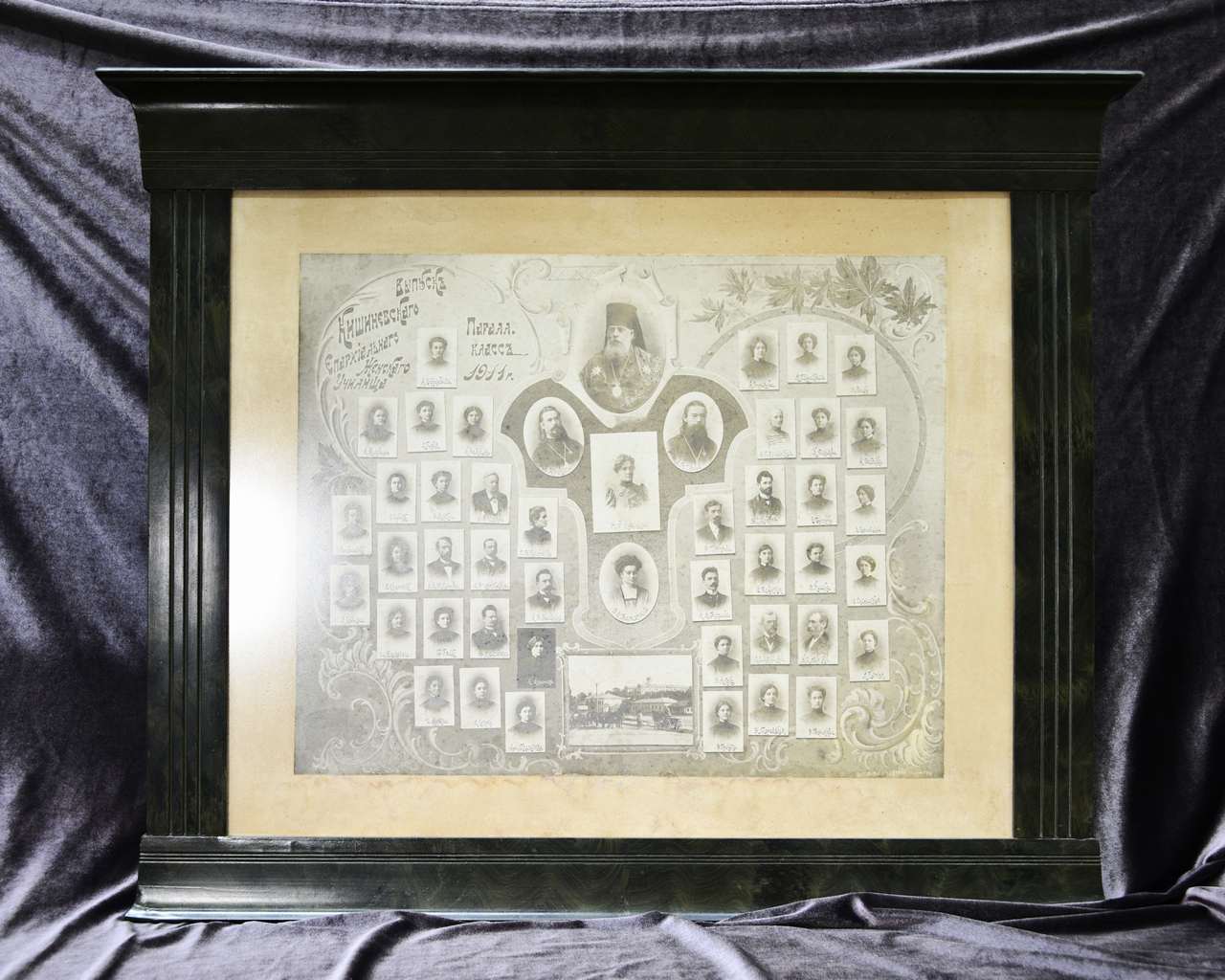
The Chișinău Diocesan Girls' School opened its doors on May 3, 1864, addressing a pressing need: in Bessarabia there were no institutions dedicated to the education of clergy's daughters. According to the 1864 circular, teaching was conducted in the Romanian language, a provision applied throughout the diocese. The school's first headmistress was Anastasia Rizo, of noble origin, invited by Archbishop Antonie.
The curriculum, approved by the Ministry of Public Education and the Chișinău Diocese, combined theoretical subjects with practical training. Students studied religion, reading and writing in Romanian, Slavonic, and Russian, arithmetic and exercises in calculation, world history and geography. The program was complemented by church singing and practical skills such as sewing, embroidery, knitting, as well as household management - baking bread and prosphora, preparing meals and preserves, caring for livestock, and cultivating gardens.
The composite, taken in 1911 at the studio of Z. N. Sumovski in Chișinău, depicts 29 graduates and 13 teachers. At the center are portraits of Bishop Serafim (Ciciagov), headmistress N. R. Mihelson, teacher V. E. Bejerian, and priests F. Ghiliarov and P. Jurikas. Among the teaching staff was Paraskovia Vasilievna Cuciurenko, a calligraphy teacher for 37 years, who in 1911 became senior educator and assistant headmistress. For her dedication, she was awarded the gold medal "For Long Service."
On the reverse of the vignette is a label from the store and workshop of frames, paintings, mirrors, and window glass owned by A. D. Kon'gova, Chișinău, Gogol Street no. 37, near the State Bank.
This graduation composite was donated at the end of 2025 to the National Museum of History of Moldova by the Dadiștian family from Drochia.
Divorces in Bessarabia in the first half of the 19th century
Tyragetia, serie nouă, vol. VI [XXI], nr. 2, Istorie. Muzeologie
A study of the problem of divorce in the 19th century is no less important than research of other issues in the field of marriage and family, because this act influenced the position of ex-spouses, especially women in society. A limited number of grounds for divorce, as well as the social foundation and moral principles of the 19th century made a divorce very difficult and controversial issue.
The issues of divorce in the history of Moldova and Wallachia during the 19th century were examined in works by V. Barbu, S. Solcan, C. Ghițulescu, M.M. Szekely, L. Zabolotnaia, S. Bolovan, I. Bolovan, and M. Brie. Their studies indicate that the Orthodox Church allowed the dissolution of marriage in certain cases, such as adultery, inappropriate behavior, battering and threat to life, expulsion of the wife out of home, taking the monastic vows, heresy, proxenetism, lesbianism, pedophilia, etc. However, until now there were not published any works on the history of marital divorce in Bessarabia after 1812, when it became a part of the Russian Empire.
This article provides specific examples of how the church rules on divorce were respected in the first half of the 19th century. As research sources there were used documents from the State Archives of the Republic of Moldova, namely from the files of the Chișinău Theological Consistory and the Civil Court of Bessarabia, which addressed such matters.
At the beginning of the 19th century the civil law in Bessarabia had standards of the local law. According to Harmenopoulos’s “Hexabiblos” (title 12, volume 4), there existed “reasons for husband’s divorce to the detriment of his wife” and “reasons for wife’s divorce to the detriment of her husband”. In the first case, a husband could divorce his wife for the following reasons: adultery, attempt on husband’s life, wife’s repast with other men without the knowledge of her husband, participation in public events without the knowledge of her husband, abortion, wife’s missing from home against the will of her husband, unless she visited her parents. In the second case, reasons for divorce were: husband’s impotence, the attempt on wife’s life, adultery even after the second warning, wife’s accusing of adultery unproven by husband. A common reason for divorce was the monasticism.
The marriage could be dissolved in the case of a wife’s depravity. Archival materials show, however, that there were different reasons and means to resolve the issue in favor of preserving the family. This was the case of the family of Hristi and Vasilca Bulgaru from the village of Vulcănești, Izmail County. Despite the fact that the accusation in wife’s depraved behavior, as well as drunkenness and theft, was proved, the divorce was rejected and the case ended in reconciliation between the spouses.
Among the cases of divorce, as reflected in the documents of the Chișinău Theological Consistory, there were marriages dissolved by the church because of the infringement of the church norms. For example, in 1819 it was considered the case of a sexton of the Briceni village, Hotin County, Tudor Ghiba, who had married a fourth time. It was decided to recognize the fourth marriage illegal. Although in accordance with the principles of the church ex- spouses had to be subjected to penance, because of their advanced age they were sentenced only to repentance.
However, there have been cases when the applicants withdrew their petitions for divorce, even though under local laws there were all grounds for the dissolution of marriage. Among these cases it should be noted that of a resident of the village of Chișla, Hotin County, Maria Buticoviceva, who wished to divorce her husband Andrei Buticovicev. The motive for the petition for divorce was his behavior: he drank every day, threatened to take her life, and ex-pulsed her out of the house at night with the young child. But a month later, Maria decided to forgive her husband and refused to divorce.
So, we can conclude that the reasons for divorce in Bessarabia in the first half of the 19th century were a violation of church rules concerning marriage, monasticism, attempt on the spouse’s life, adultery and some others. At the same time, the ecclesiastical authorities usually tried to prevent divorce, doing everything possible to preserve the family.
Alina Felea
From family history in the Romanian space: Alcoholism and family relations in the 18th century in Moldavia and in the first decades of the 19th century in Bessarabia
Tyragetia, serie nouă, vol. VIII [XXIII], nr. 2, Istorie. Muzeologie
Alina Felea
The institution of witnesses in wills in the Principality of Moldavia (the 17th century - beginning of the 19th century
Tyragetia, serie nouă, vol. XIX [XXXIV], nr. 2, Istorie. Muzeologie, Chişinău, 2025
Alina Felea
La population de la ville Soroca (XVI-XIX siècles)
Tyragetia, serie nouă, vol. I [XVI], nr. 2, Istorie. Muzeologie Chișinău, 2007
Alina Felea
Voivode/prince between Ideal and Real. Chroniclers’ representations about Tara Moldova (the middle of 17th - the middle of 18th Centuries
Tyragetia, serie nouă, vol. III [XVIII], nr. 2, Istorie. Muzeologie
Alina Felea
Cantemir’ s wills. Case Study (XVIII - beginning XIX centuries)
Tyragetia, serie nouă, vol. V [XX], nr. 2, Istorie. Muzeologie
The Chișinău Diocesan Girls' School opened its doors on May 3, 1864, addressing a pressing need: in Bessarabia there were no institutions dedicated to the education of clergy's daughters...
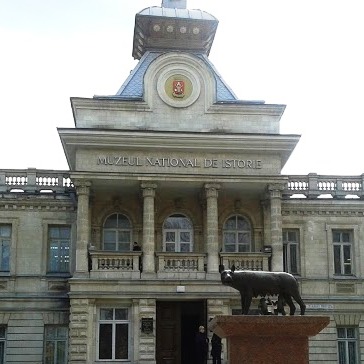
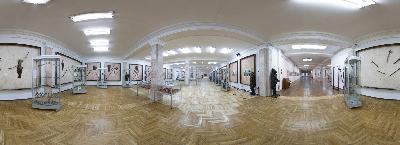
The National Museum of History of Moldova takes place among the most significant museum institutions of the Republic of Moldova, in terms of both its collection and scientific reputation.
The National Museum of History of Moldova takes place among the most significant museum institutions of the Republic of Moldova, in terms of both its collection and scientific reputation.
The National Museum of History of Moldova takes place among the most significant museum institutions of the Republic of Moldova, in terms of both its collection and scientific reputation.



















 31 August 1989 St., 121 A, MD 2012, Chisinau, Republic of Moldova