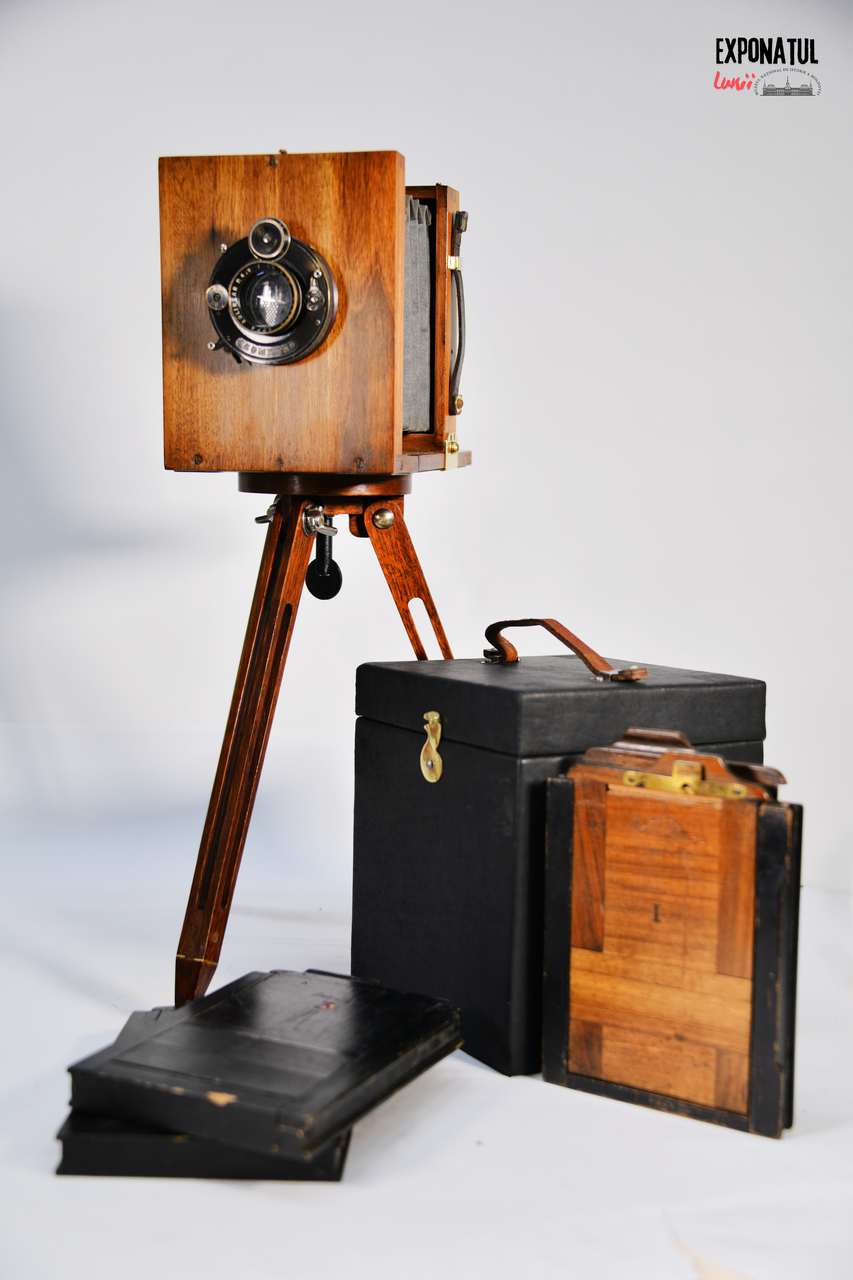
The main parts of the camera include the body, bellows, lens, and viewfinder system. The body consists of two lacquered walnut wood frames, joined by a folding black textile bellows that allows the necessary extension for focusing. On the front panel is the Agfa anastigmat lens, mounted in a Compur-type shutter produced by F. Deckel in Munich. It features a foldable "brilliant" viewfinder for both portrait and landscape orientation. It uses glass photographic plates coated with a photographic emulsion, mounted in walnut wood holders, with a frame size of 9x12 cm. The walnut wood model, considered the flagship "Agfa Isolar Luxus," was designed by the A.H. Rietzschel factory in Munich, acquired by AGFA in 1925, which continued producing this type of camera under its own name until the late 1920s. The piece was restored by Mihail Culașco, Restoration Department of NMHM. Brief History of the Camera The history of the camera spans 200 years, evolving from the camera obscura to today's digital devices. Key milestones include: the first permanent photograph in 1826 by French physicist Joseph Nicéphore Niépce, using a wooden box and a plate coated with bitumen of Judea; the invention of the first photographic process - daguerreotype - in 1839 by Frenchman Louis Daguerre, marking the official birth of photography; the invention of calotype, based on the negative/positive principle, by British physicist and chemist Fox Talbot; the invention of wet collodion plates by Englishman Frederick Scott Archer and dry glass plates by Richard Leach Maddox and John Huds Bennet; the introduction of flexible roll film and the launch of the first Kodak camera by American inventor George Eastman; the release of the first 35 mm film camera by German company "Leica"; the launch of the first instant camera "Polaroid," invented by American Edwin Land. Finally, starting in 1975, this path led to the digital photography revolution. Each successive step made cameras smaller and faster, significantly improving image quality. The first photographic studio in Chișinău was opened in 1854 by Eduard Glewski, and before World War I, there were already about 100 photography studios in Bessarabia. The collection of the National Museum of History of Moldova includes over 30 cameras, made in Austria, Germany, France, USSR, Japan, and China, dating from the late 19th century to the 2000s. Among them are folding bellows cameras, BOX-type cameras, single-lens reflex (SLR) and twin-lens reflex (TLR) cameras, as well as digital (DSLR) cameras.
The Giurgiulești earthen fortress. Preliminary research results
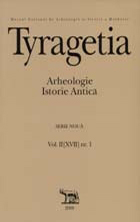
Tyragetia, serie nouă, vol. II [XVII], nr. 1, Arheologie. Istorie Antică
The Giurgiulești earthen fortress is situated on the left bank of the Prut river, on a high cape, at a distance of approximately 1500 meters from where the river flows into the Danube and defends the shallow river known as “Vadul Boului”. Several opposite hypotheses have been advanced regarding provenance and dating of the fortress.
In connection with the building of a section of the railroad Cahul-Giurgiulești in 2007, along the route and on the cape “Cetatea” very limited rescue excavations were carried out. Thus, a ditch and burnt remains of a wooden palisade have been discovered as the result of excavations. “Mushatin type” ceramic vessels were found at the bottom of the ditch, researched and dated second half of 15th - beginning of 16th centuries.
Inside the earthen fortress a half-earth type construction (12×12 m) had been revealed and partially researched. The pottery allowed to date the construction to 18th – beginning of 19th centuries.
It is proposed that the earth fortress near Giurgiulești was constructed in view of the deterioration of the political and military situation in the Lower Danube in the middle 80s of the 15th century.
Apparently, it was erected before the Ottoman forces conquered the Moldavian fortresses Chilia and Cetatea Albă in 1484 or right after their loss in order to fortify the southern boundaries of Moldova along the Lower Troian mound. According to the Moldavian chronicle, several earthen and stone fortresses such as Birlad, Tintiul, Cetatea Nouă, and Palanca on the Dniester river had been constructed, restored and fortified because of the Turkish invasion. Among them could be constructed the earthen fortress on the Prut river researched by us which subsisted for a very short time.
In the end of 18th – beginning of 19th centuries during Russo-Turkish wars, food and household warehouses were constructed inside the deserted fortress, afterwards revealed by the archaeologists.
Ion Tentiuc, Valeriu Bubulici
An incineration burial in metal urn (2nd-3rd c. AD) discovered at Iagorlîc, Dubăsari
Tyragetia, serie nouă, vol. XII [XXVII], nr. 1, Arheologie. Istorie Antică
Ion Tentiuc
About horse rider pendants from the early Medieval period in the Prut-Dniester area
Tyragetia, serie nouă, vol. IV [XIX], nr. 1, Arheologie. Istorie Antică
Сергей М. Агульников
The Belozerka culture horizon from the settlement Kriničnoe
Tyragetia, serie nouă, vol. I [XVI], nr. 1, Arheologie. Istorie Antică
Ion Tentiuc
Sergiu Matveev, Procesele etno-culturale din spațiul carpato-nistrean în secolele II-XIV. Istoriografia sovietică. Chișinău: Pontos, 2009, 230 p. text + 5 tabele
Tyragetia, serie nouă, vol. IV [XIX], nr. 1, Arheologie. Istorie Antică
Ion Tentiuc
Sergiu Musteață, Populația spațiului pruto-nistrean în secolele VIII-IX. Editura Pontos, Chișinău 2005, 189 p., rezumat în limba engleză, indice, 10 tabele, 7 diagrame, 4 hărți, 78 planșe cu figuri, 12 foto, ISBN 9975-926-43-6
Tyragetia, serie nouă, vol. II [XVII], nr. 1, Arheologie. Istorie Antică
The main parts of the camera include the body, bellows, lens, and viewfinder system. The body consists of two lacquered walnut wood frames, joined by a folding black textile bellows that allows the necessary extension for focusing...
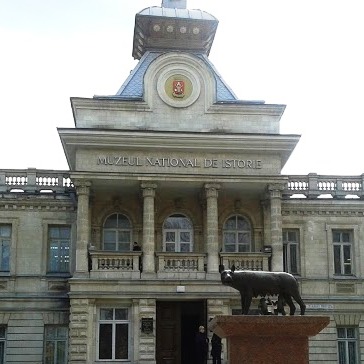
The National Museum of History of Moldova takes place among the most significant museum institutions of the Republic of Moldova, in terms of both its collection and scientific reputation.
The National Museum of History of Moldova takes place among the most significant museum institutions of the Republic of Moldova, in terms of both its collection and scientific reputation.
The National Museum of History of Moldova takes place among the most significant museum institutions of the Republic of Moldova, in terms of both its collection and scientific reputation.























 31 August 1989 St., 121 A, MD 2012, Chisinau, Republic of Moldova