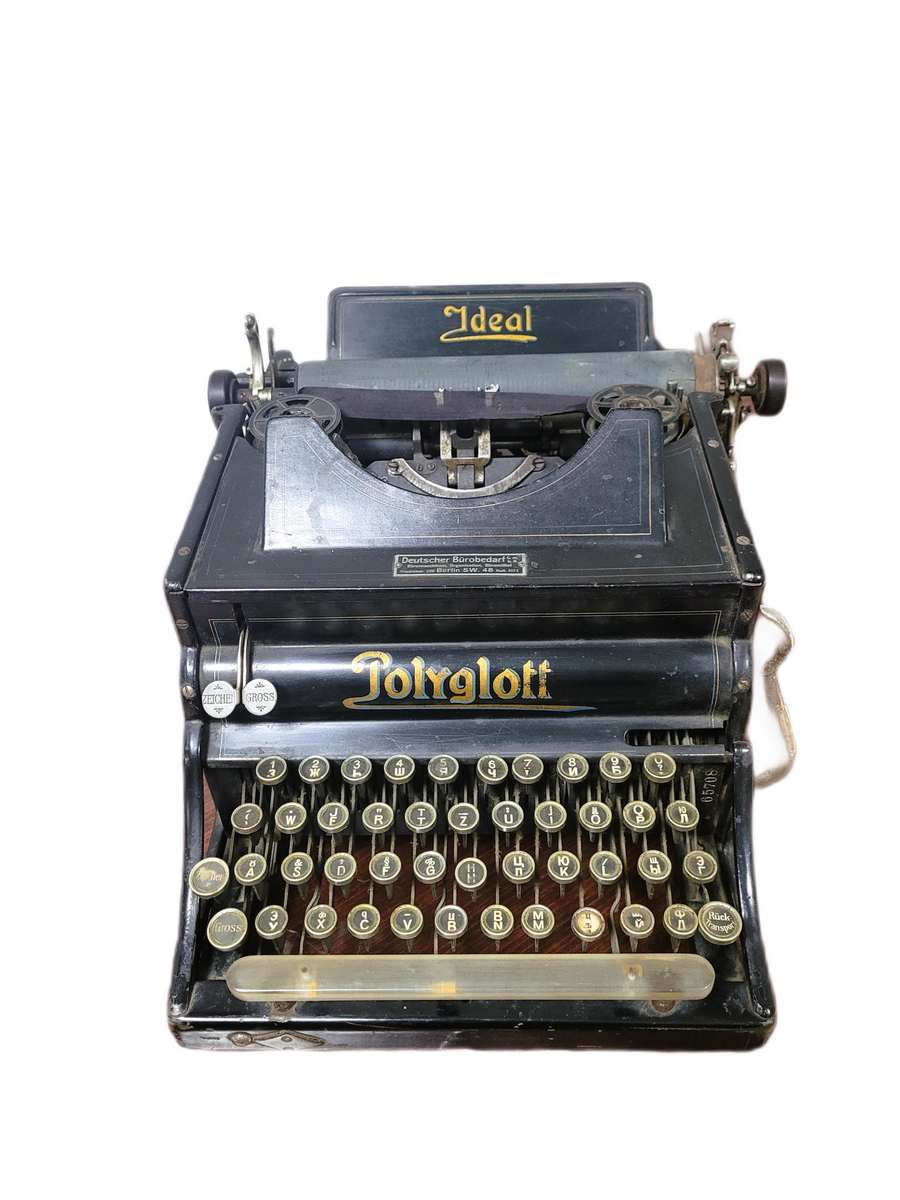
Realizată în 1902 de compania „AG vorm Siedel & Nauman" din Dresden, Germania.
Dimensiuni: lungime-38 cm, lățime-35 cm, înălțime-20 cm. Greutate-16 kg. A intrat în colecția muzeală în 1984, prin transfer de la Muzeul Național de Etnografie și Istorie Naturală. Mașina cuprinde carul normal, instalat pe rulmenți cu bile și role, și claviatura standard, pe care sunt montate 42 de clape cu două seturi complete de alfabet latin și chirilic, semne de punctuație, cifre și simboluri matematice, capabile să tasteze 126 de caractere. Sub carcasa din metal se află barele de scriere, dispuse în evantai, ce conțin caracterele în relief și rolele cu bandă tușată. Prin apăsarea clapelor se acționează barele de scriere, care lovesc banda tușată și imprimă caracterele pe hârtia încordată în sulul mașinii. Are părțile laterale frumos decorate cu elemente rafinate turnate din fontă, stil Art Nouveau, care reprezintă denumirea mărcii - „Ideal". Modelul Polyglott, dotat cu claviatură bilingvă brevetată în Marea Britanie de către Max Klaczko din Riga-Letonia, a fost produs între anii 1902 și 1913, reprezentând prima mașină care scria în două limbi. Mașina „Ideal Polyglott" a fost vândută activ în Imperiul Rus și foarte populară în Polonia, Bulgaria și Serbia. Mașina de scris - un dispozitiv mecanic folosit pentru imprimarea textelor direct pe hârtie - se numără printre cele mai importante invenții ale lumii moderne, deoarece a revoluționarizat procesul de comunicare. De la sfârșitul secolului al XIX-lea și până la începutul secolului al XXI-lea a devenit un instrument indispensabil, folosit pe scară largă de către scriitori, în birouri și pentru corespondența de afaceri, în case private. Momentul de vârf al mașinii de scris a fost în anii '50 ai sec. XX, când media de vânzări a atins în SUA 12 milioane de unități. În noiembrie 2012, fabrica „Brother" din Marea Britanie a produs ceea ce a pretins a fi ultima mașină de scris, aceasta fiind donată Muzeului Științelor din Londra.
Apariția calculatorului și a programelor de procesare text, inventarea imprimantei și scăderea prețurilor la toate acestea, au dus la dispariția mașinii de scris de pe piața largă. Aceasta a devenit exponat de muzeu. La 23 iunie se marchează Ziua mașinii de scris, ziua în care inventatorul și jurnalistul american Christopher Latham Sholes a patentat mașina sa de scris. Astfel, este celebrat dispozitivul simplu, care este deja istorie, și minunatele realizări literare pe care le-a dat lumii începând din 1868.
Considerații privind schimbul cu sare în mileniile VI-II î. Hr. în spațiul carpato-dunărean
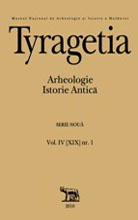
Tyragetia, serie nouă, vol. IV [XIX], nr. 1, Arheologie. Istorie Antică
The article deals with prehistoric salt production and exchange of salt in south-east and east-central Europe. The major points of the article are: 1. the modeling of the traditional forms of salt production and exchange in the area; 2. the identification of archaeological indications specific to every type of salt production and exchange; 3. the classification of available archaeological evidence of prehistoric salt production and exchange in Carpatho-Danubian zone.
Salt had two major senses during prehistoric period: on one hand it was as a good of daily consumption and thrifty use, on the other hand it was the exotic good. Every of these senses implied different types of production and exchange. The daily consumption and thrifty use salt could be made both within domestic and industrial productions. Of these, only industrial one was intended for long-distance exchange of salt. Salt as the exotic good was made only within special i.e. „sacred" type of production. This type of industry produced „miraculous" salt which was mainly, if not exclusively, intended for long-distance exchange.
The available archaeological evidence of salt production in the Carpatho-Danubian area is classified in the article on the above principles (tab. 1). Thus, the Neolithic salt production centers from Subcarpathian Moldavia (Lunca and Ţolici) as well as the Eneolithic one from the same area (Cucuieți) are attributed in the article to the domestic production of salt for daily consumption and thrifty use. The main goal of this type of production was to produce salt for domestic use or/and for short-distance traffic. Neolithic and especially Eneolithic salt production attested at Provadia-Solnitsata (northeast Bulgaria) is classified as industrial one. It produced common salt by evaporation of brine, and its main destination was the long-distance exchange, perhaps to east Balkans and North-Pontic area. The Eneolithic salt production centers from subcarpathian Moldavia (Lunca, Ţolici, Cacica, Solca etc.) produced exotic salt in the form of small cone-shaped cakes by evaporation in small briquetage. It was produced for long-distance exchange. The two Early Bronze Age salt production sites from northern Transylvania (Băile Figa and Săsarm) are classified as the domestic production centers which extracted rock salt for their own use and/or for short-distance traffic.
More attention is paid in the article to the end of Middle and Late Bronze Age (the end of 17th-9th centuries BC) salt mining centers from Transylvania and Maramureș: Băile Figa, Caila, Săsarm, Ocna Dej, Valea Florilor, Valea Regilor (Tisolovo) and Solotvino (Ocna Slatina) (Case Study). By all the available evidence, these centers seem to have been involved in the large-scale salt production and long-distance trade. Blocks of rock salt were traded from these centers to Hungarian Plane, by Someș and Tisa rivers. It is well-known fact that the period of functioning of the above salt mining production centers was the one of widest spread of tin bronze objects in the area. That is why, it seems likely that in exchange of salt its owners get, among other goods, tin.
List of illustrations: Fig. 1. The map of the Late Bronze Age salt mining sites: 1 - Caila; 2 - Săsarm; 3 - Băile Figa; 4 - Ocna Dej; 5 - Valea Florilor; 6 - Solotvino (Ocna Slatina); 7 - Valea Regilor (Tisolovo). Fig. 2. Northern Transylvania. Troughs in situ: 1 - Caila; 2, 3 - Băile Figa. Behind the trough at the position 2 the one can observe a ladder. Fig. 3. Băile Figa. One of the troughs (the same at fig. 2/3, the nearest plan). Wood. Fig. 4. Băile Figa. The pegs from the trougs (the troughs at fig. 2). Fig. 5. Băile Figa. One of the troughs (uncovered close to the trough at fig. 2/2). Fig. 6. Băile Figa. The pegs from one of the troughs (the trough at fig. 5). Fig. 7. Băile Figa, the year 2010. The experiment with the trough. Fig. 8. Băile Figa. Mining tools. Stone. Fig. 8. Băile Figa. Tools. Wood. Fig. 10. Băile Figa. The wooden construction for storage of salt (?). Fig. 11. Băile Figa. The parts of wooden constructions for storage of salt (?).
Realizată în 1902 de compania „AG vorm Siedel & Nauman" din Dresden, Germania. Dimensiuni: lungime-38 cm, lățime-35 cm, înălțime-20 cm. Greutate-16 kg. A intrat în colecția muzeală în 1984, prin transfer de la Muzeul Național de Etnografie și Istorie Naturală...
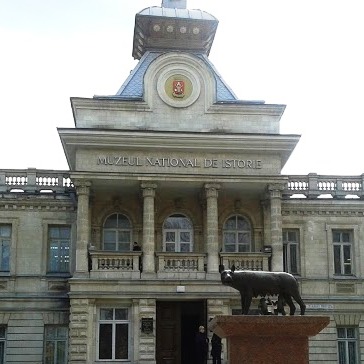
Muzeul Naţional de Istorie a Moldovei se numără printre cele mai importante instituţii muzeale din Republica Moldova, atât din punctul de vedere al patrimoniului său, cât şi al prestigiului ştiinţific.
Muzeul Naţional de Istorie a Moldovei se numără printre cele mai importante instituţii muzeale din Republica Moldova, atât din punctul de vedere al patrimoniului său, cât şi al prestigiului ştiinţific.
Muzeul Naţional de Istorie a Moldovei se numără printre cele mai importante instituţii muzeale din Republica Moldova, atât din punctul de vedere al patrimoniului său, cât şi al prestigiului ştiinţific.






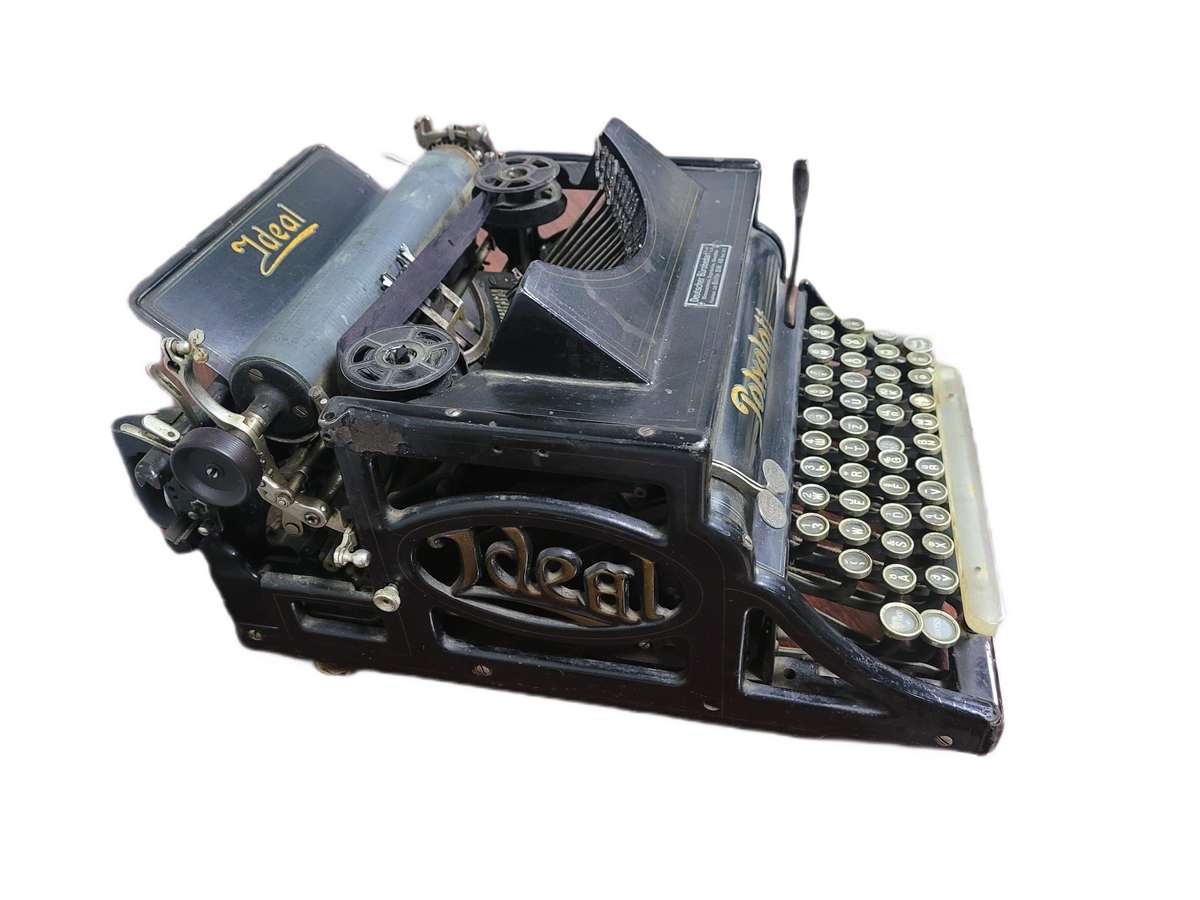 Are părțile laterale frumos decorate cu elemente rafinate turnate din fontă, stil Art Nouveau, care reprezintă denumirea mărcii - „Ideal". Modelul Polyglott, dotat cu claviatură bilingvă brevetată în Marea Britanie de către Max Klaczko din Riga-Letonia, a fost produs între anii 1902 și 1913, reprezentând prima mașină care scria în două limbi. Mașina „Ideal Polyglott" a fost vândută activ în Imperiul Rus și foarte populară în Polonia, Bulgaria și Serbia.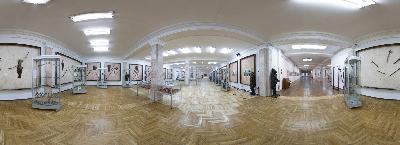


















 Str. 31 August 1989 nr.121 A, MD 2012, Chişinău, Republica Moldova