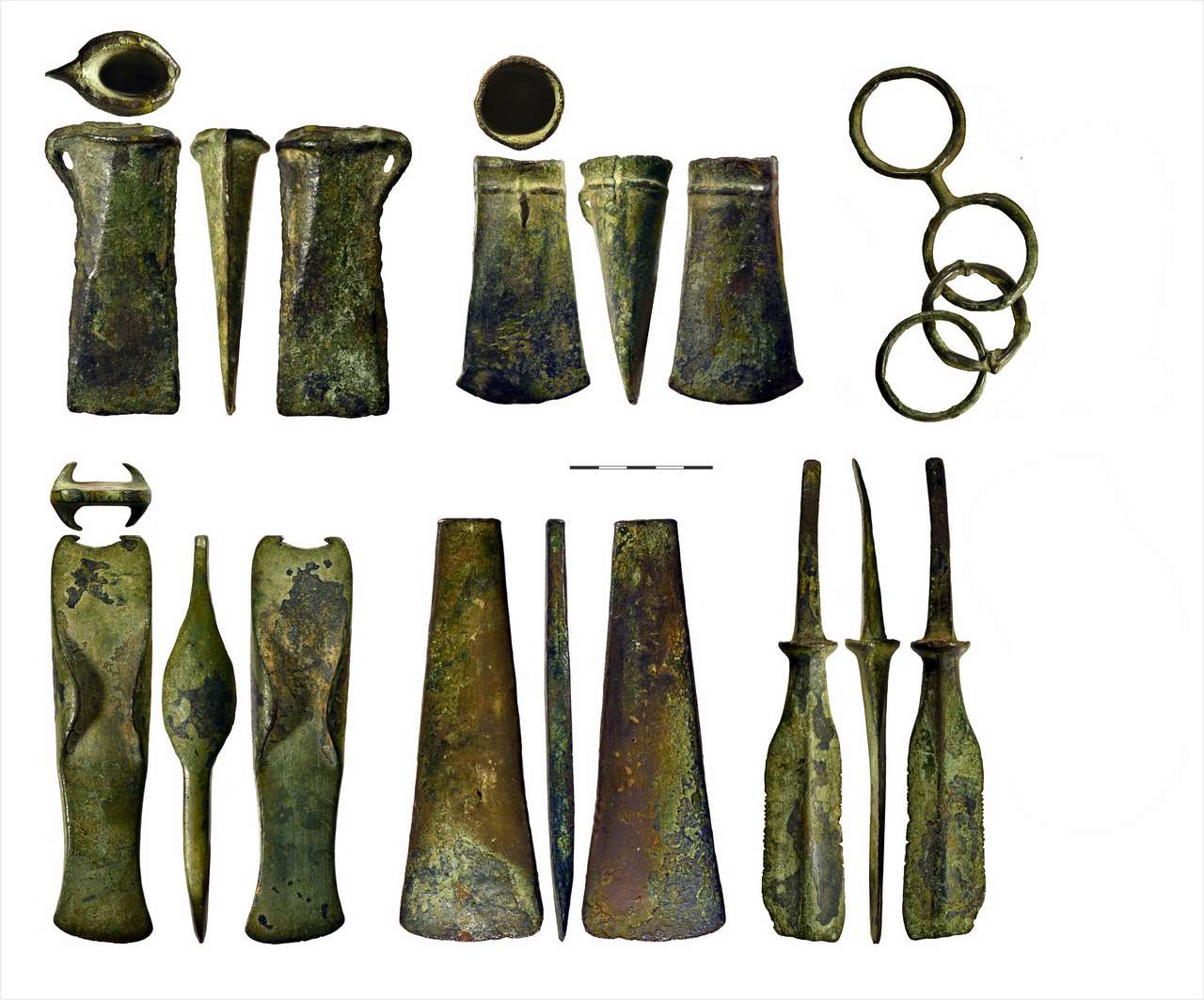
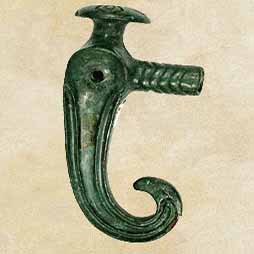
Depozitul de bronzuri a fost descoperit pe teritoriul satului Mîndrești, raionul Telenești, în anul 1968. A fost identificat întâmplător de către un grup de elevi de la școala din sat, iar materialele au ajuns ulterior în atenția specialiștilor de la Institutul de Istorie al Academiei de Științe. Conform informațiilor documentare, depozitul era alcătuit din zece piese: patru topoare-celt, un fragment de pumnal, un fragment de sabie, o seceră, un topor cu aripioare, un topor-teslă și un lanț format din patru verigi. În prezent, din ansamblul menționat, în fondurile Muzeului Național de Istorie a Moldovei se păstrează șase obiecte: două topoare-celt, toporul cu aripioare și toporul-teslă, fragmentul de pumnal și lanțul alcătuit din patru verigi. - Topor-celt cu o urechiușă. Dimensiuni: Lungimea - 10,2 cm; Greutatea - 186 g. - Topor-celt cu o urechiușă frontală. Dimensiuni: Lungimea - 8,4 cm; Lățimea: 33-46 mm; Greutatea - 124 g. - Topor cu aripioare. Dimensiuni: Lungimea - 14,0 cm; Lățimea - 2,5-3,4 cm; Greutatea - 285 g. - Topor-teslă. Dimensiuni: Lungimea - 14,8 cm; Lățimea - 2,3-5,0 cm; Greutatea - 286 g. - Fragment de pumnal. Dimensiuni: Lungimea - 16,5 cm; Lungimea lamei - 9,8 cm; Lățimea lamei - 2,8 cm; Greutatea - 81 g. - Lanț format din patru verigi. Dimensiuni: Lungimea - 17,1 cm; Diametrul verigilor - 3,8; Greutatea - 32 g.Depozitul de bronzuri de la Mândrești este important prin asocierea unor obiecte care își găsesc analogii în repertoriul regional cu piese ce prezintă analogii clare în Europa Centrală și în Bazinul Carpatic. Ansamblul de piese reflectă o zonă de contact și interacțiune, în care forme metalice de origini și tradiții diferite au circulat și au fost integrate în repertoriul comunităților locale. Cronologic, depozitul de bronzuri de la Mândrești este atribuit perioadei Hallstattului timpuriu - HaA1, fiind datat în anii 1200-1100 î. Hr.
«Вытянутые» погребения эпохи энеолита в Карпато-Днестровском регионе
Tyragetia, serie nouă, vol. IV [XIX], nr. 1, Arheologie. Istorie Antică
In the article the problem of cultural and chronological attribution of Copper Age graves with skeletons in extended position is discussed. Due to the almost complete absence of grave inventory in the burials the most reliable attribute for analysis is the shape of the grave chambers in combination with other elements (stratigraphic position, orientation of the dead, few items of grave goods, etc.). Three basic forms of chambers are distinguished: large oval pits, long narrow pits, and large rectangular pits. Graves with large oval pits posses the most archaic traits and probably can be recognized as the most ancient Copper Age contexts under barrows. The earliest graves can be dated to the second half of the 5th Millennium BC although all graves under barrows are, so far, dated from the 4th Millennium BC. The graves from this group in barrows always precede burials of the Pit-grave culture and some- times burials of the late Copper Age Usatovo culture. In some barrows they can follow other Copper Age graves. The graves in long narrow pits seem to be later and, according to kurgan stratigraphy, always precede graves of the Pit- grave culture, but sometimes follow late Copper Age graves or burials of the Usatovo culture. The extended graves in large rectangular chambers can be considered as a variant within the funeral tradition of the Pit-grave culture. Distinctions between the groups under consideration can be conditioned by their different origins. Whereas the graves from the first group can represent the development of a local tradition related to the Balkan-Carpathian cultural milieu, the graves from the second group can reflect connection with eastern European cultures. At the same time the graves from the third group are related to the Pit-grave culture.
Николай Руссев, Михаил Фокеев, Игорь Манзура
Tumulul din perioada eneolit-bronz de lângă s. Suvorovo, regiunea Odesa
Tyragetia, serie nouă, vol. VII [XXII], nr. 1, Arheologie. Istorie Antică
Игорь Манзура
Дергачев В.А. О скипетрах. Этюды в защиту миграционной концепции М. Гимбутас. Revista arheologică. vol. I. Nr. 2. Chișinău, 2005, 166 стр. ISSN 1857-016X.
Tyragetia, serie nouă, vol. I [XVI], nr. 1, Arheologie. Istorie Antică
Игорь Манзура, Владислав Петренко
Усатовский курганный могильник II (по раскопкам 1984 г.)
Tyragetia, serie nouă, vol. XVI [XXXI], nr. 1, Arheologie. Istorie Antică, Chişinău, 2022
Depozitul de bronzuri a fost descoperit pe teritoriul satului Mîndrești, raionul Telenești, în anul 1968. A fost identificat întâmplător de către un grup de elevi de la școala din sat, iar materialele au ajuns ulterior în atenția specialiștilor de la Institutul de Istorie al Academiei de Științe...
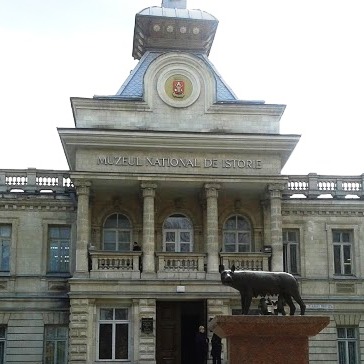
Muzeul Naţional de Istorie a Moldovei se numără printre cele mai importante instituţii muzeale din Republica Moldova, atât din punctul de vedere al patrimoniului său, cât şi al prestigiului ştiinţific.
Muzeul Naţional de Istorie a Moldovei se numără printre cele mai importante instituţii muzeale din Republica Moldova, atât din punctul de vedere al patrimoniului său, cât şi al prestigiului ştiinţific.
Muzeul Naţional de Istorie a Moldovei se numără printre cele mai importante instituţii muzeale din Republica Moldova, atât din punctul de vedere al patrimoniului său, cât şi al prestigiului ştiinţific.































 Str. 31 August 1989 nr.121 A, MD 2012, Chişinău, Republica Moldova