EN RO


#Exhibit of the Month

>>>

The Gospel is a fundamental liturgical book of the Orthodox Church that brings together the four apostolic testimonies about the Son of God - Matthew, Mark, Luke, and John - "inspired by the same Holy Spirit, the one true and sole author of the Gospel." The Gospel, or the Good News, testifying to the Glory of Christ, refers to the full teaching and deeds of the Savior; the four Gospels are regarded as the four sustaining pillars of the Church.
St. Jerome (c. 340-420), author of the first complete Latin translation of the Holy Scriptures, assigned to the four evangelists the living creatures that appear in the vision of the prophet Ezekiel (1:5). Thus, the Evangelist Matthew, the first to relate the Nativity of the Lord, is accompanied in imagery by the angel who announced the miracle; the Evangelist Mark, likened to St. John the Baptist - "the voice of one crying in the wilderness" - is associated with the lion. The Evangelist Luke, who opens his Gospel with the priest Zechariah, is personified by the winged ox, recalling the ox's sacrificial role; and the Evangelist John, for his elevated theological vision, is associated with the eagle. 
This altar Gospel, printed in 1890 at the Lavra Pecerska printing house in Kyiv, contains - in addition to the four canonical Gospels - other liturgical texts: readings for Vespers, the Divine Liturgy, prayers, and services. 
It is a large-format Gospel measuring 37 × 48 cm, bound in cardboard and leather. The gilded metal cover is fitted with two metal clasps and gilt edges. Five vertical-oval icon plaques in polychrome enamel are applied to the cover, which is engraved with vegetal and geometric ornamentation. The central plaque depicts the "Resurrection of the Lord"; in the corners of the upper register appear the faces of the Evangelists Matthew and John, and in the lower register those of Luke and Mark. Printed in red and black, the volume comprises 428 leaves; the text is enriched with various typographic ornaments - vignettes, initials, engravings, frontispieces, etc. Pagination is indicated on the leaves, the folio number appearing in the upper right. 
The Gospel of Matthew is printed on pages 1-105, the opening page accompanied by the scene of the Nativity of the Lord. The Gospel of Mark continues on pages 104-168, its representative scene being the Baptism of the Lord. The Gospel according to Luke occupies pages 172-273, its opening page bearing the scene of the Annunciation. The Gospel according to John is included between pages 280-358, the evocative scene being the Crucifixion of the Lord. 

The Lavra Pecerska printing house, cited in the colophon, has long roots - traditionally founded by Archimandrite Elisei Pletenetsky (1595-1624) in 1615 - although the precise dates of its earliest publications remain a matter of debate. This copy entered the collections of the National Museum of History of Moldova under inventory number FB-23062-35; acquired in 1982, it was transferred to the MNIM collections in 1996 from the holdings of the Museum of the History of Religion.

Virtual Tour


Events Archive

Opening of the exhibition „Digital warfare and information peace”

9 December 2025

On 9 December 2025, the National Museum of History of Moldova hosted the opening of the exhibition „Digital warfare and information peace", a project produced by Ziarul de Gardă, dedicated to International Anti-Corruption Day and now in its fifth edition. 

The event brought together readers and contributors of the publication, members of the journalistic community and public officials. Olga Andranovici, Deputy Director of the National Museum of History of Moldova, offered a welcome on behalf of the museum; Iwona Piorko, Head of the European Union Delegation to the Republic of Moldova, and the Minister of Education and Research, Dan Perciun, also addressed the audience. Alina Radu, director of ZdG and author of the exhibition concept, led a guided tour for visitors, explaining the themes and the investigative context behind the displays.

The exhibition is organized into three thematic sections, each illustrating a different dimension of integrity. The first section, dedicated to territorial integrity and the phenomenon of disinformation, references the Ilașcu case, corruption in the Transnistrian region, the war in Ukraine, and issues related to separatism and information manipulation. The second section examines political integrity through journalistic investigations, presenting a selection of recent inquiries into political corruption, the safety of journalists, the role of whistleblowers, and the accountability of those in power. The third section focuses on the integrity of the information space and offers a "societal resilience guide."


On the occasion of the opening, the Media-Guard Association presented the "Awards for Excellence in Investigating Corruption - Impact," 2025 edition, an honor recognizing investigative reporting with measurable public impact. This year the trophies were awarded to the teams from Cu Sens, Nord News and Ziarul de Gardă for investigations that exposed networks, practices and mechanisms affecting public integrity: Cu Sens (the investigations "Trained to Create Chaos" and "The Unseen Faces of the Oligarch"); Nord News (the investigation "Five Months Undercover. Moscow's Network: Conspiratorial Actions, Money, Propaganda and Electoral Manipulation"); and Ziarul de Gardă (the investigation "The Kremlin's Digital Army"). The three newsrooms received certificates and financial prizes funded by businessmen Eugene Tsyrklevich, Vasile Tofan and David Smith through The Moldova Resilience Fund; Vasile Tofan and members of the jury attended the ceremony.

The exhibition can be visited from 9 to 29 December in the first-floor hall of the National Museum of History of Moldova, Chișinău, 31 August 1989 Street 121A, between 10:00 and 17:00.


Independent Moldova
Moldavian Soviet Socialist Republic
Bessarabia and MASSR between the Two World Wars
Bessarabia and Moldavian Autonomous Soviet Socialist Republic in the Period between the Two World Wars
Revival of National Movement
Time of Reforms and their Consequences
Abolition of Autonomy. Bessarabia – a New Tsarist Colony
Period of Relative Autonomy of Bessarabia within the Russian Empire
Phanariot Regime
Golden Age of the Romanian Culture
Struggle for Maintaining of Independence of Moldova
Formation of Independent Medieval State of Moldova
Era of the
Great Nomad Migrations
Early Middle Ages
Iron Age and Antiquity
Bronze Age
Aeneolithic Age
Neolithic Age
Palaeolithic Age
  
10 December – 19 December 2025
 
Exhibition ”Art Speaks Where the Voice Is Silent”
 
25 November – 19 December 2025
 
2 December 2025 – 4 January 2026
 
September 25, 2025 – September 1, 2026
 
August 11, 2025 – January 31, 2026
 
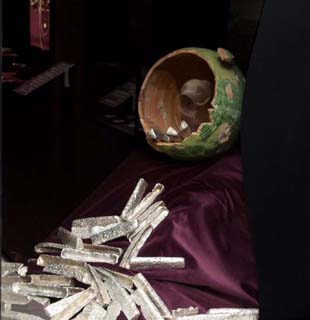
Over 2500 pieces made of precious metals with historic, artistic and symbolic value
  

Come to Museum! Discover the History!
  
Visit museum
Visit museum
Summer schedule: daily
10am – 6pm.

Winter schedule: daily
10am – 5pm.
Closed on Mondays.
Entrance fees:  adults - 50 MDL, Pensioners, students - 20 lei, pupils - 10 MDL. Free access: enlisted men (...)

WiFi Free Wi-Fi Zone in the museum: In the courtyard of the National History Museum of Moldova there is Wi-Fi Internet access for visitors.


#Exhibit of the Month

The Gospel is a fundamental liturgical book of the Orthodox Church that brings together the four apostolic testimonies about the Son of God - Matthew, Mark, Luke, and John - "inspired by the same Holy Spirit, the one true and sole author of the Gospel." ...

Read More >>


The National Museum of History of Moldova takes place among the most significant museum institutions of the Republic of Moldova, in terms of both its collection and scientific reputation.
©2006-2025 National Museum of History of Moldova
Visit museum 31 August 1989 St., 121 A, MD 2012, Chisinau, Republic of Moldova
Phones:
Secretariat: +373 (22) 24-43-25
Department of Public Relations and Museum Education: +373 (22) 24-04-26
Fax: +373 (22) 24-43-69
E-mail: office@nationalmuseum.md
Technical Support: info@nationalmuseum.md
Web site administration and maintenance: Andrei EMILCIUC


The National Museum of History of Moldova takes place among the most significant museum institutions of the Republic of Moldova, in terms of both its collection and scientific reputation.
©2006-2025 National Museum of History of Moldova
Visit museum 31 August 1989 St., 121 A, MD 2012, Chisinau, Republic of Moldova
Phones:
Secretariat: +373 (22) 24-43-25
Department of Public Relations and Museum Education: +373 (22) 24-04-26
Fax: +373 (22) 24-43-69
E-mail: office@nationalmuseum.md
Technical Support: info@nationalmuseum.md
Web site administration and maintenance: Andrei EMILCIUC

menu
The National Museum of History of Moldova takes place among the most significant museum institutions of the Republic of Moldova, in terms of both its collection and scientific reputation.
©2006-2025 National Museum of History of Moldova
Visit museum 31 August 1989 St., 121 A, MD 2012, Chisinau, Republic of Moldova
Phones:
Secretariat: +373 (22) 24-43-25
Department of Public Relations and Museum Education: +373 (22) 24-04-26
Fax: +373 (22) 24-43-69
E-mail: office@nationalmuseum.md
Technical Support: info@nationalmuseum.md
Web site administration and maintenance: Andrei EMILCIUC