EN RO


#Exhibit of the Month

>>>

We find ourselves in the month of April, as we prepare to celebrate Easter-a moveable religious holiday rich in festive rituals and ceremonial activities that place this event at the very heart of Christian spiritual life. The spirit of the Resurrection is beautifully complemented by ten Easter-themed postcards from the heritage of the National Museum of History of Moldova, printed a century ago. These pieces were added to the museum's postcard collection over a decade ago following a successful acquisition; as the fund for Easter-themed illustrations is modest, we are in a constant search for new additions.

These postcards are "extraordinary" in terms of their postal, typographical, and chromatic effects-the primary reason for revisiting this genre of greetings. Unlike "classic" postcards, these are smaller in size (6.5 cm x 11 cm), made of cardboard (with the exception of one piece made of photographic paper in black and white), and feature "vivid" colors. Printed in Romania and Germany, they bear the marks of having been sent and circulated through the post.

The name of the holiday originates from the verb persach, meaning "to pass," a term adopted by the Jews from the Egyptians. It entered the Romanian language through the Byzantine-Latin form Paschae, signifying the "passage through death to life, the victory of life, and liberation from the bondage of sin." Easter is a holiday of tolerance and forgiveness, representing a bridge between the present and the past. The significance of this celebration is conveyed through its symbols, which are also featured on these postcards: Hand-painted eggs, the Easter Bunny and the Lamb, traditional sweet breads (cozonac and pască), biblical scenes related to the crucifixion and resurrection of Jesus Christ.

The Easter table also features pască-a ritual food reminiscent of ancient, bloodless "reconciliation" sacrifices. Its preparation is the exclusive task of women, the givers of life, as the leavened dough is considered "alive."

The most significant component of the Easter holiday, however, is the Light. The Ceremony of the Holy Light is associated with the miracle of the light appearing on Easter Sunday at Christ's Tomb in Jerusalem. The candle, often depicted in these images, carries a powerful message; it is with the Resurrection candle that we return home after the midnight religious service. Furthermore, the Easter Bunny represents the rebirth of nature, so eagerly awaited after a harsh winter.

Unlike Christmas, when the announcement and ritual integration of the community into sacred time was the duty of caroling groups, at Easter, "one does not go from house to house." Instead, the ritual meal is organized within each family, symbolizing a direct communion with God.


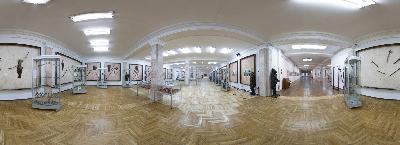
Virtual Tour


#Exhibit of the Month

February 2026

Constantin Brâncuși in Medallistics

To mark the 150th anniversary of the birth of the great Romanian sculptor Constantin Brâncuși, 2026 was declared by the President of Romania the Year of Constantin Brâncuși. Constantin Brâncuși, one of the greatest sculptors of the twentieth century, was born in 1876 in Hobița, Gorj County, and passed away in 1957 in Paris; he was buried in the Père-Lachaise cemetery. In 1904 he arrived in Paris, where he attended courses at the Royal Academy of Fine Arts. There he also worked in the studio of Auguste Rodin (1840-1917), the founder of modern sculpture, and met Amadeo Modigliani (1884-1920), the Italian sculptor settled in France. Inspired by the work of these artists, he perfected his artistic training in Paris. His works are held in museums both at home and abroad, in the Netherlands, the Scandinavian countries, France, and the United States of America. For his outstanding merits he was awarded the Order of the Star of Romania in 1923; in 1931 Nicolae Iorga proposed him for the Order of Cultural Merit; and only in 1990 was he posthumously elected a member of the Romanian Academy.

One of the artist's most famous creations is the sculpture Mademoiselle Pogany, considered a national symbol of modern Romanian art. Its protagonist was Margaret Pogany (1879-1964), a young Hungarian painter who came to Paris in 1909 to study painting techniques. Visiting her studio, she asked the sculptor to make her portrait, even leaving him a photograph and a self-portrait. In 1911 Brâncuși sculpted her likeness from memory in marble and in bronze, focusing on the deep, large, almond-shaped eyes, the subdued eyebrows, the narrow nose, the small mouth, the austere hairstyle and the modest gesture of the hands, rested against the face. Between 1912 and 1933 he produced nineteen versions of Mademoiselle Pogany.

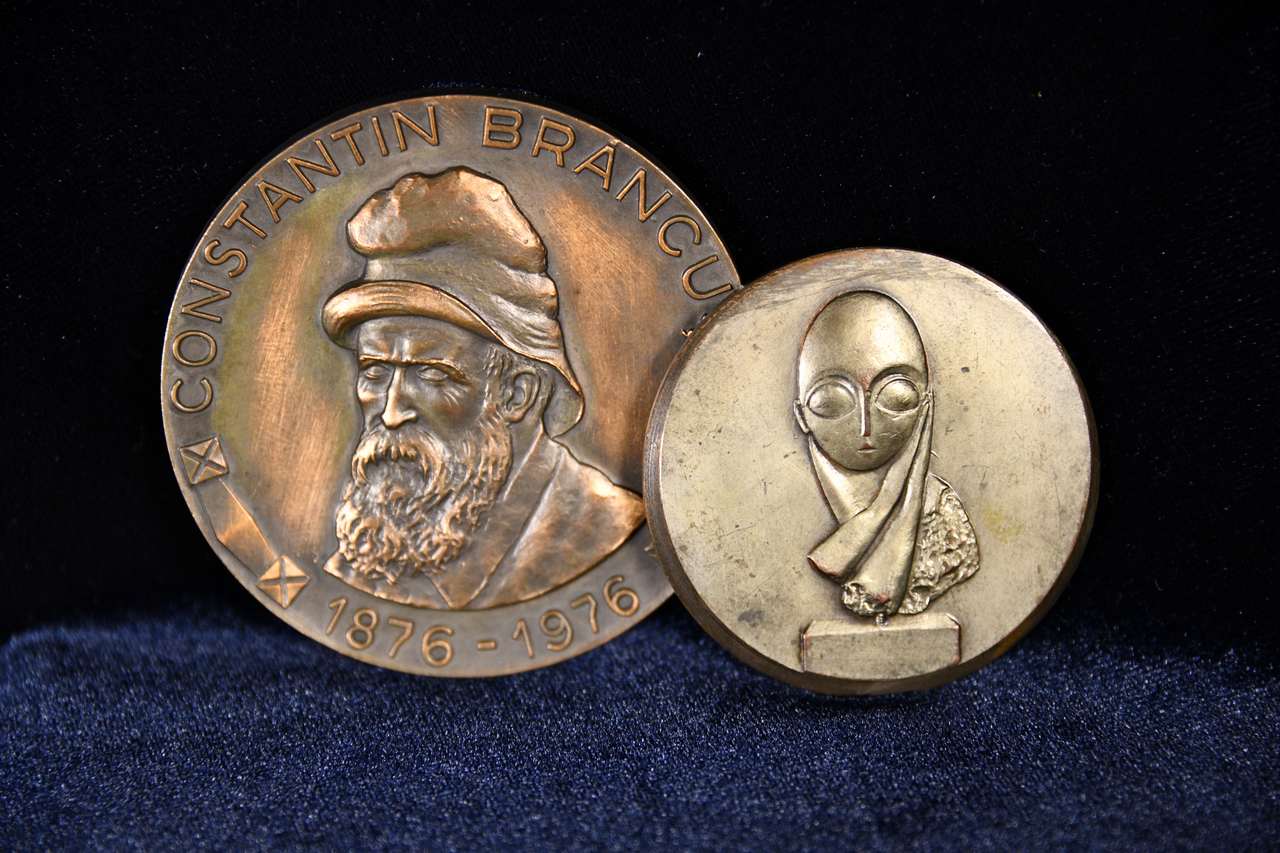
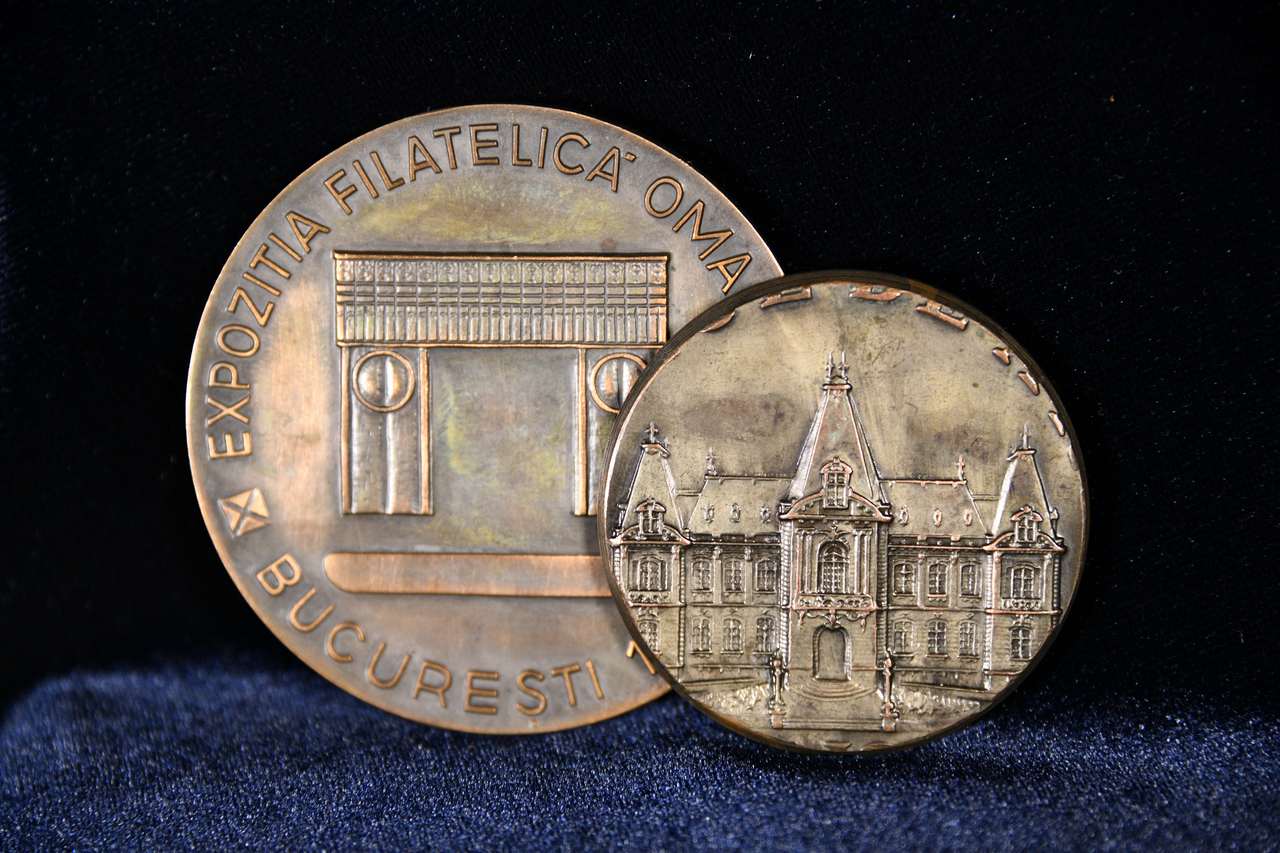
The commemorative medal "Constantin Brâncuși (1876-1976). Expoziție Filatelică Omagială - București 1976" was struck in Romania at the State Mint by the engraver Ștefan Grudinschi. Executed in bronze with a diameter of 60 mm and a weight of 113.73 g, the medal is remarkable for its memorial and artistic value. Obverse: the sculptor's bust facing left, with the semicircular legend "CONSTANTIN BRÂNCUȘI - 1876-1976." Reverse: a fragment of the triptych The Gate of the Kiss. Semicircular legend: "EXPOZIȚIA FILATELICĂ OMAGIALĂ - BUCUREȘTI 1976."

The medal "Constantin Brâncuși. Mademoiselle Pogany. Craiova Art Museum. 1987" was also executed in bronze at the State Mint (Bucharest); it has a nominal diameter of 60 mm (because of the circular cutting the actual dimensions are D: 45 mm; weight: 53.55 g). The obverse shows, in the central field, an image of the Craiova Art Museum framed by the semicircular legend "MUZEUL DE ARTĂ - CRAIOVA / 1987." The reverse depicts a replica of the sculpture Mademoiselle Pogany made by Brâncuși's pupil O. Moșescu, accompanied by the inscription "CONSTANTIN BRÂNCUȘI - M-elle POGANY / 1913."


Independent Moldova
Moldavian Soviet Socialist Republic
Bessarabia and MASSR between the Two World Wars
Bessarabia and Moldavian Autonomous Soviet Socialist Republic in the Period between the Two World Wars
Revival of National Movement
Time of Reforms and their Consequences
Abolition of Autonomy. Bessarabia – a New Tsarist Colony
Period of Relative Autonomy of Bessarabia within the Russian Empire
Phanariot Regime
Golden Age of the Romanian Culture
Struggle for Maintaining of Independence of Moldova
Formation of Independent Medieval State of Moldova
Era of the
Great Nomad Migrations
Early Middle Ages
Iron Age and Antiquity
Bronze Age
Aeneolithic Age
Neolithic Age
Palaeolithic Age
  
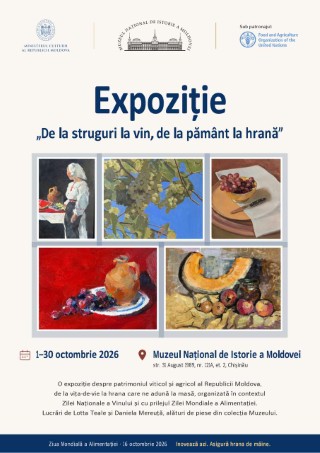
27 March – 30 April 2026
 
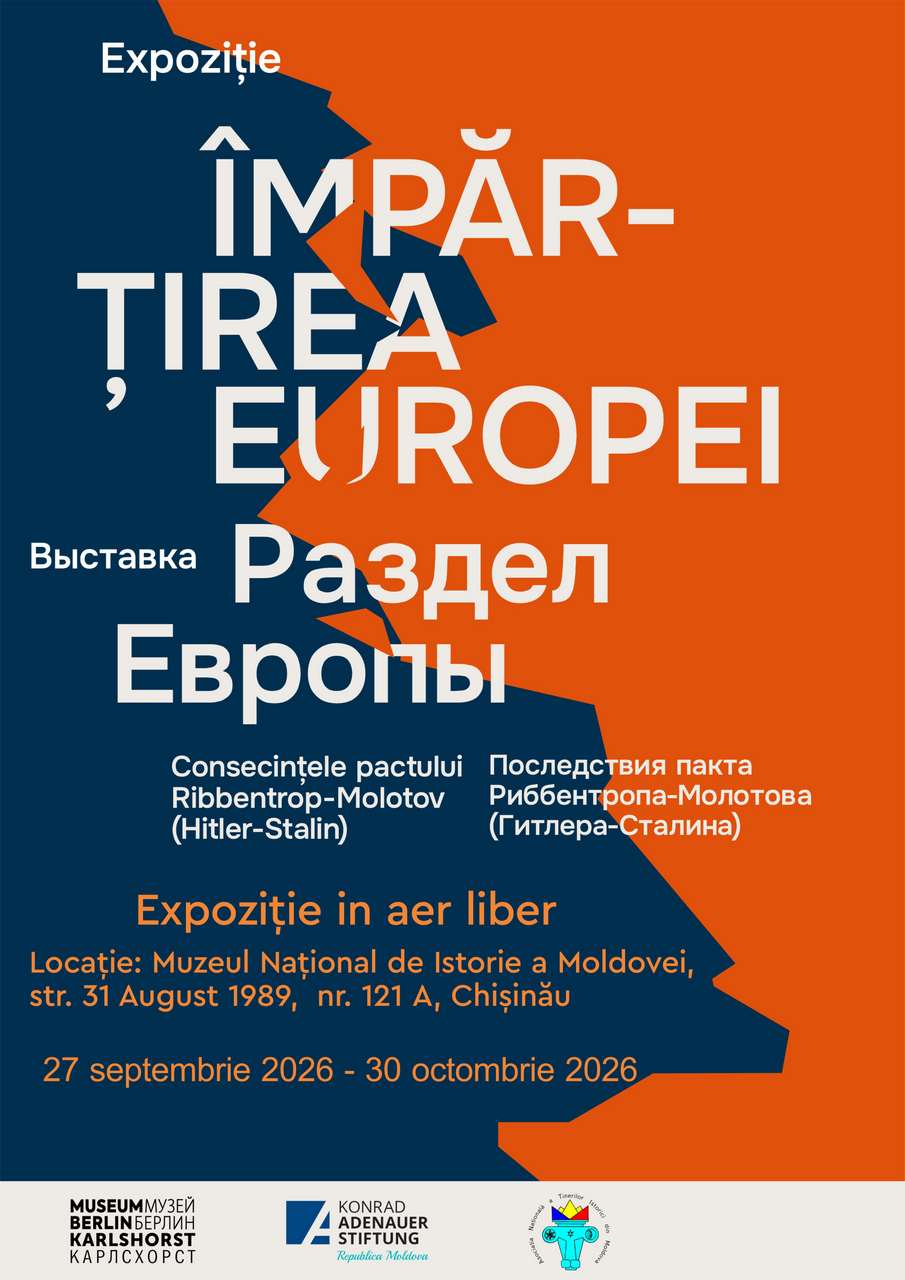
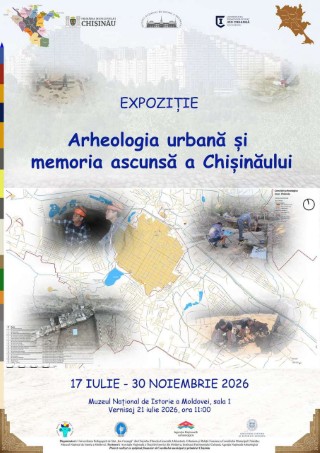
September 25, 2025 – September 1, 2026
 
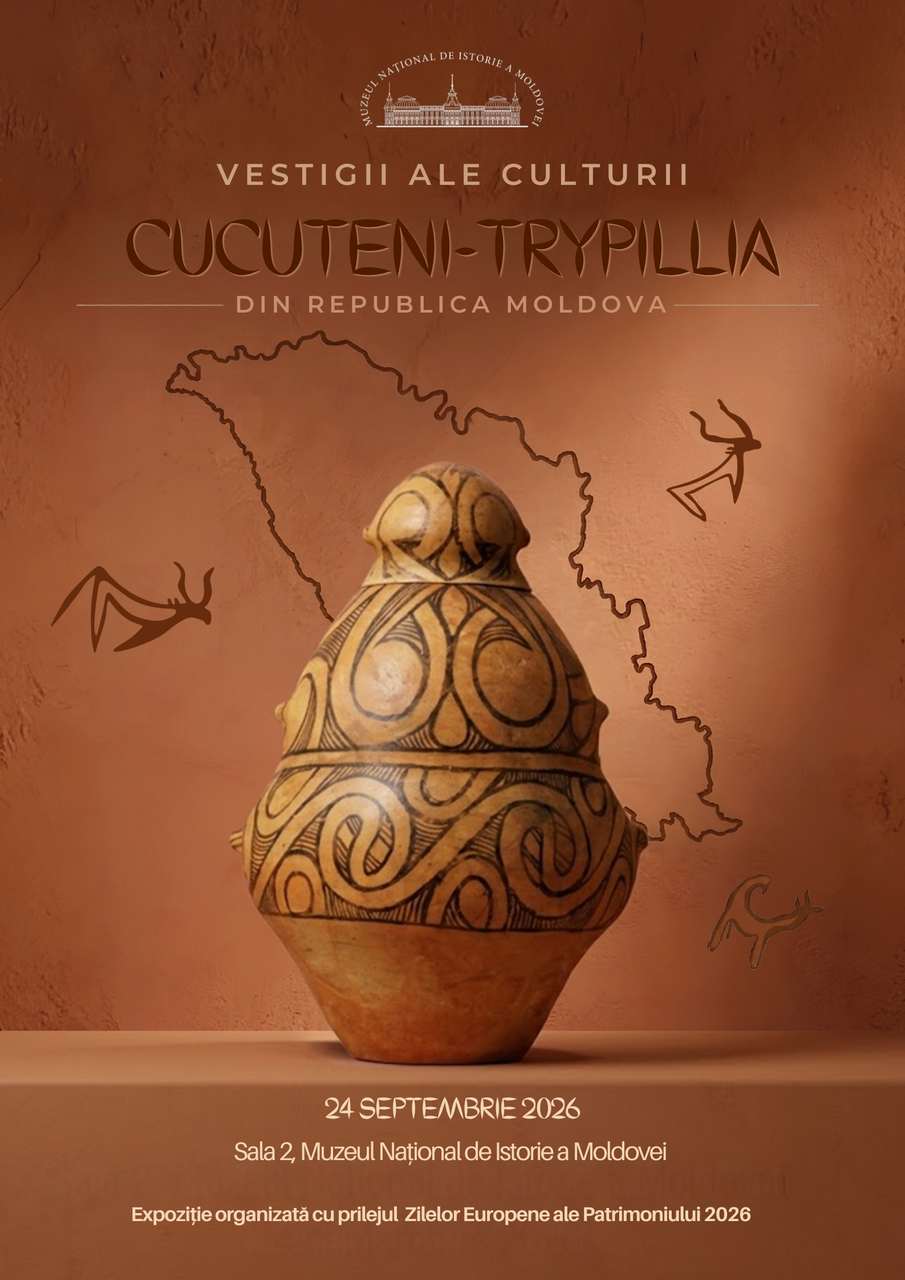
August 11, 2025 – January 31, 2026
 
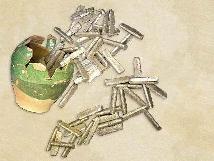
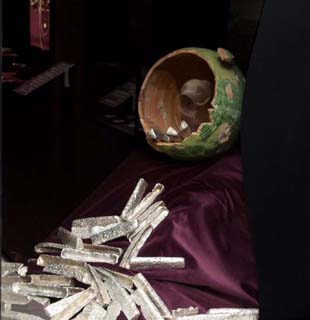
Over 2500 pieces made of precious metals with historic, artistic and symbolic value
  

Come to Museum! Discover the History!
  
Visit museum
Visit museum
Summer schedule: daily
10am – 6pm.

Winter schedule: daily
10am – 5pm.
Closed on Mondays.
Entrance fees:  adults - 50 MDL, Pensioners, students - 20 lei, pupils - 10 MDL. Free access: enlisted men (...)

WiFi Free Wi-Fi Zone in the museum: In the courtyard of the National History Museum of Moldova there is Wi-Fi Internet access for visitors.


#Exhibit of the Month

We find ourselves in the month of April, as we prepare to celebrate Easter-a moveable religious holiday rich in festive rituals and ceremonial activities that place this event at the very heart of Christian spiritual life...

Read More >>


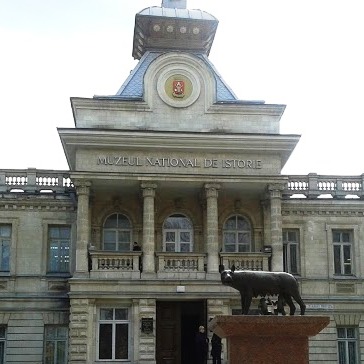
The National Museum of History of Moldova takes place among the most significant museum institutions of the Republic of Moldova, in terms of both its collection and scientific reputation.
©2006-2026 National Museum of History of Moldova
Visit museum 31 August 1989 St., 121 A, MD 2012, Chisinau, Republic of Moldova
Phones:
Secretariat: +373 (22) 24-43-25
Department of Public Relations and Museum Education: +373 (22) 24-04-26
Fax: +373 (22) 24-43-69
E-mail: office@nationalmuseum.md
Technical Support: info@nationalmuseum.md
Web site administration and maintenance: Andrei EMILCIUC


The National Museum of History of Moldova takes place among the most significant museum institutions of the Republic of Moldova, in terms of both its collection and scientific reputation.
©2006-2026 National Museum of History of Moldova
Visit museum 31 August 1989 St., 121 A, MD 2012, Chisinau, Republic of Moldova
Phones:
Secretariat: +373 (22) 24-43-25
Department of Public Relations and Museum Education: +373 (22) 24-04-26
Fax: +373 (22) 24-43-69
E-mail: office@nationalmuseum.md
Technical Support: info@nationalmuseum.md
Web site administration and maintenance: Andrei EMILCIUC

menu
The National Museum of History of Moldova takes place among the most significant museum institutions of the Republic of Moldova, in terms of both its collection and scientific reputation.
©2006-2026 National Museum of History of Moldova
Visit museum 31 August 1989 St., 121 A, MD 2012, Chisinau, Republic of Moldova
Phones:
Secretariat: +373 (22) 24-43-25
Department of Public Relations and Museum Education: +373 (22) 24-04-26
Fax: +373 (22) 24-43-69
E-mail: office@nationalmuseum.md
Technical Support: info@nationalmuseum.md
Web site administration and maintenance: Andrei EMILCIUC