EN RO


#Exhibit of the Month

>>>

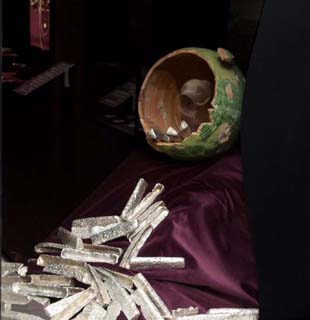
The ceramic vessel set was discovered accidentally in October 2025 in the southwestern part of the village of Bălceana, Hâncești District, approximately 1.2 km from the Lăpușnița River. The archaeological materials were recovered by the National Archaeological Agency.

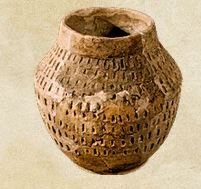
The ceramic assemblage consists of a large storage vessel (pithos) with a capacity of 20 litres (h = 39.2 cm; d = 35.0 cm), decorated with a raised band below the rim; a medium-sized bowl with a capacity of 2.5 litres (h = 16.9 cm; d = 23.2 cm); a medium-sized jug with a capacity of 0.6 litres (h = 12.0 cm; d = 13.4 cm); and the base of a jar-shaped vessel.

The coarse handmade pottery was produced using the coil-building technique, by stacking and shaping coils of clay prepared from a paste tempered with crushed fired clay (grog) and sand. The vessel surfaces are uneven and covered with a yellowish-red slip featuring black patches, while the core of the vessel walls is black in colour.

The three vessels preserved intact display well-defined biconical shapes, with their maximum diameter at the middle of the body and straight or slightly oblique rims with rounded edges. Pottery of this type is characteristic of the Early Medieval cultural area of the northern and northwestern Black Sea region, dating from the 5th to the 7th centuries. East of the Dniester River, on the territory of present-day Ukraine, analogous pottery is found in Penkovka-type settlements, while in the Carpathian-Dniester region it is characteristic of settlements belonging to the Costișa-Botoșana-Hansca cultural group.

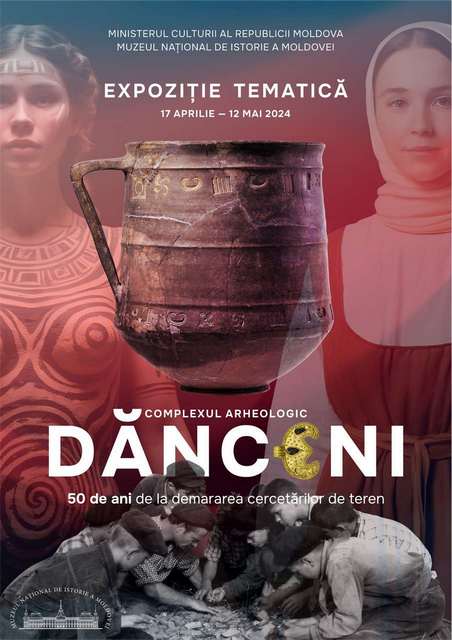
Within the Prut-Dniester region, coarse biconical pottery is generally represented by fragments and only relatively rarely by complete vessels, such as those discovered at Hansca, Dănceni, Recea, Seliște, Păhărniceni, and other sites. This type of pottery constituted an indispensable component of the local material culture during the 5th-7th centuries. In this context, the discovery at Bălceana of an almost intact set of coarse biconical vessels represents a relatively rare find of considerable scientific importance.

According to certain hypotheses, the tradition of coarse biconical pottery dating to the 5th-7th centuries originated in the North Pontic region. At the same time, it cannot be ruled out that these biconical ceramic vessels were the result of contemporary ethnocultural interactions, developing simultaneously across the vast territory extending from the Carpathian Mountains to the Dnieper River and the Seversky Donets.

Virtual Tour


International Collaboration

The working visit of scientific researcher Eugeniu Mistreanu in Kobuleti, Republic of Georgia

18-25 September 2023

The EU4Culture project

Between 18.09.2023 - 25.09.2023, our colleague Eugeniu Mistreanu, scientific researcher in the Archeology sector of the National Museum of History of Moldova, undertook a working visit to Kobuleti, Republic of Georgia. The move was financially supported by a short-term mobility grant from the European EU4Culture program.

During the visit, being hosted by Mr. Rezo Takidze, the director of the Kobuleti Museum, the directors established some themes for future collaborations, both in the field of museography and in the scientific field.

The internship resulted in several work and research visits to the Kobuleti Museum, Batumi Archaeological Museum, Ispani I and Ispani II National Reserve, Kintrishi National Park, where I visited the Tskhemvani Stone Bridge built in the c. XII BC and the Khino monastery, where clay vessels for storing wine - kvevri - are preserved in situ. The purpose of these visits is the exchange of experience in the field of cultural management, with a predilection for museum management, the establishment of partnership relations with the museum in Kobuleti and the drawing up of cooperation directions in the future.

Another important activity was related to familiarization with the impressive archaeological collections from the Eneolithic to the Middle Ages, presented by Mr. Takidze. In this context, a field visit was also carried out, to the famous Pichvnari archaeological site - ancient necropolis, c. VI-III BC, of large size and the nearby settlement.

The discussions focused on the possibility of signing a memorandum of cooperation that will allow us to collaborate in order to organize exhibitions, joint conferences, but also exchanges of experiences for museographers and researchers from both museums. We also agreed on a joint research project focused on Eneolithic material culture and an exhibition in Chisinau and Kobuleti, where we will present the history, culture and potential of our countries.

The interaction with the Georgian cultural heritage, with the museological environment of Adjara allowed the establishment of new contacts with colleagues from these museum and research centers, which will certainly contribute to future collaborations both in the field of museology and archaeological research.

The mobility was funded by the European Union in the framework of the EU4Culture project implemented by the Goethe-Institut, Czech Centers, Danish Cultural Institute and Institut Français de Géorgie.


Independent Moldova
Moldavian Soviet Socialist Republic
Bessarabia and MASSR between the Two World Wars
Bessarabia and Moldavian Autonomous Soviet Socialist Republic in the Period between the Two World Wars
Revival of National Movement
Time of Reforms and their Consequences
Abolition of Autonomy. Bessarabia – a New Tsarist Colony
Period of Relative Autonomy of Bessarabia within the Russian Empire
Phanariot Regime
Golden Age of the Romanian Culture
Struggle for Maintaining of Independence of Moldova
Formation of Independent Medieval State of Moldova
Era of the
Great Nomad Migrations
Early Middle Ages
Iron Age and Antiquity
Bronze Age
Aeneolithic Age
Neolithic Age
Palaeolithic Age
  
September 25, 2025 – September 1, 2026
 
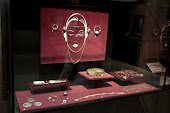
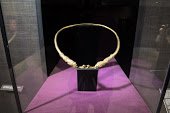
Over 2500 pieces made of precious metals with historic, artistic and symbolic value
  

Come to Museum! Discover the History!
  
Visit museum
Visit museum
Summer schedule: daily
10am – 6pm.

Winter schedule: daily
10am – 5pm.
Closed on Mondays.
Entrance fees:  adults - 50 MDL, Pensioners, students - 20 lei, pupils - 10 MDL. Free access: enlisted men (...)

WiFi Free Wi-Fi Zone in the museum: In the courtyard of the National History Museum of Moldova there is Wi-Fi Internet access for visitors.


#Exhibit of the Month

The ceramic vessel set was discovered accidentally in October 2025 in the southwestern part of the village of Bălceana, Hâncești District, approximately 1.2 km from the Lăpușnița River. The archaeological materials were recovered by the National Archaeological Agency...

Read More >>


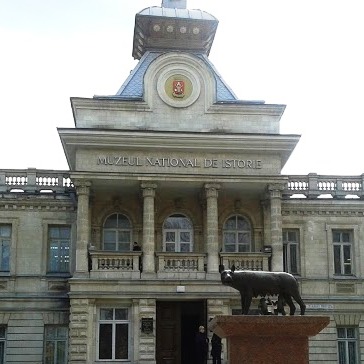
The National Museum of History of Moldova takes place among the most significant museum institutions of the Republic of Moldova, in terms of both its collection and scientific reputation.
©2006-2026 National Museum of History of Moldova
Visit museum 31 August 1989 St., 121 A, MD 2012, Chisinau, Republic of Moldova
Phones:
Secretariat: +373 (22) 24-43-25
Department of Public Relations and Museum Education: +373 (22) 24-04-26
Fax: +373 (22) 24-43-69
E-mail: office@nationalmuseum.md
Technical Support: info@nationalmuseum.md
Web site administration and maintenance: Andrei EMILCIUC


The National Museum of History of Moldova takes place among the most significant museum institutions of the Republic of Moldova, in terms of both its collection and scientific reputation.
©2006-2026 National Museum of History of Moldova
Visit museum 31 August 1989 St., 121 A, MD 2012, Chisinau, Republic of Moldova

Phones:
Secretariat: +373 (22) 24-43-25
Department of Public Relations and Museum Education: +373 (22) 24-04-26
Fax: +373 (22) 24-43-69
E-mail: office@nationalmuseum.md
Technical Support: info@nationalmuseum.md
Web site administration and maintenance: Andrei EMILCIUC

menu
The National Museum of History of Moldova takes place among the most significant museum institutions of the Republic of Moldova, in terms of both its collection and scientific reputation.
©2006-2026 National Museum of History of Moldova
Visit museum 31 August 1989 St., 121 A, MD 2012, Chisinau, Republic of Moldova
Phones:
Secretariat: +373 (22) 24-43-25
Department of Public Relations and Museum Education: +373 (22) 24-04-26
Fax: +373 (22) 24-43-69
E-mail: office@nationalmuseum.md
Technical Support: info@nationalmuseum.md
Web site administration and maintenance: Andrei EMILCIUC