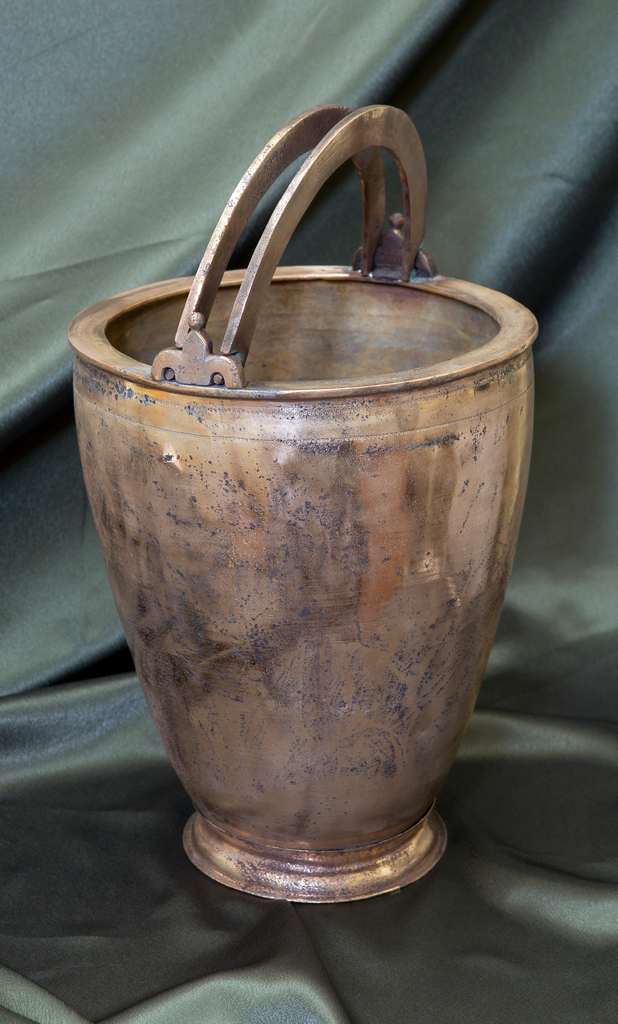
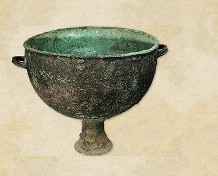
The Roman bronze situla comes from a collection of archaeological artifacts confiscated at customs and transferred to the holdings of the National Museum of History of Moldova in 2009. Its place of discovery remains unknown.
A situla (Latin for "bucket") is a metal vessel-usually made of bronze-shaped like a pail and equipped with two movable handles at the top, traditionally used for mixing wine with water. The handles are attached to the vessel via two decorated ears that are welded to the rim.
The body of the situla is truncated-conical in shape and features two decorative bands with small circular patterns formed by hammering, located just below the rim.
Its base is double-layered: the inner bottom is hemispherical and hammered, while the outer bottom is flat and lathe-made. The outer base is welded to the inner bottom, serving as the vessel's foot-support.
This object was crafted using a combination of casting, hammering, and partial lathe-finishing. Dimensions: Maximum height - 31.7 cm; Maximum diameter - 22.8 cm; Base diameter - 13.5 cm
Situlae of this type originated in the Roman Empire and were later adopted by various ancient peoples, including those from the northwestern Pontic region.
The Roman bronze situla comes from a collection of archaeological artifacts confiscated at customs and transferred to the holdings of the National Museum of History of Moldova in 2009. Its place of discovery remains unknown....
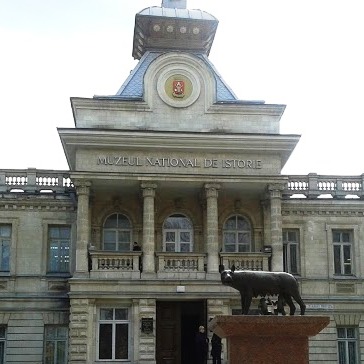
The National Museum of History of Moldova takes place among the most significant museum institutions of the Republic of Moldova, in terms of both its collection and scientific reputation.
The National Museum of History of Moldova takes place among the most significant museum institutions of the Republic of Moldova, in terms of both its collection and scientific reputation.
The National Museum of History of Moldova takes place among the most significant museum institutions of the Republic of Moldova, in terms of both its collection and scientific reputation.


















 31 August 1989 St., 121 A, MD 2012, Chisinau, Republic of Moldova