EN RO


#Exhibit of the Month

>>>

The grapevine plant, now widespread across the globe, traces its origins back to the Upper Cretaceous geological period, when species of Vitis Linn appeared on Earth (Mesozoic era), followed later by Vitis vinifera L., the latter already classified among cultivated agricultural plants. Most researchers link the origin of the cultivated grapevine (Vitis vinifera L.) to the wild forest species Vitis sylvestris Gmel. Thickets of Vitis sylvestris Gmel. can still sporadically be found in the groves along the Prut and Dniester floodplains.

During the Precucuteni III - Trypillia A period (ca. 4750-4600 BC), the presence of cultivated grape seeds was clearly documented on pottery from the settlement of Ruseştii Noi I, layer I, kiln A, consisting of a seed impression on a ceramic fragment, with the elongated beak characteristic of the domesticated species Vitis vinifera L. Another seed impression of Vitis vinifera L. was recorded at the settlement of Vărvăreuca VIII, identified on the wall of a painted vessel from the Cucuteni B - Trypillia CI stage (3800-3500/3300 BC). 
In October, on the occasion of the National Wine Day, the National Museum of History of Moldova presents to your attention a unique relic in Southeastern Europe. The exhibit originates from the settlement Brînzeni VIII "Sâiece," belonging to the Cucuteni-Trypillia culture and dated to the Cucuteni AB2 - Trypillia B2 phase (ca. 4050-3800 BC), located in Brînzeni village, Edineț district. The site lies 2 km southwest of the locality, in a triangle formed by the confluence of the Racovăț and Drobiște streams and the local road L36 Bădragii Vechi-Brînzeni. Positioned on land 25-30 meters above the valley, it was discovered in 1966 by archaeologist Nicolaie Chetraru and investigated through excavations between 1978-1980 by Vsevolod Marchevici. 
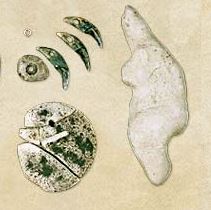
The October exhibit is a grapevine leaf impression discovered in 1980. It comes from pit no. 5, partially investigated, with a maximum depth of 155 cm. From the same archaeological complex near dwelling no. 1, several grape seeds were also recovered, as noted in the excavation report. The grapevine leaf impression appears on a coarse clay lump, fired and vitrified due to secondary burning, reddish in color, with an irregular rectangular, flattened shape. The outer surface is uneven and rough. The impression surface is smoothed, with the leaf veins clearly highlighted. Measuring 99 mm in length, 110 mm in width, and 28-31 mm in thickness, the exhibit presents in full splendor an authentic grapevine leaf impression. Some researchers attribute it to the domesticated grapevine Vitis vinifera L., while others, more skeptical, consider it a wild species. Nevertheless, being discovered in a well-documented archaeological context, together with grape seeds near a dwelling, it provides evidence that grapevine was part of Cucuteni community life 6,000 years ago. These findings allow us to affirm that the process of domestication and the creation of table grapes was already underway. The diversity of Cucuteni ceramic forms, as well as the painting on some vessels, undoubtedly suggests their use as containers for various liquids. Accordingly, the emergence of wine among Cucuteni communities can be taken into consideration.

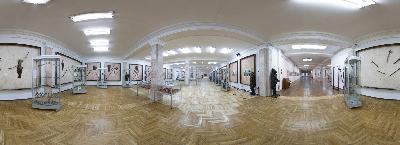
Virtual Tour


Exhibitions

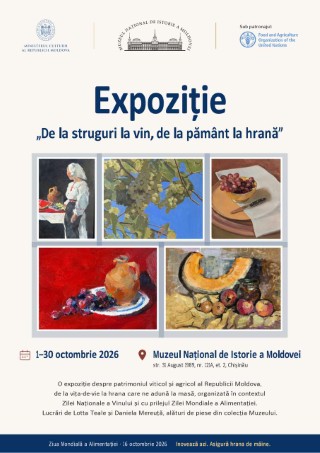
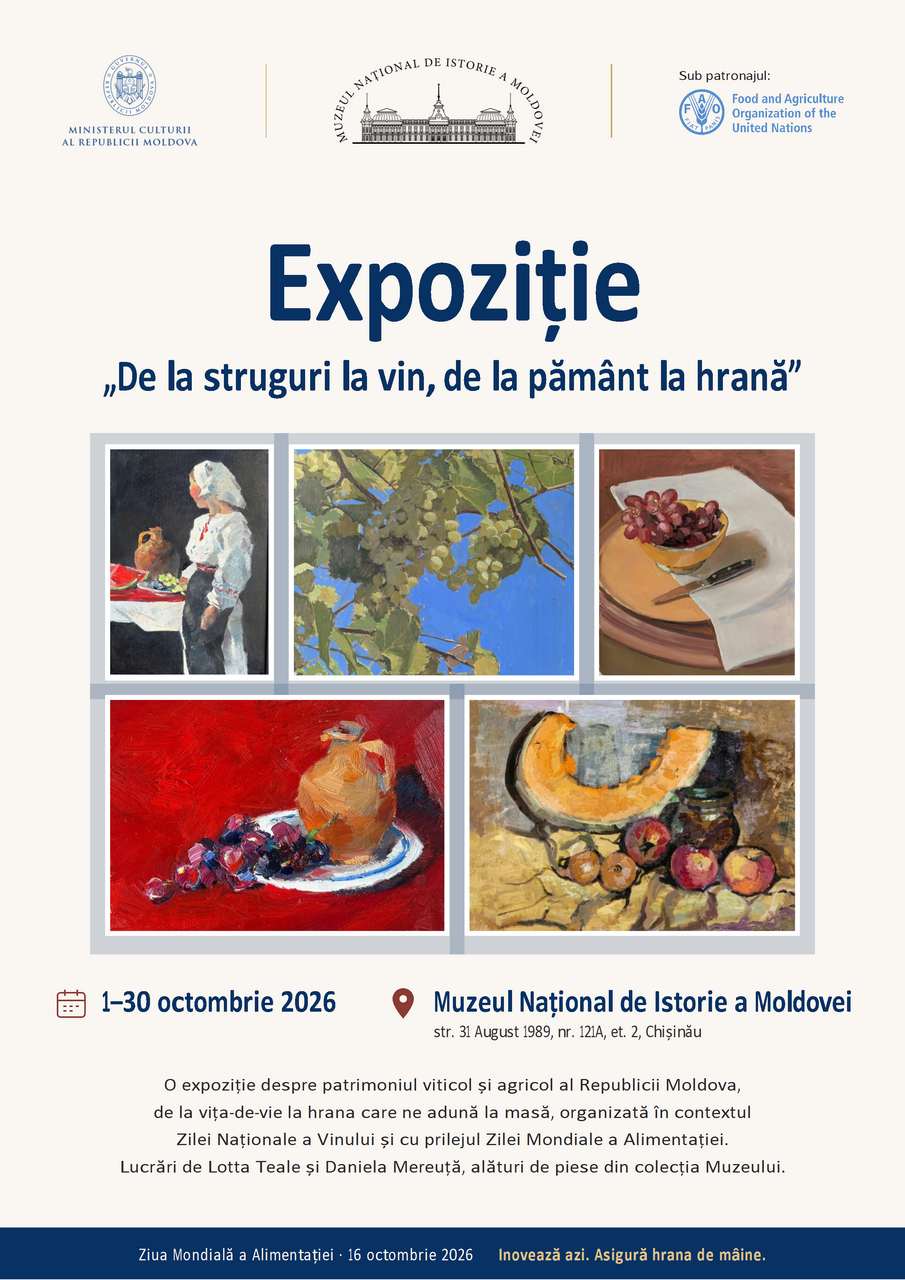
‟From Grapes to Wine; from Earth to Food”

1st – 30th October 2026

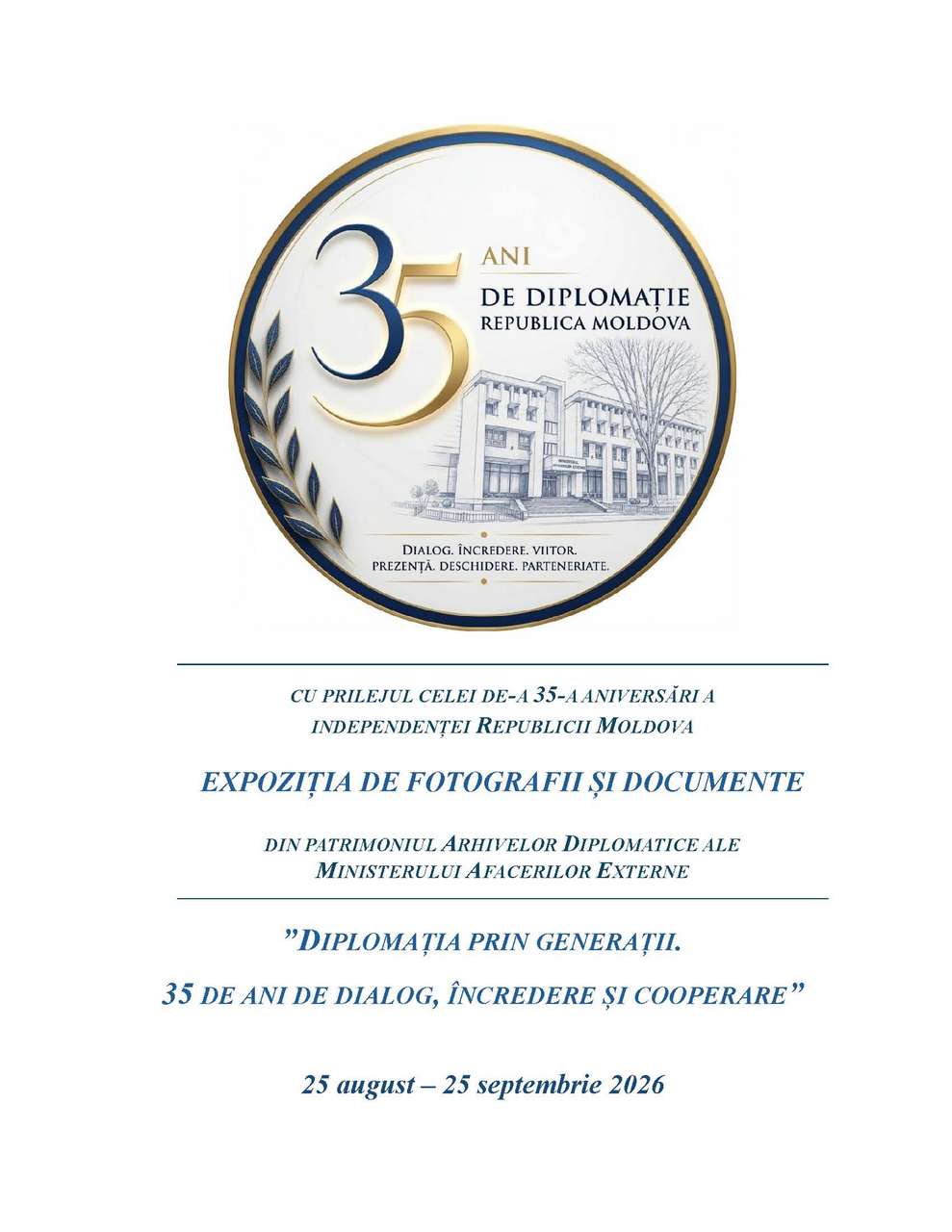
This exhibition, timed to coincide with National Wine Day in the Republic of Moldova (3-4 October) and World Food Day (16 October), brings together a diverse array of paintings and artefacts from two contemporary artists and from the Museum's collection, many of which are rarely on display, around the theme of grapes, wine and the production of food, to celebrate Moldova's growing international reputation in the wine and agrifood sector. 

Building on its heritage as one of the world's oldest winemaking regions, Moldova is now also at the cutting edge of innovations in the growing of grapes and the production of wine, with some of its producers among the earliest adopters of artificial intelligence (AI) and other digital technologies in the industry. Alongside grape production, Moldova's broader food production industry is expanding rapidly: total agricultural output rose by almost 16 percent in 2025 and by almost 9 percent in the first half of 2026 alone. Agrifood exports account for 45 percent of the country's total export revenue. 

This exhibition reflects on the central place of viticulture, and of food production more broadly, in cultural life, from the earliest archaeological times to the present. It includes paintings and artefacts related to all stages of the cycle of production, from depictions of grapes on the vine, the harvest and fruit ready to eat on the table, all the way to the remains of half-empty glasses left after a meal. It draws together oil paintings, textiles and ceramics around this common theme and looks at how these subjects have been depicted from the early twentieth century to the present day. Together they reflect the cycle of production which has been a mainstay of day-to-day life regardless of historical transformations. 

Paintings: the exhibition includes a collection of new oil paintings created especially for the occasion by Lotta Teale, an English artist living in Chișinău, and Daniela Mereută, an emerging Moldovan artist. It also includes a number of works chosen from the Museum's reserve collection by several well-known mid- to late-twentieth-century Moldovan artists, which are rarely on display to the public, including Tatiana Nicolaidi, Aurelia Roman and Chiril Novac. 

Textiles: The ensemble consisting of the silk headscarf, blouse, skirt, and wool belt forms a unified composition of the Moldovan folk costume, a symbol of national identity and the continuity of traditions. These pieces, created between the early 20th century and the 1980s, are complemented by handwoven towels decorated with vegetal motifs and multicolored grapes. Together, the displayed textiles evoke the beauty of traditional attire and its connection to the fertility of the land and the rituals of food. 

Ceramics: The jugs, flasks, carafes, wine sets, fruit bowls, and decorative plates with grapes illustrate the tradition of hospitality and wine consumption in Moldovan culture. Made of ceramic, faience, glass, or wood between the 1950s and the early 21st century, these utilitarian and decorative objects reflect both artisanal craftsmanship and the symbolism of wine as a central element of conviviality. Modern souvenirs and figurines complete this selection, showing the continuity of the theme in contemporary creation. 

The exhibition is organized under the patronage of the Food and Agriculture Organization of the United Nations (FAO) in the Republic of Moldova. A partner of the Republic of Moldova since 1995, FAO helps small-scale farmers and producers become more competitive and resilient through climate-smart agriculture, better access to markets and the adoption of European Union standards and practices in the agrifood sector. The exhibition is part of the celebrations for World Food Day, marked every year on 16 October, the day FAO was founded in 1945. This year's theme - "Innovate today. Nourish tomorrow." - recognizes that innovation, together with traditional knowledge passed down through generations, is key to ensuring that everyone has access to safe and nutritious food, today and for generations to come.


Independent Moldova
Moldavian Soviet Socialist Republic
Bessarabia and MASSR between the Two World Wars
Bessarabia and Moldavian Autonomous Soviet Socialist Republic in the Period between the Two World Wars
Revival of National Movement
Time of Reforms and their Consequences
Abolition of Autonomy. Bessarabia – a New Tsarist Colony

Period of Relative Autonomy of Bessarabia within the Russian Empire
Phanariot Regime
Golden Age of the Romanian Culture
Struggle for Maintaining of Independence of Moldova
Formation of Independent Medieval State of Moldova
Era of the
Great Nomad Migrations
Early Middle Ages
Iron Age and Antiquity
Bronze Age
Aeneolithic Age
Neolithic Age
Palaeolithic Age


Come to Museum! Discover the History!
  
Visit museum
Visit museum
Summer schedule: daily
10am – 6pm.

Winter schedule: daily
10am – 5pm.
Closed on Mondays.
Entrance fees:  adults - 50 MDL, Pensioners, students - 20 lei, pupils - 10 MDL. Free access: enlisted men (...)

WiFi Free Wi-Fi Zone in the museum: In the courtyard of the National History Museum of Moldova there is Wi-Fi Internet access for visitors.


#Exhibit of the Month

The grapevine plant, now widespread across the globe, traces its origins back to the Upper Cretaceous geological period, when species of Vitis Linn appeared on Earth (Mesozoic era), followed later by Vitis vinifera L., the latter already classified among cultivated agricultural plants. Most researchers link the origin of the cultivated grapevine (Vitis vinifera L.) to the wild forest species Vitis sylvestris Gmel...

Read More >>


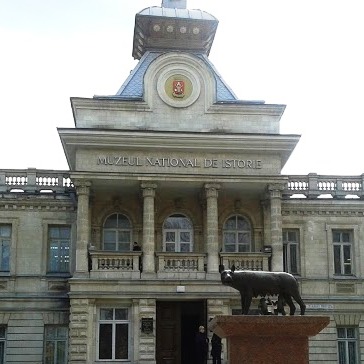
The National Museum of History of Moldova takes place among the most significant museum institutions of the Republic of Moldova, in terms of both its collection and scientific reputation.
©2006-2026 National Museum of History of Moldova
Visit museum 31 August 1989 St., 121 A, MD 2012, Chisinau, Republic of Moldova
Phones:
Secretariat: +373 (22) 24-43-25
Department of Public Relations and Museum Education: +373 (22) 24-04-26
Fax: +373 (22) 24-43-69
E-mail: office@nationalmuseum.md
Technical Support: info@nationalmuseum.md
Web site administration and maintenance: Andrei EMILCIUC


The National Museum of History of Moldova takes place among the most significant museum institutions of the Republic of Moldova, in terms of both its collection and scientific reputation.
©2006-2026 National Museum of History of Moldova
Visit museum 31 August 1989 St., 121 A, MD 2012, Chisinau, Republic of Moldova

Phones:
Secretariat: +373 (22) 24-43-25
Department of Public Relations and Museum Education: +373 (22) 24-04-26
Fax: +373 (22) 24-43-69
E-mail: office@nationalmuseum.md
Technical Support: info@nationalmuseum.md
Web site administration and maintenance: Andrei EMILCIUC

menu
The National Museum of History of Moldova takes place among the most significant museum institutions of the Republic of Moldova, in terms of both its collection and scientific reputation.
©2006-2026 National Museum of History of Moldova
Visit museum 31 August 1989 St., 121 A, MD 2012, Chisinau, Republic of Moldova
Phones:
Secretariat: +373 (22) 24-43-25
Department of Public Relations and Museum Education: +373 (22) 24-04-26
Fax: +373 (22) 24-43-69
E-mail: office@nationalmuseum.md
Technical Support: info@nationalmuseum.md
Web site administration and maintenance: Andrei EMILCIUC