EN RO


#Exhibit of the Month

>>>

Around thirty icons from the collection of the National Museum of History of Moldova feature Saint Nicholas the Hierarch and Miracle Worker. While most represent the later iconographic tradition, a few early images stand out as rare examples due to their composition.
In the icon "Saint Nicholas with Scenes from His Life", the hierarch is depicted bust-length, blessing the Gospel. He is framed by two round medallions showing Christ and the Mother of God, who hand him the Gospel and the omophorion. Saint Nicholas, earlier than other saints, was portrayed with scenes from his hagiographic cycle. The first images of his life date back to the 11th century, represented on a folding icon from the Monastery of Saint Catherine at Sinai. 

The museum icon dates from the early 19th century, preserving the traditional chest format typical of classical icons. Twelve panels illustrate episodes from the saint's life, arranged from left to right: four on the upper register, four on the lower, and two on each side, as follows: Birth of Saint Nicholas (1), Baptism of Saint Nicholas (2), Miracle of Healing the Crippled Woman (3), Apprenticeship of Young Nicholas (4), Ordination as Deacon (5), Ordination as Bishop (6) Vision of Constantine (7), Saint Nicholas Saves Three Voivodes from Execution (8), Miracle of Rescue from Drowning (9), Miracle of Saving Basil from the Arabs (10), Dormition of Saint Nicholas (11), Translation of the Relics of Saint Nicholas to Bari (12).

Saint Nicholas the Hierarch is commemorated by the Orthodox Church twice a year: on December 6/19, the day of his birth, and on May 9/22, the day his relics were transferred from Myra to Bari (1087). Among all saints of the Christian world, the image of Saint Nicholas is one of the most popular, easily recognizable even to those unfamiliar with iconography.

He was born in the Roman Empire, at Patara in the province of Lycia, between 260-280, though early sources omit the exact date. Coming from a wealthy family, he rejected fame and luxury. From an early age he devoted himself to prayer and the study of Holy Scripture, while also mastering other disciplines. He avoided noisy gatherings and idle talk, attended church regularly, and pursued a life of chastity. Later he dedicated himself to pastoral ministry, defending the Christian faith with perseverance and firmly opposing heresies.
Through his care for people and the benefactions he performed everywhere, he became highly venerated not only in Myra but also in the surrounding regions. The grace of the Holy Spirit dwelling in his heart was revealed through miracles performed both during his life and after his death, earning him the enduring title of "Miracle Worker." Saint Nicholas passed away in the 330s (circa 334-337), and his remains were placed in a sumptuous marble tomb in the episcopal cathedral where he had served for many years. This soon became an important center of pilgrimage.
Holy Tradition has preserved with accuracy the features of his portrait, and his appearance in icons is marked by a distinct individuality. Ecclesiastical art has produced numerous iconographic representations, ranging from bust images to full-length depictions. The diversity of these representations suggests that the final iconography of Saint Nicholas was not yet established, taking shape only in the 10th-11th centuries. It is said that an authentic icon from the basilica in Myra, executed during the saint's lifetime and mentioned in written sources as early as the 11th century, played a significant role in his veneration.
Icons depicting the hagiographic cycle of Saint Nicholas spread widely in both Byzantine and post-Byzantine art, confirming the importance and popularity of his cult.

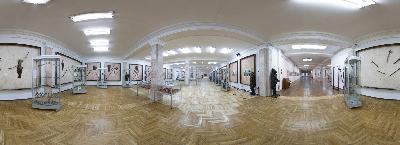
Virtual Tour


Events Archive

MEMORY PELOTONE 2025

Chisinau, August 30, 2025
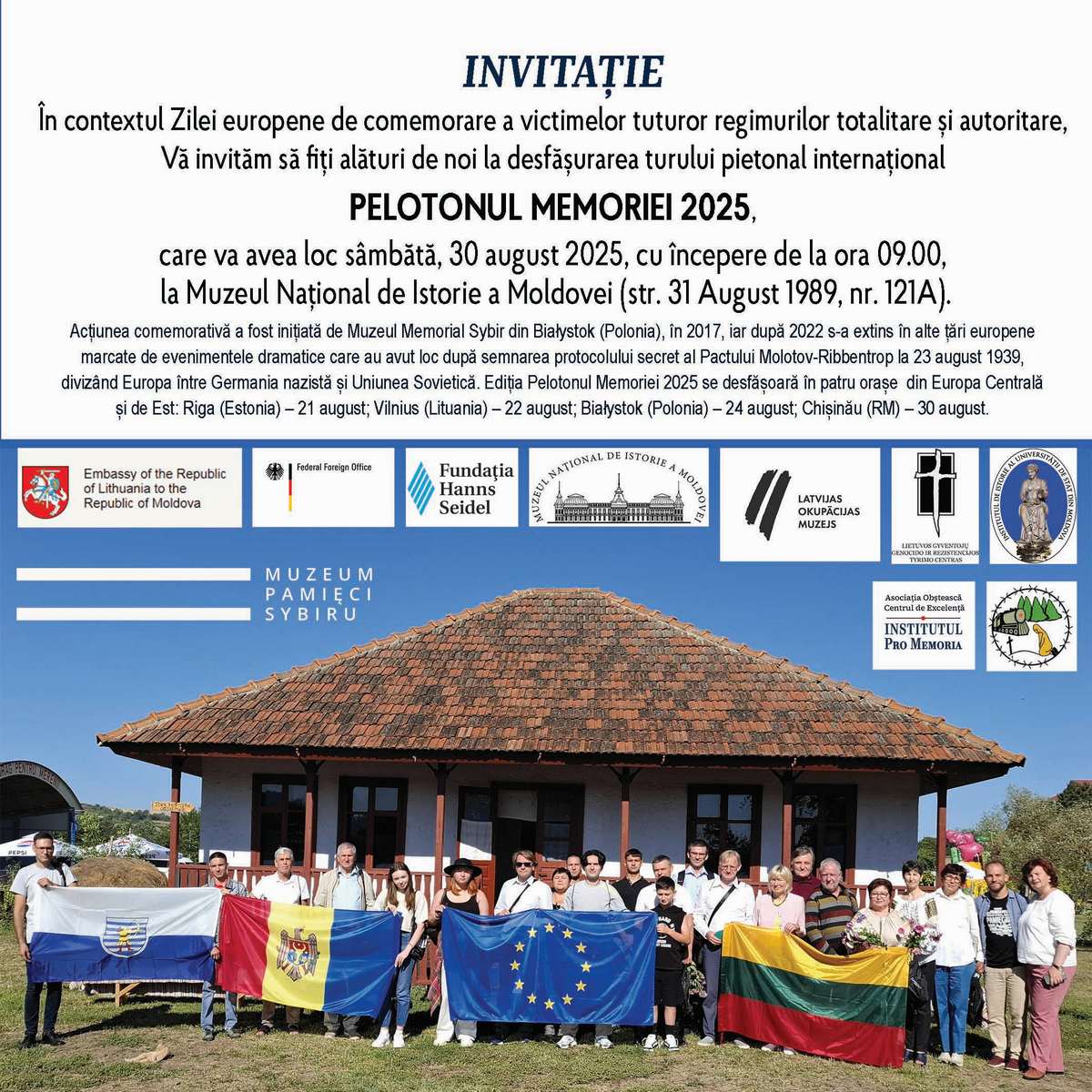
In the context of the European Day of Commemoration of the Victims of All Totalitarian and Authoritarian Regimes, we invite you to join us for the international walking tour MEMORY PELOTONE, which will take place on Saturday, August 30, 2025, starting at 09:00, at the National Museum of History of Moldova (31 August 1989 Street, No. 121A).

The commemorative action was initiated by the Sybir Memorial Museum in Białystok (Poland) in 2017, and after 2022 it expanded to other European countries marked by the dramatic events that took place after the signing of the secret protocol of the Molotov-Ribbentrop Pact on August 23, 1939, dividing Europe between Nazi Germany and the Soviet Union. "The goal of the Peloton is to share history with future generations, as well as with people from other continents who may not know this history," says the director of the Sybir Memorial Museum, Prof. Wojciech Śleszyński. "We want the memory of Siberia, Katyn and the deportations to be transmitted beyond the borders of Poland and Europe."

In Chisinau, the route will include places of memory marked by the atrocities of the totalitarian regime. Participants will have the opportunity to listen to stories and learn testimonies about the victims, but also about those who showed resistance. Evoking their memory and deeds, the action takes the form of a "living history lesson", where memory is intertwined with collective experience.

On August 29, the day before the Chisinau edition of the Peloton, the traveling exhibition "Sybir - the prison of nations" will be presented to the larger public at the National Museum of History of Moldova. It was developed by the Sybir Memorial Museum, in cooperation with the Embassy of the Republic of Poland in Chisinau and the National History Museum of Moldova.

The 2025 edition of the Memorial Peloton takes place in four cities in Central and Eastern Europe: Riga (Estonia) - August 21; Vilnius (Lithuania) - August 22; Białystok (Poland) - August 24; Chisinau (RM) - August 30. Guests from Poland and Lithuania will be present at the walking tour in Chisinau, who will walk the route with us.

In the Republic of Moldova, the Memory Peloton took place for the first time in 2024, at the Open Air Museum in Mereni, being the final event of last year's international action. This year's edition, together with the accompanying exhibition, remains an open invitation to reflect together on the history of the 20th century and the tragic events in Central and Eastern Europe.

We look forward to seeing you!

Organizers and partners:

- National Museum of History of Moldova
- Embassy of the Republic of Lithuania to the Republic of Moldova
- Hanns Seidel Foundation - Republic of Moldova
- Sybir Memorial Museum in Białystok (Poland)
- The Genocide and Resistance Research Centre (Lithuania)
- Museum of the Occupation of Latvia (Latvia)
- Institute of History of the Moldova State University
- Public Association Institute Pro Memoria
- Association of Former Deportees and Political Prisoners of Moldova


Independent Moldova
Moldavian Soviet Socialist Republic
Bessarabia and MASSR between the Two World Wars
Bessarabia and Moldavian Autonomous Soviet Socialist Republic in the Period between the Two World Wars
Revival of National Movement
Time of Reforms and their Consequences
Abolition of Autonomy. Bessarabia – a New Tsarist Colony
Period of Relative Autonomy of Bessarabia within the Russian Empire
Phanariot Regime
Golden Age of the Romanian Culture
Struggle for Maintaining of Independence of Moldova
Formation of Independent Medieval State of Moldova
Era of the
Great Nomad Migrations
Early Middle Ages
Iron Age and Antiquity
Bronze Age
Aeneolithic Age
Neolithic Age
Palaeolithic Age


Come to Museum! Discover the History!
  
Visit museum
Visit museum
Summer schedule: daily
10am – 6pm.

Winter schedule: daily
10am – 5pm.
Closed on Mondays.
Entrance fees:  adults - 50 MDL, Pensioners, students - 20 lei, pupils - 10 MDL. Free access: enlisted men (...)

WiFi Free Wi-Fi Zone in the museum: In the courtyard of the National History Museum of Moldova there is Wi-Fi Internet access for visitors.


#Exhibit of the Month

Around thirty icons from the collection of the National Museum of History of Moldova feature Saint Nicholas the Hierarch and Miracle Worker. While most represent the later iconographic tradition, a few early images stand out as rare examples due to their composition...

Read More >>


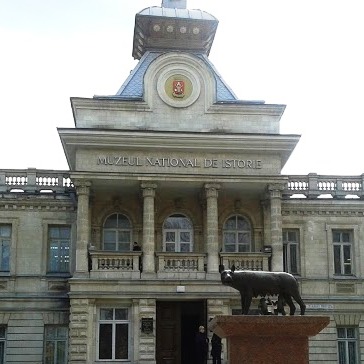
The National Museum of History of Moldova takes place among the most significant museum institutions of the Republic of Moldova, in terms of both its collection and scientific reputation.
©2006-2026 National Museum of History of Moldova
Visit museum 31 August 1989 St., 121 A, MD 2012, Chisinau, Republic of Moldova
Phones:
Secretariat: +373 (22) 24-43-25
Department of Public Relations and Museum Education: +373 (22) 24-04-26
Fax: +373 (22) 24-43-69
E-mail: office@nationalmuseum.md
Technical Support: info@nationalmuseum.md
Web site administration and maintenance: Andrei EMILCIUC


The National Museum of History of Moldova takes place among the most significant museum institutions of the Republic of Moldova, in terms of both its collection and scientific reputation.
©2006-2026 National Museum of History of Moldova
Visit museum 31 August 1989 St., 121 A, MD 2012, Chisinau, Republic of Moldova
Phones:
Secretariat: +373 (22) 24-43-25
Department of Public Relations and Museum Education: +373 (22) 24-04-26
Fax: +373 (22) 24-43-69
E-mail: office@nationalmuseum.md
Technical Support: info@nationalmuseum.md
Web site administration and maintenance: Andrei EMILCIUC

menu
The National Museum of History of Moldova takes place among the most significant museum institutions of the Republic of Moldova, in terms of both its collection and scientific reputation.
©2006-2026 National Museum of History of Moldova
Visit museum 31 August 1989 St., 121 A, MD 2012, Chisinau, Republic of Moldova
Phones:
Secretariat: +373 (22) 24-43-25
Department of Public Relations and Museum Education: +373 (22) 24-04-26
Fax: +373 (22) 24-43-69
E-mail: office@nationalmuseum.md
Technical Support: info@nationalmuseum.md
Web site administration and maintenance: Andrei EMILCIUC