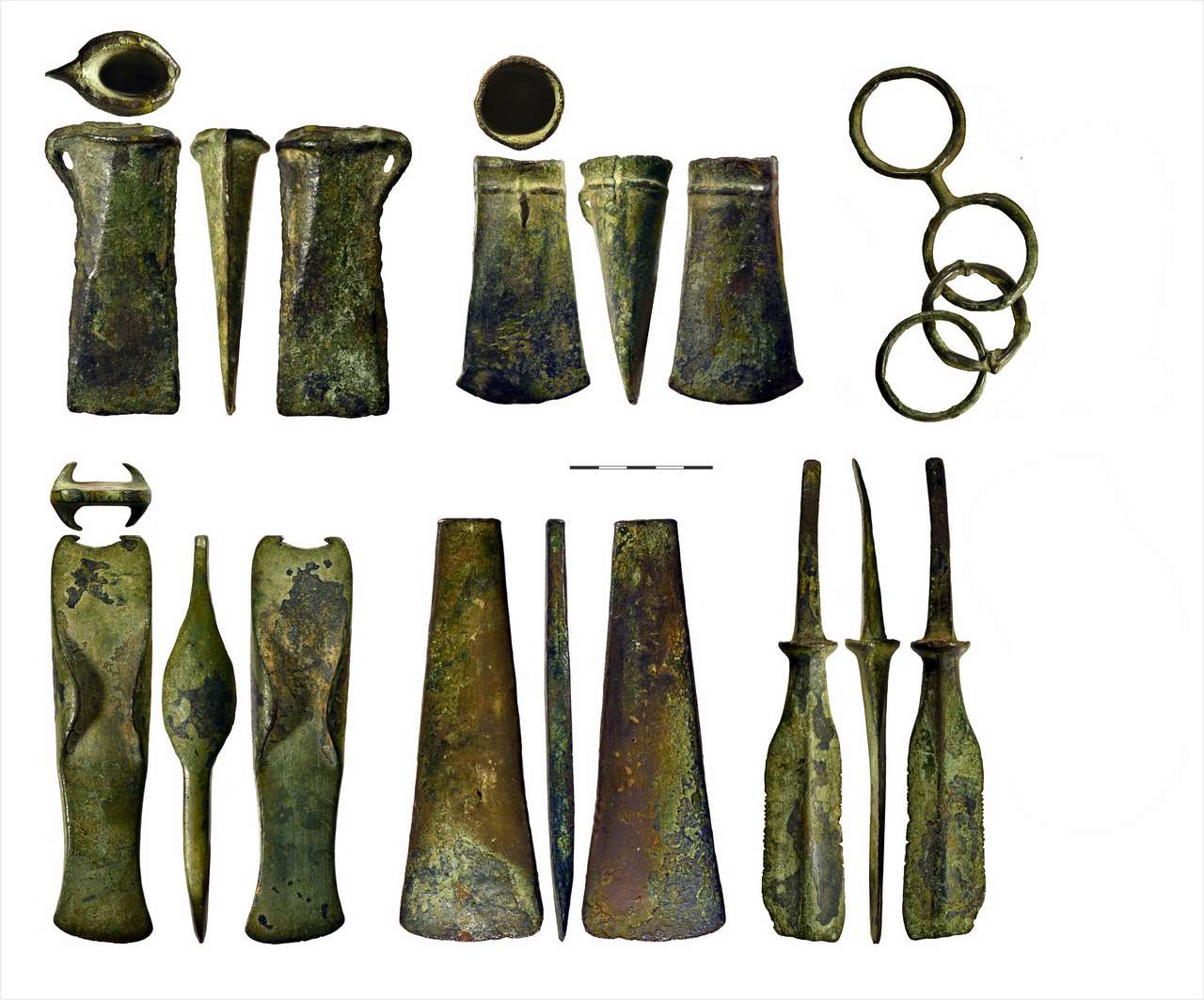
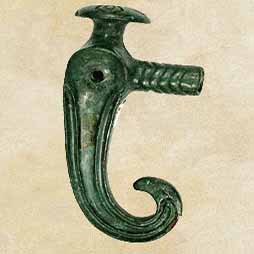
The bronze hoard was discovered on the territory of Mîndrești village, Telenești district, in 1968. It was identified accidentally by a group of students from the village school, and the materials later came to the attention of specialists at the Institute of History of the Academy of Sciences. According to documentary records, the hoard was composed of ten pieces: four socketed axes (celts), a dagger fragment, a sword fragment, a sickle, a winged axe, an adze-axe, and a chain consisting of four links. Currently, of the mentioned assemblage, six objects are preserved in the collections of the National Museum of History of Moldova: two socketed axes (celts), the winged axe, the adze-axe, the dagger fragment, and the chain made of four links.- Socketed axe (celt) with one loop. Dimensions: Length - 10.2 cm; Weight - 186 g. - Socketed axe (celt) with one frontal loop. Dimensions: Length - 8.4 cm; Width: 33-46 mm; Weight - 124 g. - Winged axe. Dimensions: Length - 14.0 cm; Width - 2.5-3.4 cm; Weight - 285 g. - Adze-axe. Dimensions: Length - 14.8 cm; Width - 2.3-5.0 cm; Weight - 286 g. - Dagger fragment. Dimensions: Length - 16.5 cm; Blade length - 9.8 cm; Blade width - 2.8 cm; Weight - 81 g. - Chain formed of four links. Dimensions: Length - 17.1 cm; Link diameter - 3.8; Weight - 32 g.The bronze hoard of Mîndrești is important due to the association of objects that find analogies in the regional repertoire with pieces that show clear analogies in Central Europe and the Carpathian Basin. The assemblage reflects a zone of contact and interaction where metallic forms of different origins and traditions circulated and were integrated into the repertoire of local communities. Chronologically, the bronze hoard of Mîndrești is attributed to the Early Hallstatt period - HaA1, being dated to 1200-1100 BC.
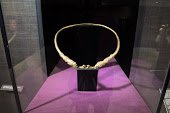
Exhibition “Byzantium through the Centuries” at the State Hermitage Museum, St Petersburg
Tyragetia, serie nouă, vol. XI [XXVI], nr. 1, Arheologie. Istorie Antică
Михаил Веревкин, Юрий Пятницкий
On the Issues of the Technical Examination of Oriental Silver in the Collection of the State Hermitage Museum
Tyragetia, serie nouă, vol. XII [XXVII], nr. 1, Arheologie. Istorie Antică
Юрий Пятницкий
Е.И. Арсентьева, О.В. Горская, Античные ювелирные изделия из частных собраний. Кольца и перстни. Каталог коллекции. Государственный Эрмитаж. Санкт-Петербург: Издательство Государственного Эрмитажа, 2019, 196 стр., ил., ISBN: 9785935728779
Tyragetia, serie nouă, vol. XVI [XXXI], nr. 1, Arheologie. Istorie Antică, Chişinău, 2022
Юрий Пятницкий
Georgian Art in the Hermitage Museum: the History and Study of the Collection
Tyragetia, serie nouă, vol. XIV [XXIX], nr. 2, Istorie. Muzeologie
The bronze hoard was discovered on the territory of Mîndrești village, Telenești district, in 1968. It was identified accidentally by a group of students from the village school, and the materials later came to the attention of specialists at the Institute of History of the Academy of Sciences...
The National Museum of History of Moldova takes place among the most significant museum institutions of the Republic of Moldova, in terms of both its collection and scientific reputation.
The National Museum of History of Moldova takes place among the most significant museum institutions of the Republic of Moldova, in terms of both its collection and scientific reputation.
The National Museum of History of Moldova takes place among the most significant museum institutions of the Republic of Moldova, in terms of both its collection and scientific reputation.




















 31 August 1989 St., 121 A, MD 2012, Chisinau, Republic of Moldova