EN RO


#Exhibit of the Month

>>>

We find ourselves in the month of April, as we prepare to celebrate Easter-a moveable religious holiday rich in festive rituals and ceremonial activities that place this event at the very heart of Christian spiritual life. The spirit of the Resurrection is beautifully complemented by ten Easter-themed postcards from the heritage of the National Museum of History of Moldova, printed a century ago. These pieces were added to the museum's postcard collection over a decade ago following a successful acquisition; as the fund for Easter-themed illustrations is modest, we are in a constant search for new additions.

These postcards are "extraordinary" in terms of their postal, typographical, and chromatic effects-the primary reason for revisiting this genre of greetings. Unlike "classic" postcards, these are smaller in size (6.5 cm x 11 cm), made of cardboard (with the exception of one piece made of photographic paper in black and white), and feature "vivid" colors. Printed in Romania and Germany, they bear the marks of having been sent and circulated through the post.

The name of the holiday originates from the verb persach, meaning "to pass," a term adopted by the Jews from the Egyptians. It entered the Romanian language through the Byzantine-Latin form Paschae, signifying the "passage through death to life, the victory of life, and liberation from the bondage of sin." Easter is a holiday of tolerance and forgiveness, representing a bridge between the present and the past. The significance of this celebration is conveyed through its symbols, which are also featured on these postcards: Hand-painted eggs, the Easter Bunny and the Lamb, traditional sweet breads (cozonac and pască), biblical scenes related to the crucifixion and resurrection of Jesus Christ.

The Easter table also features pască-a ritual food reminiscent of ancient, bloodless "reconciliation" sacrifices. Its preparation is the exclusive task of women, the givers of life, as the leavened dough is considered "alive."

The most significant component of the Easter holiday, however, is the Light. The Ceremony of the Holy Light is associated with the miracle of the light appearing on Easter Sunday at Christ's Tomb in Jerusalem. The candle, often depicted in these images, carries a powerful message; it is with the Resurrection candle that we return home after the midnight religious service. Furthermore, the Easter Bunny represents the rebirth of nature, so eagerly awaited after a harsh winter.

Unlike Christmas, when the announcement and ritual integration of the community into sacred time was the duty of caroling groups, at Easter, "one does not go from house to house." Instead, the ritual meal is organized within each family, symbolizing a direct communion with God.


Virtual Tour


Publications Journal „Tyragetia"


Tyragetia, serie nouă, vol. XIV [XXIX], nr. 2, Istorie. Muzeologie
ISSN 1857-0240
E-ISSN 2537-6330

Tyragetia, serie nouă, vol. XIV [XXIX], nr. 2, Istorie. Muzeologie

Chişinău, 2020

Researchers


Raimonda Ragauskienė
The Evangelical Environment of Voivode of Vilnius Mikolaj the Black Radziwill (1515-1565) during Iacob’s Heraclid vizite in Vilnius

Lilia Zabolotnaia
The bounds of the private in the life of Antiochus Cantemir: Myths, speculations and realness regarding his secret family in Paris

Aurelia Corneţchi
Digital technologies: a modern way to preserve and promote museum collections

Papers and surveys


Надежда Нижник
Marriage union: a variety of ways to create it in the Old Russian state

Vazha Kiknadze
East-West cultural dialogue in Georgia during the Queen Tamar’s Reign

Şarolta Solcan
Witchcraft at Romanians: Documents of witchcraft trials in Transylvania of the 16th-17th centuries)

Costin Croitoru
Contributions to the history of the Romanian vocabulary: names of Polish coins that circulated in Moldova. II. Poltorac / Polturac / Potor

Александр Пономарёв
The Wallachian family of Corbea (Korbe) in Ukraine-Hetmanate in the 18th century

Игорь Сапожников
Isaccea and ferry across the Danube in the 1770s - 1870s according to cartography and iconography

Valentin Tomuleţ
The social status of Bessarabian boierinaşi in the first half of the 19th century

Игорь Сапожников, Майя Кашуба
German names of the burial mounds of Budjak in the 19th and first half of 20th century

Andrei Emilciuc
Representatives of Bessarabia at commodity exhibitions in the Russian Empire and in Western Europe (1829-1869)

Viorel Bolduma
Emigration of the population from Bassarabia to the Caucasus, the Crimea and the Northern Black Sea Region (1870s-1890s)

Francis Conte
Les «parisiennes d’Odessa» et l’art de l’émigration russe en France (autournant du XXe siècle)

Marius Tărîţă
The wine industry of Besarabia as reflected in Polish consular reports (1924-1931)

Nicolae Fuştei
Moscow – Orthodox Vatican: a failed project

Elena Postică
The famine of 1946-1947 from Moldova in official documents and testimonies of survivors

Liliana Rotaru
“I think there is only one language!” Linguistic contradictions in the Chişinău Pedagogical Institute)

Marcel Revenco
Foreign trade relations of the Republic of Moldova: historiographic aspects

Gherghina Boda
Exhibitions as they appear in the press of the time (1902-1905)

Elena Ploşniţa
The system of legislative acts on cultural institutions of Romania after the Great Unification. Museum aspects

Vera Serjant
The legacy of Vasile Stroescu

Anatolie Povestca
Firearms from the collection of the National Museum of History of Moldova

Vera Stăvilă
Post-war social poster as a means of public information (from the collections of the National Museum of History of Moldova)

Юрий Пятницкий
Georgian Art in the Hermitage Museum: the History and Study of the Collection

Adelaida Chiroşca
Multi-part icons in the collection of the National Museum of History of Moldova. Visual hagiography

Ana Griţco
Imprinted stamps and postal pieces dedicated to the National Day of the Romanian Language

Lucia Marinescu-Tonu
Techniques for interpreting cultural heritage in the provinces of Trento and Ferrara

Silviu Andrieş-Tabac
Rural heraldic symbols adopted in the Republic of Moldova in 2017-2018

Recenzii şi prezentări de carte


Anatol Povestca
Anatol Petrencu, Rusia, 2019: „acesta a fost un an greu...” [“это был тяжелый год...”]. Chişinău: Balacron, 2020, 296 p., ISBN:978-9975-66-689-3

In memoriam


Aurelia Corneţchi
Un maestru al cuvintelor. În amintirea lingvistului Vlad Pohilă

In memoriam Evgheni Gansinskii

Adelaida Chiroşca
O lumânare aprinsă pentru Iurie Caminschi


Independent Moldova
Moldavian Soviet Socialist Republic
Bessarabia and MASSR between the Two World Wars
Bessarabia and Moldavian Autonomous Soviet Socialist Republic in the Period between the Two World Wars
Revival of National Movement
Time of Reforms and their Consequences
Abolition of Autonomy. Bessarabia – a New Tsarist Colony
Period of Relative Autonomy of Bessarabia within the Russian Empire
Phanariot Regime
Golden Age of the Romanian Culture
Struggle for Maintaining of Independence of Moldova
Formation of Independent Medieval State of Moldova
Era of the
Great Nomad Migrations
Early Middle Ages
Iron Age and Antiquity
Bronze Age
Aeneolithic Age
Neolithic Age
Palaeolithic Age


Come to Museum! Discover the History!
  
Visit museum
Visit museum
Summer schedule: daily
10am – 6pm.

Winter schedule: daily
10am – 5pm.
Closed on Mondays.
Entrance fees:  adults - 50 MDL, Pensioners, students - 20 lei, pupils - 10 MDL. Free access: enlisted men (...)

WiFi Free Wi-Fi Zone in the museum: In the courtyard of the National History Museum of Moldova there is Wi-Fi Internet access for visitors.


#Exhibit of the Month

We find ourselves in the month of April, as we prepare to celebrate Easter-a moveable religious holiday rich in festive rituals and ceremonial activities that place this event at the very heart of Christian spiritual life...

Read More >>


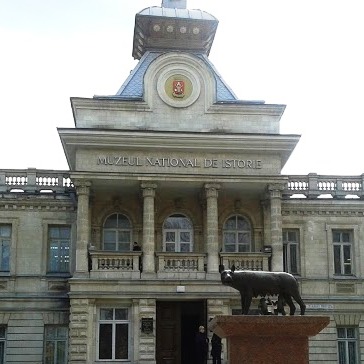
The National Museum of History of Moldova takes place among the most significant museum institutions of the Republic of Moldova, in terms of both its collection and scientific reputation.
©2006-2026 National Museum of History of Moldova
Visit museum 31 August 1989 St., 121 A, MD 2012, Chisinau, Republic of Moldova
Phones:
Secretariat: +373 (22) 24-43-25
Department of Public Relations and Museum Education: +373 (22) 24-04-26
Fax: +373 (22) 24-43-69
E-mail: office@nationalmuseum.md
Technical Support: info@nationalmuseum.md
Web site administration and maintenance: Andrei EMILCIUC


The National Museum of History of Moldova takes place among the most significant museum institutions of the Republic of Moldova, in terms of both its collection and scientific reputation.
©2006-2026 National Museum of History of Moldova
Visit museum 31 August 1989 St., 121 A, MD 2012, Chisinau, Republic of Moldova
Phones:
Secretariat: +373 (22) 24-43-25
Department of Public Relations and Museum Education: +373 (22) 24-04-26
Fax: +373 (22) 24-43-69
E-mail: office@nationalmuseum.md
Technical Support: info@nationalmuseum.md
Web site administration and maintenance: Andrei EMILCIUC

menu
The National Museum of History of Moldova takes place among the most significant museum institutions of the Republic of Moldova, in terms of both its collection and scientific reputation.
©2006-2026 National Museum of History of Moldova
Visit museum 31 August 1989 St., 121 A, MD 2012, Chisinau, Republic of Moldova
Phones:
Secretariat: +373 (22) 24-43-25
Department of Public Relations and Museum Education: +373 (22) 24-04-26
Fax: +373 (22) 24-43-69
E-mail: office@nationalmuseum.md
Technical Support: info@nationalmuseum.md
Web site administration and maintenance: Andrei EMILCIUC