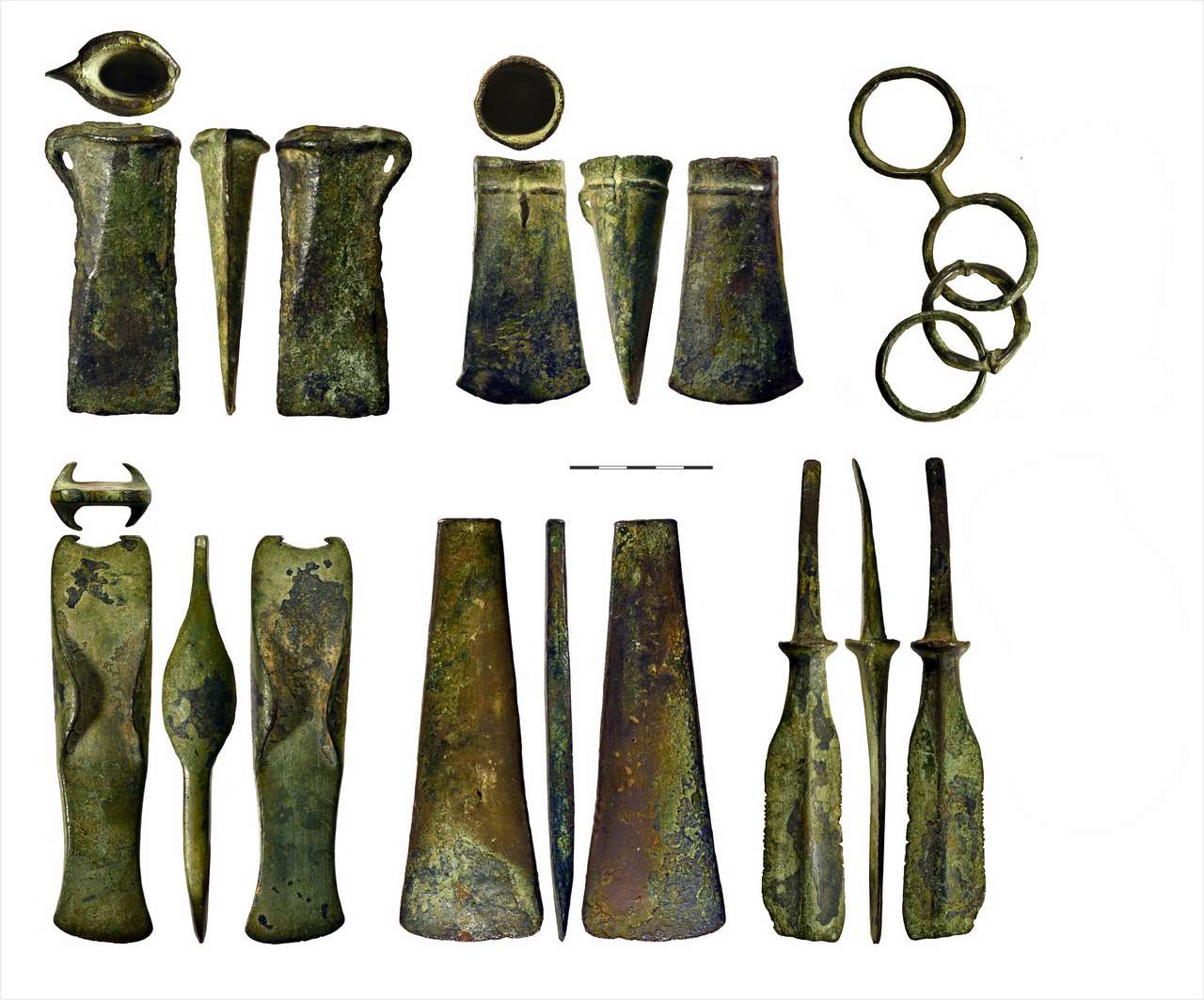
The bronze hoard was discovered on the territory of Mîndrești village, Telenești district, in 1968. It was identified accidentally by a group of students from the village school, and the materials later came to the attention of specialists at the Institute of History of the Academy of Sciences. According to documentary records, the hoard was composed of ten pieces: four socketed axes (celts), a dagger fragment, a sword fragment, a sickle, a winged axe, an adze-axe, and a chain consisting of four links. Currently, of the mentioned assemblage, six objects are preserved in the collections of the National Museum of History of Moldova: two socketed axes (celts), the winged axe, the adze-axe, the dagger fragment, and the chain made of four links.- Socketed axe (celt) with one loop. Dimensions: Length - 10.2 cm; Weight - 186 g. - Socketed axe (celt) with one frontal loop. Dimensions: Length - 8.4 cm; Width: 33-46 mm; Weight - 124 g. - Winged axe. Dimensions: Length - 14.0 cm; Width - 2.5-3.4 cm; Weight - 285 g. - Adze-axe. Dimensions: Length - 14.8 cm; Width - 2.3-5.0 cm; Weight - 286 g. - Dagger fragment. Dimensions: Length - 16.5 cm; Blade length - 9.8 cm; Blade width - 2.8 cm; Weight - 81 g. - Chain formed of four links. Dimensions: Length - 17.1 cm; Link diameter - 3.8; Weight - 32 g.The bronze hoard of Mîndrești is important due to the association of objects that find analogies in the regional repertoire with pieces that show clear analogies in Central Europe and the Carpathian Basin. The assemblage reflects a zone of contact and interaction where metallic forms of different origins and traditions circulated and were integrated into the repertoire of local communities. Chronologically, the bronze hoard of Mîndrești is attributed to the Early Hallstatt period - HaA1, being dated to 1200-1100 BC.
Zabolotnaia Lilia, Dreptul la proprietate și la moștenire al femeilor din Moldova și țările vecine (secolele XIV-XVII). Studii și documente. Istoria la feminin. Chișinău: Cardidact, 2015, 351 p. ISBN 978-9975-9609-7-7
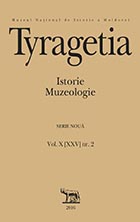
Tyragetia, serie nouă, vol. X [XXV], nr. 2, Istorie. Muzeologie
Вячеслав Степанов
История жизни Марии Кантемир в письмах и документах, автор-составитель Лилия Заболотная. Кишинэу: «Lexon Prim», 2018, 270 с. ISBN 978-9975-139-44-1
Tyragetia, serie nouă, vol. XII [XXVII], nr. 2, Istorie. Muzeologie
Вячеслав Степанов
Лилия Заболотная / Lilia Zabolotnaia, Известная и неизвестная история жизни дочерей Дмитрия Кантемира: Мария Кантемир и Екатерина-Смарагда Голицына (сборник статей, документов и иллюстраций) / The known and unknown life story of the daughters of Dimitrie Cantemir: Maria Cantemir and Ekaterina-Smaragda Golitsyna: (Collection of articles, documents and illustrations). Chişinău: Cardidact, 2020, 664 p. ISBN 978-9975-3469-7-9
Tyragetia, serie nouă, vol. XVI [XXXI], nr. 2, Istorie. Muzeologie
Вячеслав Степанов
Romani studies in Bessarabia of the 19th century - early 20th century. Origin and dynamics
Tyragetia, serie nouă, vol. XVI [XXXI], nr. 2, Istorie. Muzeologie
The bronze hoard was discovered on the territory of Mîndrești village, Telenești district, in 1968. It was identified accidentally by a group of students from the village school, and the materials later came to the attention of specialists at the Institute of History of the Academy of Sciences...
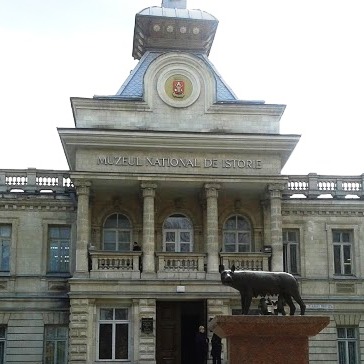
The National Museum of History of Moldova takes place among the most significant museum institutions of the Republic of Moldova, in terms of both its collection and scientific reputation.
The National Museum of History of Moldova takes place among the most significant museum institutions of the Republic of Moldova, in terms of both its collection and scientific reputation.
The National Museum of History of Moldova takes place among the most significant museum institutions of the Republic of Moldova, in terms of both its collection and scientific reputation.




















 31 August 1989 St., 121 A, MD 2012, Chisinau, Republic of Moldova