EN RO


#Exhibit of the Month

>>>

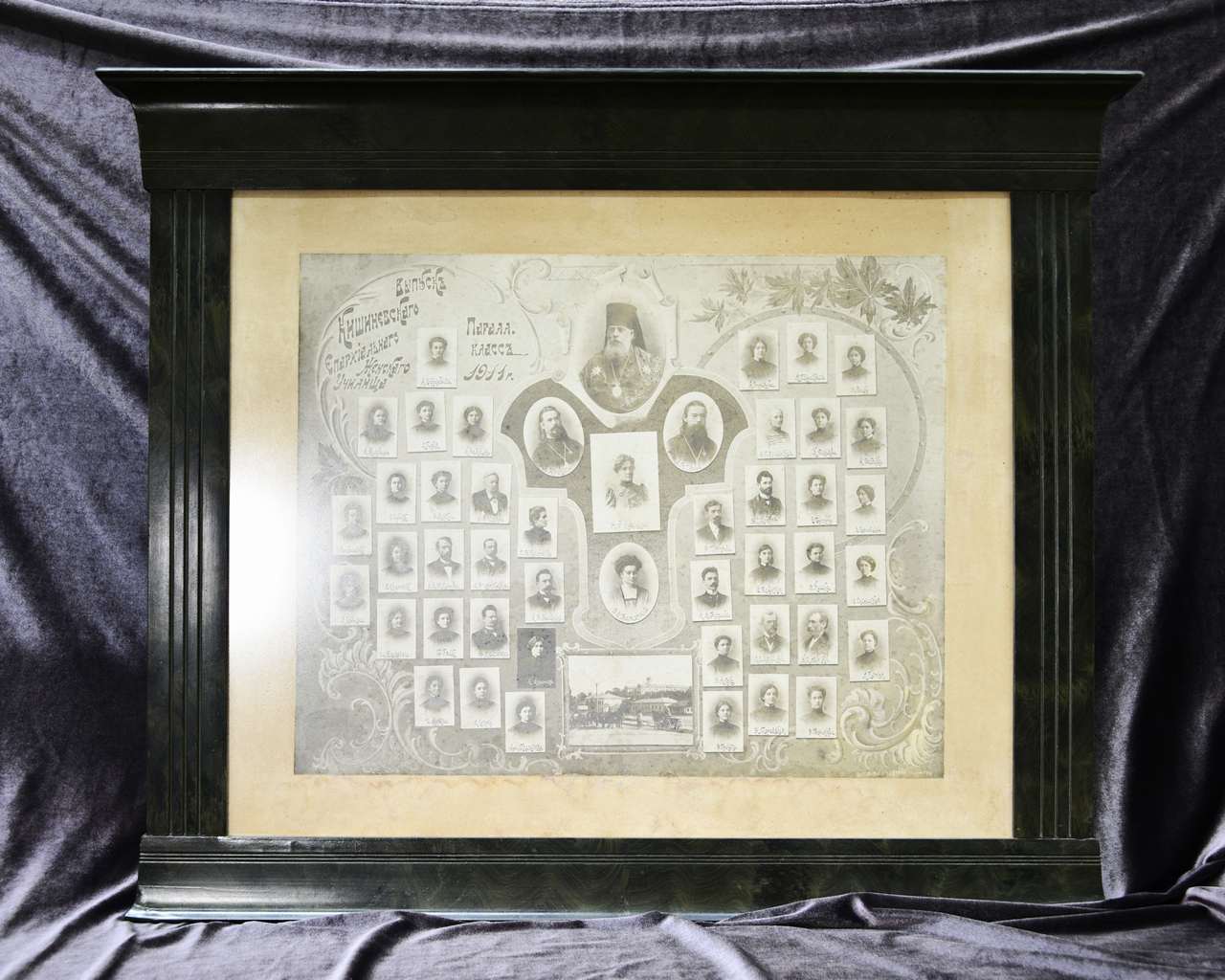
The Chișinău Diocesan Girls' School opened its doors on May 3, 1864, addressing a pressing need: in Bessarabia there were no institutions dedicated to the education of clergy's daughters. According to the 1864 circular, teaching was conducted in the Romanian language, a provision applied throughout the diocese. The school's first headmistress was Anastasia Rizo, of noble origin, invited by Archbishop Antonie.

The curriculum, approved by the Ministry of Public Education and the Chișinău Diocese, combined theoretical subjects with practical training. Students studied religion, reading and writing in Romanian, Slavonic, and Russian, arithmetic and exercises in calculation, world history and geography. The program was complemented by church singing and practical skills such as sewing, embroidery, knitting, as well as household management - baking bread and prosphora, preparing meals and preserves, caring for livestock, and cultivating gardens.

The composite, taken in 1911 at the studio of Z. N. Sumovski in Chișinău, depicts 29 graduates and 13 teachers. At the center are portraits of Bishop Serafim (Ciciagov), headmistress N. R. Mihelson, teacher V. E. Bejerian, and priests F. Ghiliarov and P. Jurikas. Among the teaching staff was Paraskovia Vasilievna Cuciurenko, a calligraphy teacher for 37 years, who in 1911 became senior educator and assistant headmistress. For her dedication, she was awarded the gold medal "For Long Service."

On the reverse of the vignette is a label from the store and workshop of frames, paintings, mirrors, and window glass owned by A. D. Kon'gova, Chișinău, Gogol Street no. 37, near the State Bank.

This graduation composite was donated at the end of 2025 to the National Museum of History of Moldova by the Dadiștian family from Drochia.


Virtual Tour


#Exhibit of the Month

December 2024

Fabergé Ladle
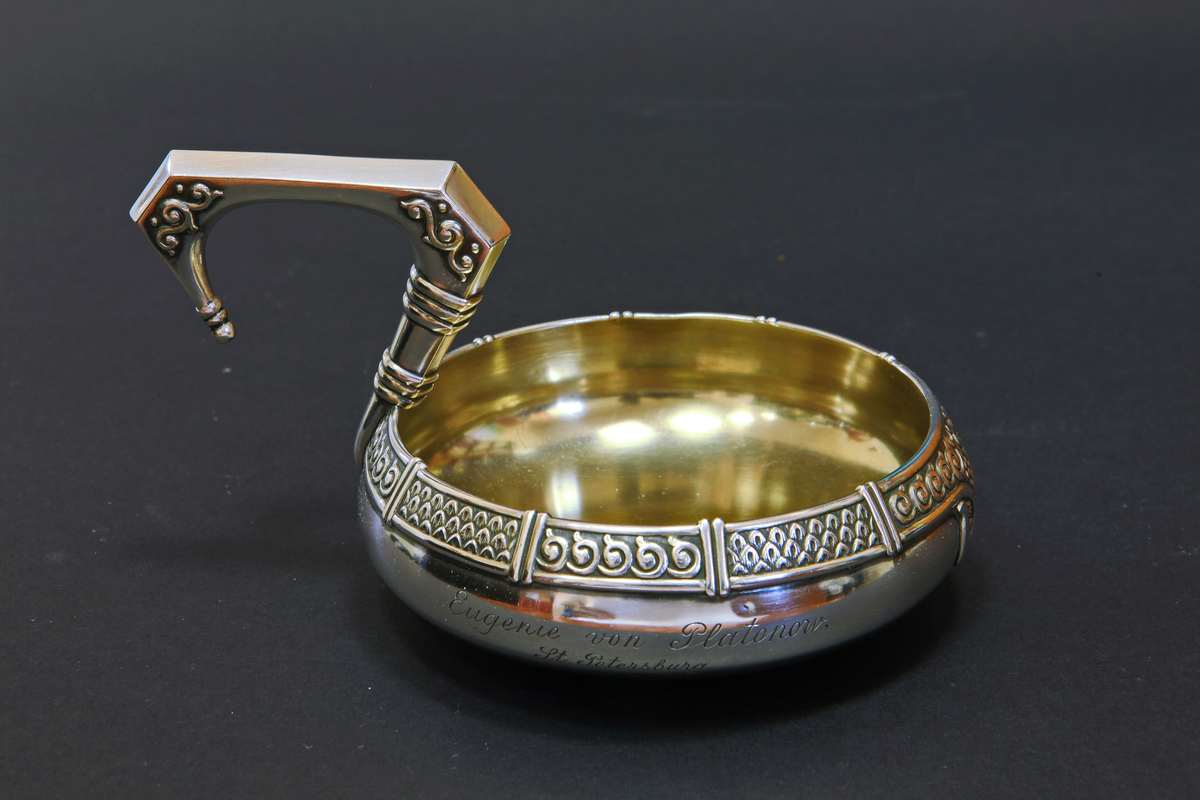
In the dazzling world of precious stones and noble metals, certain jewelers stand out, mastering the art of harmonizing understated elegance with absolute refinement, genius with design, and sophistication with eternal, unforgettable splendor.

The name Fabergé, emblematic of originality and synonymous with the creations of a legendary house, has left an indelible mark on the history of jewelry and decorative arts. Renowned for uniting jewelry, artistic design, and utility into objets de luxe and objets de fantaisie, Fabergé's creations have always captivated with their exquisite craftsmanship. Fashioned from gold, silver, enamel, and precious stones, the pieces produced in Fabergé's workshops testify to exceptional virtuosity, marked by meticulous attention to detail and perfect material harmony. Even works inspired by earlier stylistic vocabularies bear the unmistakable mark of originality.

The National Museum of History of Moldova treasures a spectacular ladle, crafted in Fabergé's workshops in the late 19th century.

The Fabergé ladle is a curious blend of the "Russian style" and the "modern style." Made of solid silver, it features a circular, gold-plated bowl. Its raised, stylized handle (hook-shaped) is adorned with vegetal motifs, triple rings, and silver pearls. The rim is embellished with a wide band composed of rectangular medallions, decorated with spiral loops and stylized scales arranged alternately. The bowl is supported by four hemispherical feet. At the center, engraved inscriptions read: Eugenie von Platonow/St. Petersburg and ТОРГОВЫЙ ДОМЪ „АЛЕКСАНДРЪ"/1863/15/10/1913.

Research suggests that this ladle was commissioned by Alexander Trauberg, a first-guild merchant and owner of the "АЛЕКСАНДРЪ" Trading House located at Nevsky Boulevard 11, St. Petersburg. It was likely created to mark the 50th anniversary of his business in 1913.

The hallmark stamped on the base-Fabergé's K. ФАБЕРЖЕ logo surmounted by the Russian Empire's coat of arms, alongside the female profile in a kokoshnik within an oval frame, accompanied by the Greek letter Δ (delta) and the silver purity standard "88"-confirms that the piece was produced by Fabergé's Moscow branch.

The hypnotic charm of Fabergé's creations defined the aesthetic ideals of an era, embodying exuberance and refinement, crafted by a jeweler to kings and a king among jewelers.


Independent Moldova
Moldavian Soviet Socialist Republic
Bessarabia and MASSR between the Two World Wars
Bessarabia and Moldavian Autonomous Soviet Socialist Republic in the Period between the Two World Wars
Revival of National Movement
Time of Reforms and their Consequences
Abolition of Autonomy. Bessarabia – a New Tsarist Colony
Period of Relative Autonomy of Bessarabia within the Russian Empire
Phanariot Regime
Golden Age of the Romanian Culture
Struggle for Maintaining of Independence of Moldova
Formation of Independent Medieval State of Moldova
Era of the
Great Nomad Migrations
Early Middle Ages
Iron Age and Antiquity
Bronze Age
Aeneolithic Age
Neolithic Age
Palaeolithic Age


Come to Museum! Discover the History!
  
Visit museum
Visit museum
Summer schedule: daily
10am – 6pm.

Winter schedule: daily
10am – 5pm.
Closed on Mondays.
Entrance fees:  adults - 50 MDL, Pensioners, students - 20 lei, pupils - 10 MDL. Free access: enlisted men (...)

WiFi Free Wi-Fi Zone in the museum: In the courtyard of the National History Museum of Moldova there is Wi-Fi Internet access for visitors.


#Exhibit of the Month

The Chișinău Diocesan Girls' School opened its doors on May 3, 1864, addressing a pressing need: in Bessarabia there were no institutions dedicated to the education of clergy's daughters...

Read More >>


The National Museum of History of Moldova takes place among the most significant museum institutions of the Republic of Moldova, in terms of both its collection and scientific reputation.
©2006-2026 National Museum of History of Moldova
Visit museum 31 August 1989 St., 121 A, MD 2012, Chisinau, Republic of Moldova
Phones:
Secretariat: +373 (22) 24-43-25
Department of Public Relations and Museum Education: +373 (22) 24-04-26
Fax: +373 (22) 24-43-69
E-mail: office@nationalmuseum.md
Technical Support: info@nationalmuseum.md
Web site administration and maintenance: Andrei EMILCIUC


The National Museum of History of Moldova takes place among the most significant museum institutions of the Republic of Moldova, in terms of both its collection and scientific reputation.
©2006-2026 National Museum of History of Moldova
Visit museum 31 August 1989 St., 121 A, MD 2012, Chisinau, Republic of Moldova
Phones:
Secretariat: +373 (22) 24-43-25
Department of Public Relations and Museum Education: +373 (22) 24-04-26
Fax: +373 (22) 24-43-69
E-mail: office@nationalmuseum.md
Technical Support: info@nationalmuseum.md
Web site administration and maintenance: Andrei EMILCIUC

menu
The National Museum of History of Moldova takes place among the most significant museum institutions of the Republic of Moldova, in terms of both its collection and scientific reputation.
©2006-2026 National Museum of History of Moldova
Visit museum 31 August 1989 St., 121 A, MD 2012, Chisinau, Republic of Moldova
Phones:
Secretariat: +373 (22) 24-43-25
Department of Public Relations and Museum Education: +373 (22) 24-04-26
Fax: +373 (22) 24-43-69
E-mail: office@nationalmuseum.md
Technical Support: info@nationalmuseum.md
Web site administration and maintenance: Andrei EMILCIUC