EN RO


#Exhibit of the Month

>>>

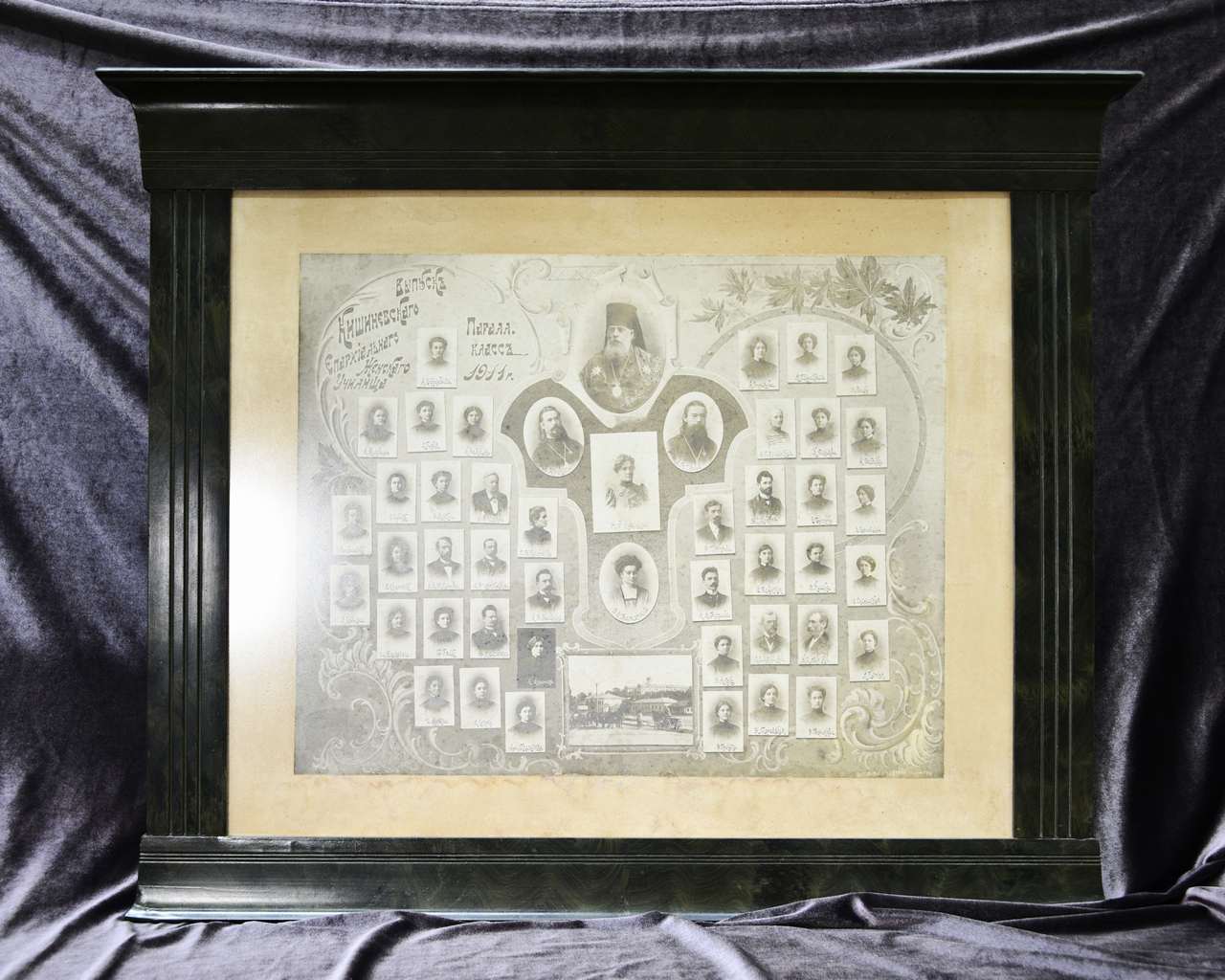
The Chișinău Diocesan Girls' School opened its doors on May 3, 1864, addressing a pressing need: in Bessarabia there were no institutions dedicated to the education of clergy's daughters. According to the 1864 circular, teaching was conducted in the Romanian language, a provision applied throughout the diocese. The school's first headmistress was Anastasia Rizo, of noble origin, invited by Archbishop Antonie.

The curriculum, approved by the Ministry of Public Education and the Chișinău Diocese, combined theoretical subjects with practical training. Students studied religion, reading and writing in Romanian, Slavonic, and Russian, arithmetic and exercises in calculation, world history and geography. The program was complemented by church singing and practical skills such as sewing, embroidery, knitting, as well as household management - baking bread and prosphora, preparing meals and preserves, caring for livestock, and cultivating gardens.

The composite, taken in 1911 at the studio of Z. N. Sumovski in Chișinău, depicts 29 graduates and 13 teachers. At the center are portraits of Bishop Serafim (Ciciagov), headmistress N. R. Mihelson, teacher V. E. Bejerian, and priests F. Ghiliarov and P. Jurikas. Among the teaching staff was Paraskovia Vasilievna Cuciurenko, a calligraphy teacher for 37 years, who in 1911 became senior educator and assistant headmistress. For her dedication, she was awarded the gold medal "For Long Service."

On the reverse of the vignette is a label from the store and workshop of frames, paintings, mirrors, and window glass owned by A. D. Kon'gova, Chișinău, Gogol Street no. 37, near the State Bank.

This graduation composite was donated at the end of 2025 to the National Museum of History of Moldova by the Dadiștian family from Drochia.


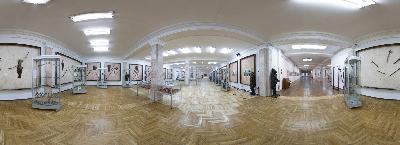
Virtual Tour


Events Archive

Europe Days at the National History Museum of Moldova

May 7-10, 2024

The National Museum of History of Moldova hosted a series of film screenings during the Europe Days celebration. The event, held between 7-10 May 2024, offered the audience the opportunity to explore various aspects of European culture and history through exceptional films.

During the four days, the Museum ran a varied selection of films, which captivated attention and stimulated cultural dialogue. Here are the featured titles:

May 7, 2024, 12:00 p.m. - "MALURI"

The documentary film "MALURI", provided by the EU program "Confidence-Building Measures", was an inspired starting point for the event. Produced by Telefilm Chisinau and directed by Lucia Tăut, this film brought together dozens of actors from both banks of the Prut and told the history of the villages of Rașcov and Vadul-Rașcov, which hosted the largest Jewish fair in Moldova. The documentary was awarded for "Best Documentary" and "Best Cinematography".
May 8, 2024, 12:00 p.m. - "A VILLAGE DEFENDS ITSELF"
A captivating drama offered by the Austrian Embassy in the Republic of Moldova, directed by Gabriela Zerhau, captured the last days of the Second World War. The film received the award for best televised film and told the courageous story of villagers who defied Gauleiter Eigruber's orders to destroy a salt mine that housed stolen art treasures.
May 8, 2024, 2 p.m. - "HALLSTATT - A LIFE BETWEEN THE ROCKS AND THE LAKE"
An exciting documentary film, also provided by the Austrian Embassy, presented the Austrian region of Hallstatt-Dachstein in a captivating light. Directed by Wolfgang Thaler, this film provided viewers with spectacular landscapes, crystal clear lakes and a foray into the fascinating history of the region.
May 10, 2024, 12:00 p.m. - "IN THE NAME OF THE EARTH"
The Polish Institute in Bucharest offered the audience an impressive historical drama, adapted from the novel "The Peasants" by Władysław Reymont. Directed by DK Welchman and Hugh Welchman, this animation-drama film gained attention through the story of the beautiful Jagna and her struggle for love and freedom in a community torn apart by feuds and land battles.


The event represented a wonderful opportunity to celebrate cultural diversity and highlight the close ties between the Republic of Moldova and European countries. The National History Museum of Moldova thanks its partners and participants for their support and involvement.


Independent Moldova
Moldavian Soviet Socialist Republic
Bessarabia and MASSR between the Two World Wars
Bessarabia and Moldavian Autonomous Soviet Socialist Republic in the Period between the Two World Wars
Revival of National Movement
Time of Reforms and their Consequences
Abolition of Autonomy. Bessarabia – a New Tsarist Colony
Period of Relative Autonomy of Bessarabia within the Russian Empire
Phanariot Regime
Golden Age of the Romanian Culture
Struggle for Maintaining of Independence of Moldova
Formation of Independent Medieval State of Moldova
Era of the
Great Nomad Migrations
Early Middle Ages
Iron Age and Antiquity
Bronze Age
Aeneolithic Age
Neolithic Age
Palaeolithic Age


Come to Museum! Discover the History!
  
Visit museum
Visit museum
Summer schedule: daily
10am – 6pm.

Winter schedule: daily
10am – 5pm.
Closed on Mondays.
Entrance fees:  adults - 50 MDL, Pensioners, students - 20 lei, pupils - 10 MDL. Free access: enlisted men (...)

WiFi Free Wi-Fi Zone in the museum: In the courtyard of the National History Museum of Moldova there is Wi-Fi Internet access for visitors.


#Exhibit of the Month

The Chișinău Diocesan Girls' School opened its doors on May 3, 1864, addressing a pressing need: in Bessarabia there were no institutions dedicated to the education of clergy's daughters...

Read More >>


The National Museum of History of Moldova takes place among the most significant museum institutions of the Republic of Moldova, in terms of both its collection and scientific reputation.
©2006-2026 National Museum of History of Moldova
Visit museum 31 August 1989 St., 121 A, MD 2012, Chisinau, Republic of Moldova
Phones:
Secretariat: +373 (22) 24-43-25
Department of Public Relations and Museum Education: +373 (22) 24-04-26
Fax: +373 (22) 24-43-69
E-mail: office@nationalmuseum.md
Technical Support: info@nationalmuseum.md
Web site administration and maintenance: Andrei EMILCIUC


The National Museum of History of Moldova takes place among the most significant museum institutions of the Republic of Moldova, in terms of both its collection and scientific reputation.
©2006-2026 National Museum of History of Moldova
Visit museum 31 August 1989 St., 121 A, MD 2012, Chisinau, Republic of Moldova
Phones:
Secretariat: +373 (22) 24-43-25
Department of Public Relations and Museum Education: +373 (22) 24-04-26
Fax: +373 (22) 24-43-69
E-mail: office@nationalmuseum.md
Technical Support: info@nationalmuseum.md
Web site administration and maintenance: Andrei EMILCIUC

menu
The National Museum of History of Moldova takes place among the most significant museum institutions of the Republic of Moldova, in terms of both its collection and scientific reputation.
©2006-2026 National Museum of History of Moldova
Visit museum 31 August 1989 St., 121 A, MD 2012, Chisinau, Republic of Moldova
Phones:
Secretariat: +373 (22) 24-43-25
Department of Public Relations and Museum Education: +373 (22) 24-04-26
Fax: +373 (22) 24-43-69
E-mail: office@nationalmuseum.md
Technical Support: info@nationalmuseum.md
Web site administration and maintenance: Andrei EMILCIUC