EN RO


#Exhibit of the Month

>>>

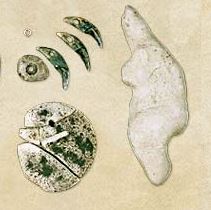
The exhibited necklace of beads originates from Funerary Complex No. 6 of Kurgan No. 4, excavated in 1982 by Dr. Habil. Eugen SAVA near the town of Taraclia. The beads were found in the chest area of the deceased, indicating that they had been worn as a necklace and had remained in their original position within the funerary assemblage.
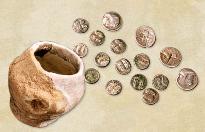
The necklace consists of 11 elements made entirely of Egyptian faience. Eight of the beads are spherical and decorated with vertical incisions forming between 14 and 21 raised ribs. Their diameters range from 13 to 20 mm. Two additional elements are scarab representations measuring 23.5 × 19.5 mm, while the final component is a flattened cylindrical pendant bead featuring a central vertical groove and measuring 22 × 9 mm. The objects range in color from light blue to dark blue and violet hues, reflecting the natural deterioration and glaze variations characteristic of Egyptian faience.
Egyptian faience is an artificial quartz-based material coated with an alkaline glaze, typically blue or blue-green in color. It was widely used in Ancient Egypt and later spread throughout the Mediterranean and Pontic regions through trade networks. During the first centuries AD, such objects served as important indicators of cultural and economic contacts between the Mediterranean world and the communities of the North Pontic region.
Owing to its typological, technological, and symbolic characteristics, the Taraclia necklace is an exceptionally valuable artifact for the study of intercultural relations, the circulation of prestige goods, and the funerary practices of the Sarmatian communities during the first centuries AD (1st-2nd centuries AD).

Virtual Tour


Events Archive

Museum Event "Restoring History from Shards"

September 26, 2024

The National Museum of History of Moldova celebrated the European Heritage Days on September 26, 2024, with the activity "Rebuilding History from Fragments." The event was organized by the Public Relations and Museum Education Department in collaboration with the Museum Restoration Department.

The activity was held for a group of students from "Mircea Eliade" Theoretical High School in Chisinau and focused on sharing knowledge and information with the younger generation, offering them the opportunity to better understand the importance of preserving national cultural heritage and the process of restoring artifacts.

The first part of the activity took place in the ceramics restoration laboratory, where museum specialists Mariana Guzun and Daniela Feroni enthusiastically discussed the specialized work carried out on various ceramic pieces, each with different levels of degradation. They explained how hundreds of fragments, which may seem worthless at first glance, can eventually be brought back to life as a well-preserved museum piece.

During the activity, the students had the opportunity to talk to restorer Anastasia Craev, who introduced them to various specialized techniques and discussed the importance of heritage preservation. She also touched on the topic of souvenirs, highlighting how they can contribute to promoting and understanding national history and culture in an international context. The students learned not only about the restoration process but also about the educational and cultural value of national heritage.

Through interactive and educational activities, participants were encouraged to appreciate local history and traditions, thus contributing to the formation of a deeper cultural awareness. Upon leaving, the students expressed enthusiasm and appreciation for the experience at the National Museum of History of Moldova. They emphasized how interesting and informative the activities were, noting that they learned a lot about the importance of preserving national cultural heritage and the process of restoring artifacts. Many of them mentioned that interacting with the museum restorers and specialists gave them a new perspective on history and universal culture, inspiring them to explore these fields further in the future.
This initiative reflects a successful model of integrating education and culture, having a significant impact on the perception of the younger generations towards national cultural heritage.


Independent Moldova
Moldavian Soviet Socialist Republic
Bessarabia and MASSR between the Two World Wars
Bessarabia and Moldavian Autonomous Soviet Socialist Republic in the Period between the Two World Wars
Revival of National Movement
Time of Reforms and their Consequences
Abolition of Autonomy. Bessarabia – a New Tsarist Colony
Period of Relative Autonomy of Bessarabia within the Russian Empire
Phanariot Regime
Golden Age of the Romanian Culture
Struggle for Maintaining of Independence of Moldova
Formation of Independent Medieval State of Moldova
Era of the
Great Nomad Migrations
Early Middle Ages
Iron Age and Antiquity
Bronze Age
Aeneolithic Age
Neolithic Age
Palaeolithic Age
  
September 25, 2025 – September 1, 2026
 
Over 2500 pieces made of precious metals with historic, artistic and symbolic value
  

Come to Museum! Discover the History!
  
Visit museum
Visit museum
Summer schedule: daily
10am – 6pm.

Winter schedule: daily
10am – 5pm.
Closed on Mondays.
Entrance fees:  adults - 50 MDL, Pensioners, students - 20 lei, pupils - 10 MDL. Free access: enlisted men (...)

WiFi Free Wi-Fi Zone in the museum: In the courtyard of the National History Museum of Moldova there is Wi-Fi Internet access for visitors.


#Exhibit of the Month

The exhibited necklace of beads originates from Funerary Complex No. 6 of Kurgan No. 4, excavated in 1982 by Dr. Habil. Eugen SAVA near the town of Taraclia. The beads were found in the chest area of the deceased, indicating that they had been worn as a necklace and had remained in their original position within the funerary assemblage...

Read More >>


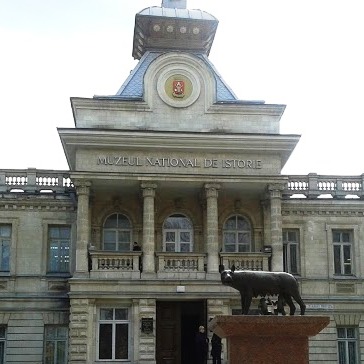
The National Museum of History of Moldova takes place among the most significant museum institutions of the Republic of Moldova, in terms of both its collection and scientific reputation.
©2006-2026 National Museum of History of Moldova
Visit museum 31 August 1989 St., 121 A, MD 2012, Chisinau, Republic of Moldova
Phones:
Secretariat: +373 (22) 24-43-25
Department of Public Relations and Museum Education: +373 (22) 24-04-26
Fax: +373 (22) 24-43-69
E-mail: office@nationalmuseum.md
Technical Support: info@nationalmuseum.md
Web site administration and maintenance: Andrei EMILCIUC


The National Museum of History of Moldova takes place among the most significant museum institutions of the Republic of Moldova, in terms of both its collection and scientific reputation.
©2006-2026 National Museum of History of Moldova
Visit museum 31 August 1989 St., 121 A, MD 2012, Chisinau, Republic of Moldova

Phones:
Secretariat: +373 (22) 24-43-25
Department of Public Relations and Museum Education: +373 (22) 24-04-26
Fax: +373 (22) 24-43-69
E-mail: office@nationalmuseum.md
Technical Support: info@nationalmuseum.md
Web site administration and maintenance: Andrei EMILCIUC

menu
The National Museum of History of Moldova takes place among the most significant museum institutions of the Republic of Moldova, in terms of both its collection and scientific reputation.
©2006-2026 National Museum of History of Moldova
Visit museum 31 August 1989 St., 121 A, MD 2012, Chisinau, Republic of Moldova
Phones:
Secretariat: +373 (22) 24-43-25
Department of Public Relations and Museum Education: +373 (22) 24-04-26
Fax: +373 (22) 24-43-69
E-mail: office@nationalmuseum.md
Technical Support: info@nationalmuseum.md
Web site administration and maintenance: Andrei EMILCIUC