EN RO


#Exhibit of the Month

>>>

The Chișinău Diocesan Girls' School opened its doors on May 3, 1864, addressing a pressing need: in Bessarabia there were no institutions dedicated to the education of clergy's daughters. According to the 1864 circular, teaching was conducted in the Moldovan language, a provision applied throughout the diocese. The school's first headmistress was noblewoman Anastasia Dmitrievna Rizo, invited by Archbishop Antonie.

The curriculum, approved by the Ministry of Public Education and the Chișinău Diocese, combined theoretical subjects with practical training. Students studied religion, reading and writing in Moldovan, Slavonic, and Russian, arithmetic and mental calculation, world history and geography. The program was complemented by church singing and practical skills such as sewing, embroidery, knitting, as well as household management - baking bread and prosphora, preparing meals and preserves, caring for livestock, and cultivating gardens.

The vignette, created in 1911 at the photographic studio of Z. N. Sumovski in Chișinău, depicts 29 graduates and 13 teachers. At the center are portraits of Bishop Serafim (Ciciagov), headmistress N. R. Mihelson, teacher V. E. Bejerian, and priests F. Ghiliarov and P. Jurikas. A notable figure is Praskovia Vasilievna Cuciurenko, a calligraphy teacher for 37 years, who in 1911 became senior educator and assistant headmistress. For her dedication, she was awarded the gold medal "For Long Service."

By 1911, the school had 648 students across 17 classes. Its library contained 7,414 volumes, including 3,955 for students and 3,459 for teachers. Graduates, often becoming priests' wives or teachers in rural and urban schools, contributed to spreading faith and moral education, strengthening the cultural and spiritual role of the institution.

On the reverse of the vignette is a label reading: "Store and workshop for frames, paintings, mirrors, and window glass, A. D. Kon'gova, Chișinău, Gogol Street no. 37, next to the State Bank."

This unique vignette was donated at the end of 2025 to the National Museum of History of Moldova by the Dadiștian family from Drochia.


Virtual Tour


Events Archive

Opening of the exhibition “Sybir - Prison of the Nations”

August 29, 2025

On August 29, 2025, the National Museum of History of Moldova hosted the Opening of the exhibition "Sybir - Prison of the Nations", developed as a result of cooperation between the Sybir Memorial Museum (Muzeum Pamięci Sybiru) in Białystok, the National Museum of History of Moldova and the Embassy of the Republic of Poland in the Republic of Moldova.

In his opening address, the General Director of the National Museum of History of Moldova, dr. hab. Eugen Sava, pointed out the historical context of the dramatic events reflected in the exhibition approach: "It began on September 1, 1939 with the German attack on Poland, to which fascist Germany and the Soviet Union then aligned themselves, and conquered a large part of Poland. Assassinations and deportations of Poles followed. In the spring of 1940, the Soviets, the NKVD, assassinated thousands of Polish officers in Katyn".

The opening speech from the partner institution was delivered by the director of the Sybir Memorial Museum in Białystok, dr. hab. Wojciech Śleszyński, who mentioned the opportunity to unite the efforts in promoting our common history: "We present the destinies of Poles and Moldovans. It is very important, especially now, when there is war in Ukraine, to talk more about our common history".


The Embassy of the Republic of Poland in Chisinau, which supported the organization of the opening at the National Museum of History of Moldova, referred to the building of a European memory in our countries and encouraged the exhibition's tour in the localities of the Republic of Moldova. "A commemorative exhibition in the context of marking the European Day of Honoring the Memory of the Victims of All Totalitarian Regimes. It is an action that resonates with the European policy of promoting memory. It is important for us that we are carrying out the project in partnership with the Sybir Memorial Museum, recently awarded the most prestigious European Award," said the Ambassador of Poland to the Republic of Moldova, H.E. Tomasz Michał Kobzdej.

The sources of the photographs and oral history testimonies presented to the general public through the exhibition approach come from the collection of the Sybir Memorial Museum, the collection of the National Museum of History of Moldova, Tomasz Kizny's GULAG album and the public domain.

The exhibition "Sybir - Prison of the Nations" can be visited until September 29, 2025, at the National Museum of History of Moldova, Chisinau, str. 31 August 1989 121 A, first floor hall.

We are waiting for you!


Independent Moldova
Moldavian Soviet Socialist Republic
Bessarabia and MASSR between the Two World Wars
Bessarabia and Moldavian Autonomous Soviet Socialist Republic in the Period between the Two World Wars
Revival of National Movement
Time of Reforms and their Consequences
Abolition of Autonomy. Bessarabia – a New Tsarist Colony
Period of Relative Autonomy of Bessarabia within the Russian Empire
Phanariot Regime
Golden Age of the Romanian Culture
Struggle for Maintaining of Independence of Moldova
Formation of Independent Medieval State of Moldova
Era of the
Great Nomad Migrations
Early Middle Ages
Iron Age and Antiquity
Bronze Age
Aeneolithic Age
Neolithic Age
Palaeolithic Age


Come to Museum! Discover the History!
  
Visit museum
Visit museum
Summer schedule: daily
10am – 6pm.

Winter schedule: daily
10am – 5pm.
Closed on Mondays.
Entrance fees:  adults - 50 MDL, Pensioners, students - 20 lei, pupils - 10 MDL. Free access: enlisted men (...)

WiFi Free Wi-Fi Zone in the museum: In the courtyard of the National History Museum of Moldova there is Wi-Fi Internet access for visitors.


#Exhibit of the Month

The Chișinău Diocesan Girls' School opened its doors on May 3, 1864, addressing a pressing need: in Bessarabia there were no institutions dedicated to the education of clergy's daughters...

Read More >>


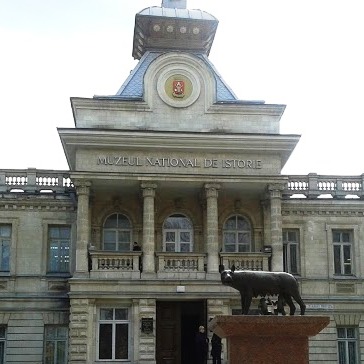
The National Museum of History of Moldova takes place among the most significant museum institutions of the Republic of Moldova, in terms of both its collection and scientific reputation.
©2006-2026 National Museum of History of Moldova
Visit museum 31 August 1989 St., 121 A, MD 2012, Chisinau, Republic of Moldova
Phones:
Secretariat: +373 (22) 24-43-25
Department of Public Relations and Museum Education: +373 (22) 24-04-26
Fax: +373 (22) 24-43-69
E-mail: office@nationalmuseum.md
Technical Support: info@nationalmuseum.md
Web site administration and maintenance: Andrei EMILCIUC


The National Museum of History of Moldova takes place among the most significant museum institutions of the Republic of Moldova, in terms of both its collection and scientific reputation.
©2006-2026 National Museum of History of Moldova
Visit museum 31 August 1989 St., 121 A, MD 2012, Chisinau, Republic of Moldova
Phones:
Secretariat: +373 (22) 24-43-25
Department of Public Relations and Museum Education: +373 (22) 24-04-26
Fax: +373 (22) 24-43-69
E-mail: office@nationalmuseum.md
Technical Support: info@nationalmuseum.md
Web site administration and maintenance: Andrei EMILCIUC

menu
The National Museum of History of Moldova takes place among the most significant museum institutions of the Republic of Moldova, in terms of both its collection and scientific reputation.
©2006-2026 National Museum of History of Moldova
Visit museum 31 August 1989 St., 121 A, MD 2012, Chisinau, Republic of Moldova
Phones:
Secretariat: +373 (22) 24-43-25
Department of Public Relations and Museum Education: +373 (22) 24-04-26
Fax: +373 (22) 24-43-69
E-mail: office@nationalmuseum.md
Technical Support: info@nationalmuseum.md
Web site administration and maintenance: Andrei EMILCIUC