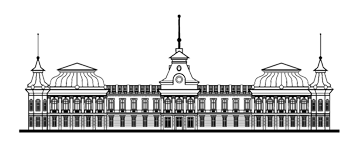
The Chișinău Diocesan Girls' School opened its doors on May 3, 1864, addressing a pressing need: in Bessarabia there were no institutions dedicated to the education of clergy's daughters. According to the 1864 circular, teaching was conducted in the Romanian language, a provision applied throughout the diocese. The school's first headmistress was Anastasia Rizo, of noble origin, invited by Archbishop Antonie.
The curriculum, approved by the Ministry of Public Education and the Chișinău Diocese, combined theoretical subjects with practical training. Students studied religion, reading and writing in Romanian, Slavonic, and Russian, arithmetic and exercises in calculation, world history and geography. The program was complemented by church singing and practical skills such as sewing, embroidery, knitting, as well as household management - baking bread and prosphora, preparing meals and preserves, caring for livestock, and cultivating gardens.
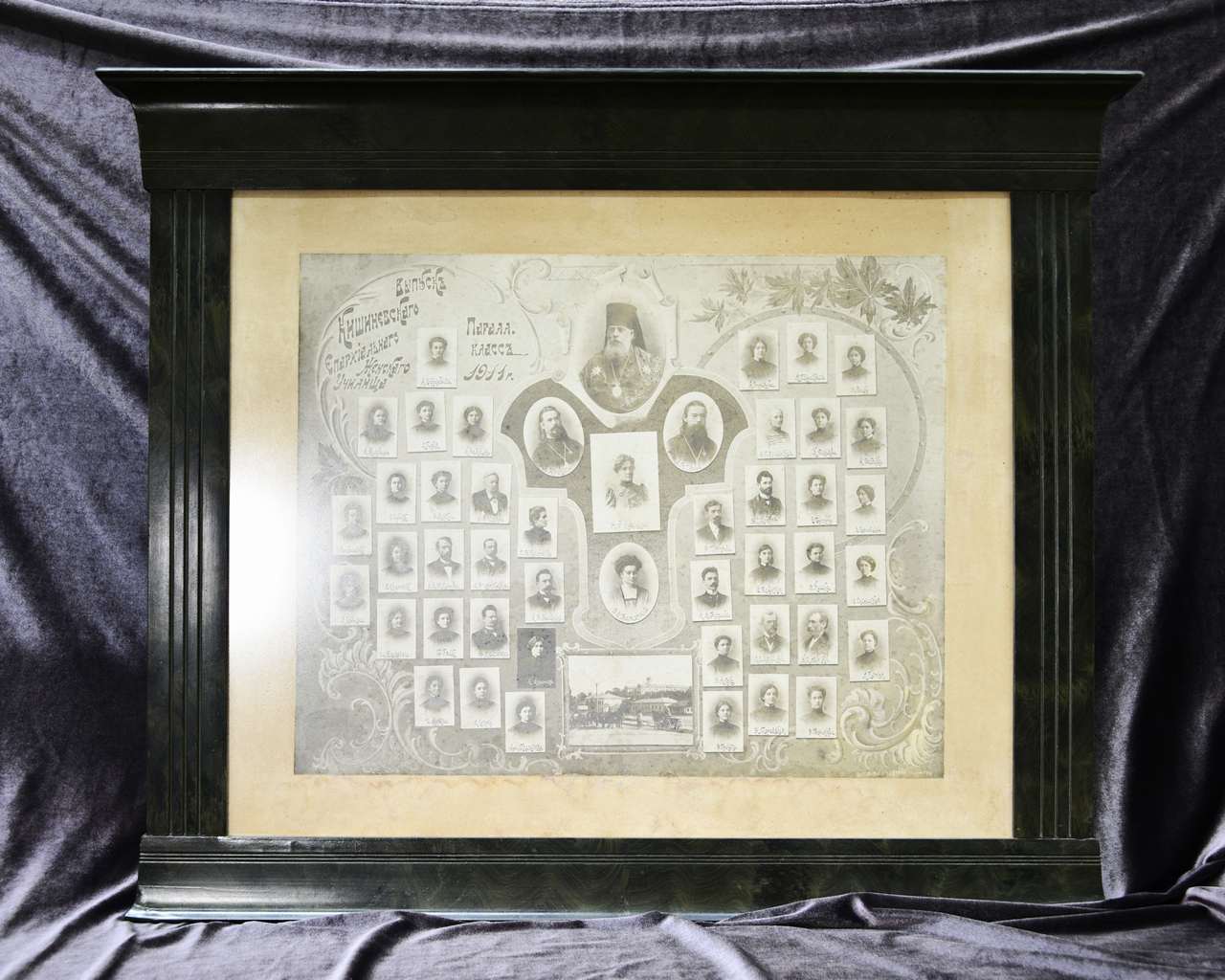
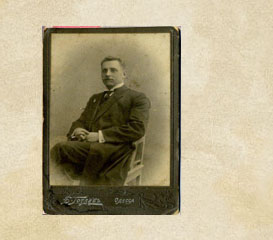
The composite, taken in 1911 at the studio of Z. N. Sumovski in Chișinău, depicts 29 graduates and 13 teachers. At the center are portraits of Bishop Serafim (Ciciagov), headmistress N. R. Mihelson, teacher V. E. Bejerian, and priests F. Ghiliarov and P. Jurikas. Among the teaching staff was Paraskovia Vasilievna Cuciurenko, a calligraphy teacher for 37 years, who in 1911 became senior educator and assistant headmistress. For her dedication, she was awarded the gold medal "For Long Service."
On the reverse of the vignette is a label from the store and workshop of frames, paintings, mirrors, and window glass owned by A. D. Kon'gova, Chișinău, Gogol Street no. 37, near the State Bank.
This graduation composite was donated at the end of 2025 to the National Museum of History of Moldova by the Dadiștian family from Drochia.
Tyragetia, serie nouă, vol. IV [XIX], nr. 1, Arheologie. Istorie Antică
In 2007 a group of researches from the Institute of Cultural Heritage of ASM and the National Museum of Archaeology and History of Moldova had investigated an anthropomorphic stela with an incised Sarmatian tamga near Taraclia town, Republic of Moldova. According to our preliminary research, the tamga belongs to the Sarmatian King Farzoi and dates to the second half of 1st century B.C.
List of illustration: Fig. 1. Map of spread of “Sarmatian tamgas” in North-Western Black Sea. Stone stelae: 1 - Zazdrost’; 2 - Tețcani; 3 - Bleșteni; 4 - Corpaci; 5 - Cosăuți; 6 - Taraclia; 7 - Tasna. Discoveries of pieces with „Sarmatian tamgas”: 8 - Porogi; 9 - Hrușca; 10 - Olbia; 11 - Bugskij liman. Fig. 2. Stone stela discovered near Taraclia town.
Сергей М. Агульников
The Belozerka culture horizon from the settlement Kriničnoe
Tyragetia, serie nouă, vol. I [XVI], nr. 1, Arheologie. Istorie Antică
The Chișinău Diocesan Girls' School opened its doors on May 3, 1864, addressing a pressing need: in Bessarabia there were no institutions dedicated to the education of clergy's daughters...
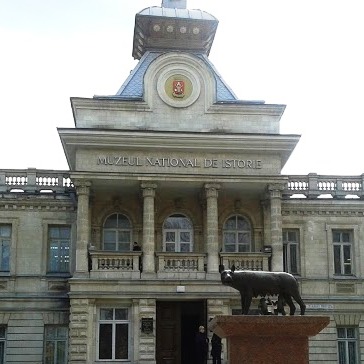
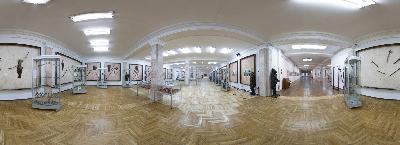
The National Museum of History of Moldova takes place among the most significant museum institutions of the Republic of Moldova, in terms of both its collection and scientific reputation.
The National Museum of History of Moldova takes place among the most significant museum institutions of the Republic of Moldova, in terms of both its collection and scientific reputation.
The National Museum of History of Moldova takes place among the most significant museum institutions of the Republic of Moldova, in terms of both its collection and scientific reputation.


















 31 August 1989 St., 121 A, MD 2012, Chisinau, Republic of Moldova