EN RO


#Exhibit of the Month

>>>

The Chișinău Diocesan Girls' School opened its doors on May 3, 1864, addressing a pressing need: in Bessarabia there were no institutions dedicated to the education of clergy's daughters. According to the 1864 circular, teaching was conducted in the Romanian language, a provision applied throughout the diocese. The school's first headmistress was Anastasia Rizo, of noble origin, invited by Archbishop Antonie.

The curriculum, approved by the Ministry of Public Education and the Chișinău Diocese, combined theoretical subjects with practical training. Students studied religion, reading and writing in Romanian, Slavonic, and Russian, arithmetic and exercises in calculation, world history and geography. The program was complemented by church singing and practical skills such as sewing, embroidery, knitting, as well as household management - baking bread and prosphora, preparing meals and preserves, caring for livestock, and cultivating gardens.

The composite, taken in 1911 at the studio of Z. N. Sumovski in Chișinău, depicts 29 graduates and 13 teachers. At the center are portraits of Bishop Serafim (Ciciagov), headmistress N. R. Mihelson, teacher V. E. Bejerian, and priests F. Ghiliarov and P. Jurikas. Among the teaching staff was Paraskovia Vasilievna Cuciurenko, a calligraphy teacher for 37 years, who in 1911 became senior educator and assistant headmistress. For her dedication, she was awarded the gold medal "For Long Service."

On the reverse of the vignette is a label from the store and workshop of frames, paintings, mirrors, and window glass owned by A. D. Kon'gova, Chișinău, Gogol Street no. 37, near the State Bank.

This graduation composite was donated at the end of 2025 to the National Museum of History of Moldova by the Dadiștian family from Drochia.


Virtual Tour


Exhibitions

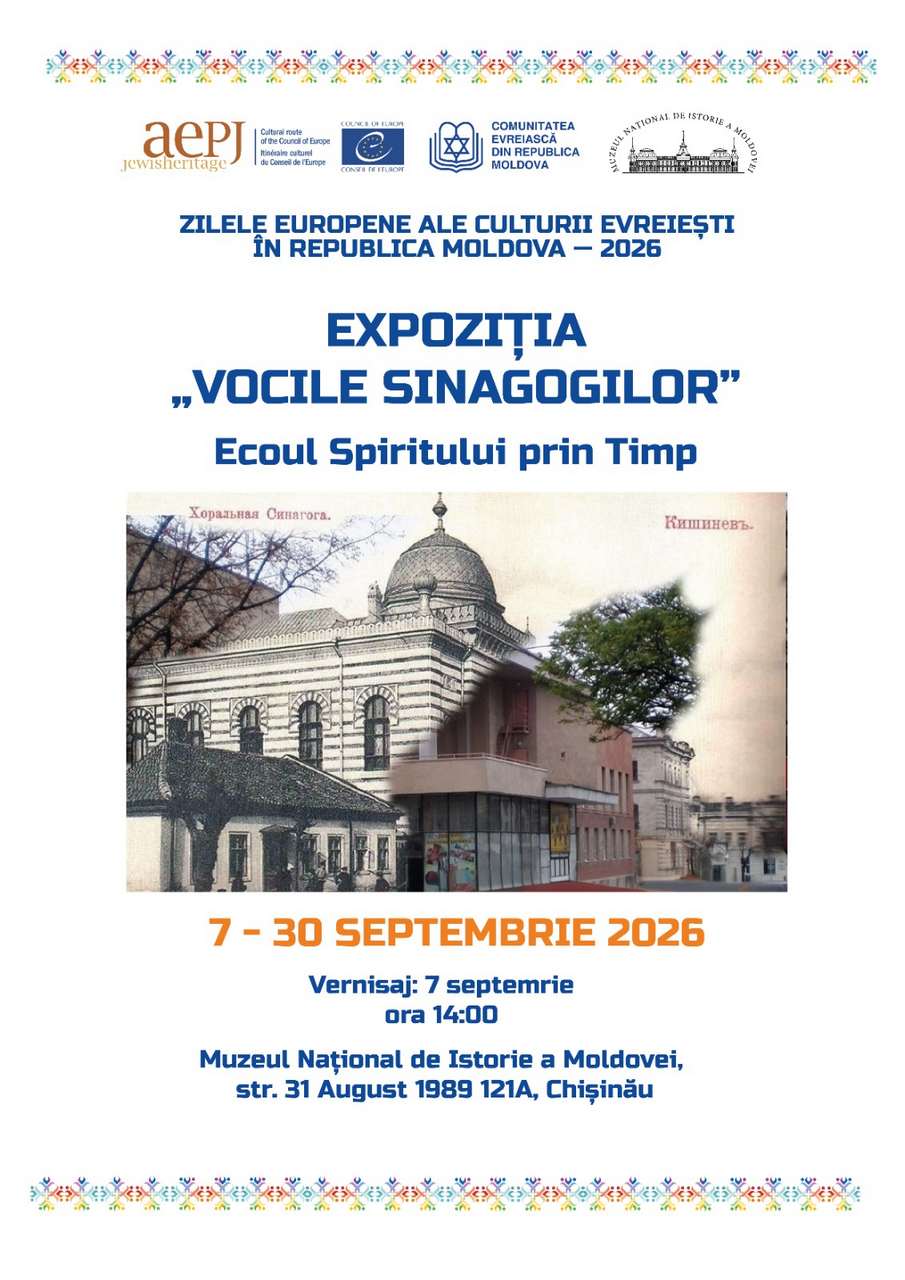
“Voices of Synagogues. The Echo of Spirit through Time”

September 7–30, 2026

Between September 7-30, 2026, the Jewish Community of the Republic of Moldova, in partnership with the National Museum of History of Moldova, presents the documentary-photographic exhibition "Voices of Synagogues", open to the public on the ground floor of the museum.

The exhibition offers a visual journey into the Jewish religious heritage of Moldova, through a series of panels juxtaposing archival and historical photographs with the current state of synagogues built between the 18th and 20th centuries. These edifices, erected by Jewish communities, guilds, and families, have endured political regimes, wars, and social transformations. Some have preserved their original religious function, others have been repurposed, while a few survive today only as ruins or memories.

Synagogues were more than places of worship: they served as community centers, spaces of education and solidarity, contributing significantly to the urban and economic life of Moldova. The exhibition provides a comparative perspective on these transformations, inviting visitors to reflect on urban memory and on the ways in which built heritage silently preserves the layers of a community's history.

Beyond its documentary value, the exhibition is a meditation on urban memory and on how architectural spaces often retain, in silence, the strata of a communal history essential for understanding Moldova's multiethnic past and religious diversity. "Voices of Synagogues" restores visibility to these architectural witnesses and opens a dialogue about heritage, memory, and continuity.

The exhibition is part of the program of the European Days of Jewish Culture in the Republic of Moldova - 2026, under the motto "The Echo of Spirit through Time". It also aligns with the theme of the European Heritage Days in the Republic of Moldova 2026, held under the banner "Heritage at Risk: Revive, Resist, Reimagine". Within this framework, "Voices of Synagogues" stands as an example of reactivating collective memory and raising awareness about the fragility of built heritage, while inviting society to reimagine its role in contemporary life.

The exhibition "Voices of Synagogues. The Echo of Spirit through Time" can be visited between September 7-30, 2026, on the ground floor of the National Museum of History of Moldova, Chișinău, str. 31 August 1989, no. 121A.


Independent Moldova
Moldavian Soviet Socialist Republic
Bessarabia and MASSR between the Two World Wars
Bessarabia and Moldavian Autonomous Soviet Socialist Republic in the Period between the Two World Wars
Revival of National Movement
Time of Reforms and their Consequences
Abolition of Autonomy. Bessarabia – a New Tsarist Colony
Period of Relative Autonomy of Bessarabia within the Russian Empire
Phanariot Regime
Golden Age of the Romanian Culture
Struggle for Maintaining of Independence of Moldova
Formation of Independent Medieval State of Moldova
Era of the
Great Nomad Migrations
Early Middle Ages
Iron Age and Antiquity
Bronze Age
Aeneolithic Age
Neolithic Age
Palaeolithic Age


Come to Museum! Discover the History!
  
Visit museum
Visit museum
Summer schedule: daily
10am – 6pm.

Winter schedule: daily
10am – 5pm.
Closed on Mondays.
Entrance fees:  adults - 50 MDL, Pensioners, students - 20 lei, pupils - 10 MDL. Free access: enlisted men (...)

WiFi Free Wi-Fi Zone in the museum: In the courtyard of the National History Museum of Moldova there is Wi-Fi Internet access for visitors.


#Exhibit of the Month

The Chișinău Diocesan Girls' School opened its doors on May 3, 1864, addressing a pressing need: in Bessarabia there were no institutions dedicated to the education of clergy's daughters...

Read More >>


The National Museum of History of Moldova takes place among the most significant museum institutions of the Republic of Moldova, in terms of both its collection and scientific reputation.
©2006-2026 National Museum of History of Moldova
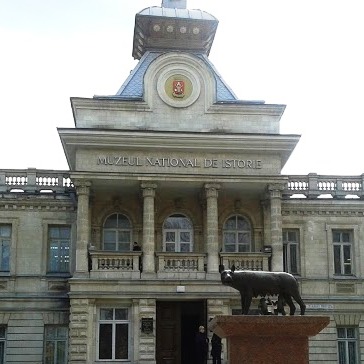
Visit museum 31 August 1989 St., 121 A, MD 2012, Chisinau, Republic of Moldova
Phones:
Secretariat: +373 (22) 24-43-25
Department of Public Relations and Museum Education: +373 (22) 24-04-26
Fax: +373 (22) 24-43-69
E-mail: office@nationalmuseum.md
Technical Support: info@nationalmuseum.md
Web site administration and maintenance: Andrei EMILCIUC


The National Museum of History of Moldova takes place among the most significant museum institutions of the Republic of Moldova, in terms of both its collection and scientific reputation.
©2006-2026 National Museum of History of Moldova
Visit museum 31 August 1989 St., 121 A, MD 2012, Chisinau, Republic of Moldova
Phones:
Secretariat: +373 (22) 24-43-25
Department of Public Relations and Museum Education: +373 (22) 24-04-26
Fax: +373 (22) 24-43-69
E-mail: office@nationalmuseum.md
Technical Support: info@nationalmuseum.md
Web site administration and maintenance: Andrei EMILCIUC

menu
The National Museum of History of Moldova takes place among the most significant museum institutions of the Republic of Moldova, in terms of both its collection and scientific reputation.
©2006-2026 National Museum of History of Moldova
Visit museum 31 August 1989 St., 121 A, MD 2012, Chisinau, Republic of Moldova
Phones:
Secretariat: +373 (22) 24-43-25
Department of Public Relations and Museum Education: +373 (22) 24-04-26
Fax: +373 (22) 24-43-69
E-mail: office@nationalmuseum.md
Technical Support: info@nationalmuseum.md
Web site administration and maintenance: Andrei EMILCIUC