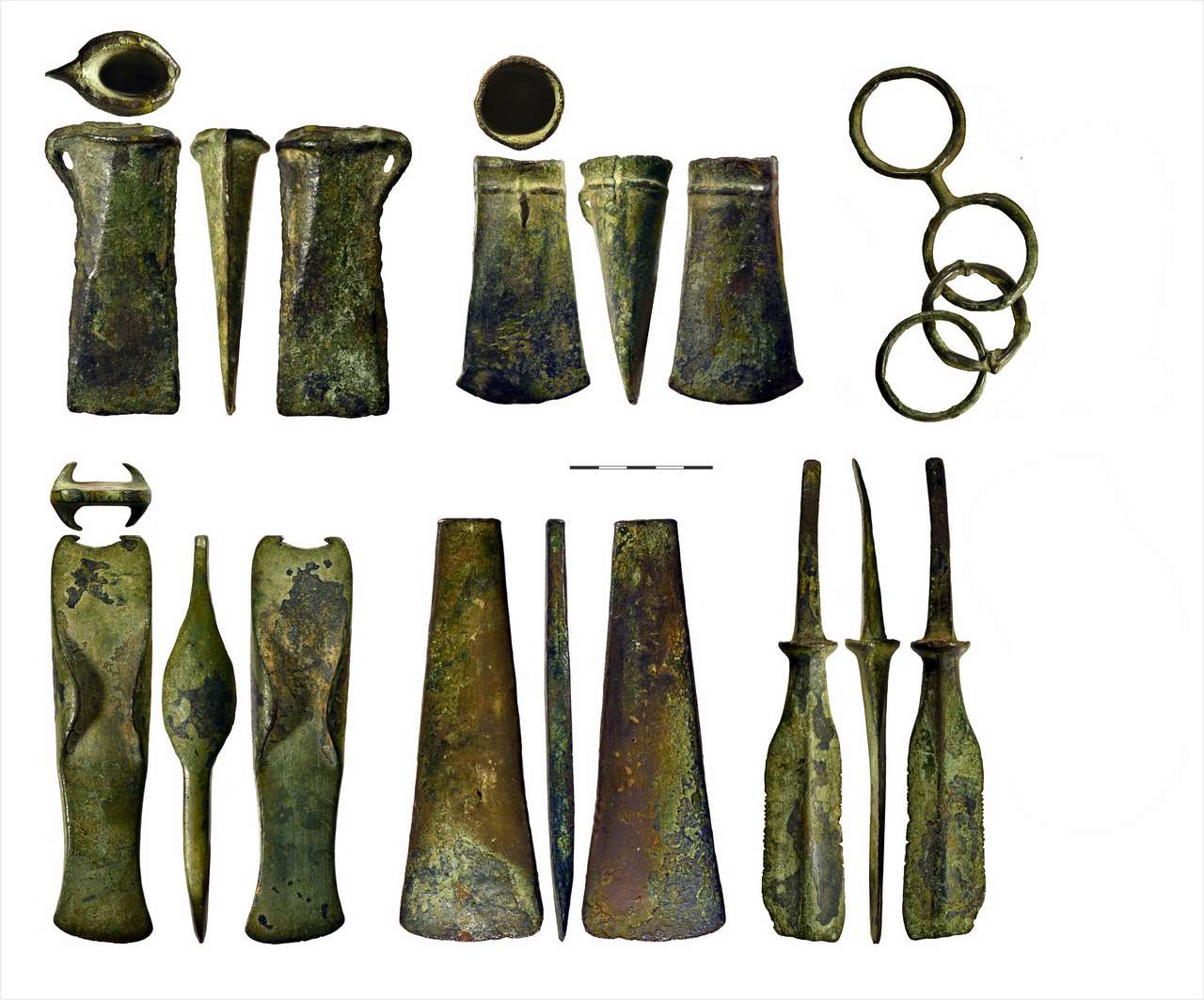
The bronze hoard was discovered on the territory of Mîndrești village, Telenești district, in 1968. It was identified accidentally by a group of students from the village school, and the materials later came to the attention of specialists at the Institute of History of the Academy of Sciences. According to documentary records, the hoard was composed of ten pieces: four socketed axes (celts), a dagger fragment, a sword fragment, a sickle, a winged axe, an adze-axe, and a chain consisting of four links. Currently, of the mentioned assemblage, six objects are preserved in the collections of the National Museum of History of Moldova: two socketed axes (celts), the winged axe, the adze-axe, the dagger fragment, and the chain made of four links.- Socketed axe (celt) with one loop. Dimensions: Length - 10.2 cm; Weight - 186 g. - Socketed axe (celt) with one frontal loop. Dimensions: Length - 8.4 cm; Width: 33-46 mm; Weight - 124 g. - Winged axe. Dimensions: Length - 14.0 cm; Width - 2.5-3.4 cm; Weight - 285 g. - Adze-axe. Dimensions: Length - 14.8 cm; Width - 2.3-5.0 cm; Weight - 286 g. - Dagger fragment. Dimensions: Length - 16.5 cm; Blade length - 9.8 cm; Blade width - 2.8 cm; Weight - 81 g. - Chain formed of four links. Dimensions: Length - 17.1 cm; Link diameter - 3.8; Weight - 32 g.The bronze hoard of Mîndrești is important due to the association of objects that find analogies in the regional repertoire with pieces that show clear analogies in Central Europe and the Carpathian Basin. The assemblage reflects a zone of contact and interaction where metallic forms of different origins and traditions circulated and were integrated into the repertoire of local communities. Chronologically, the bronze hoard of Mîndrești is attributed to the Early Hallstatt period - HaA1, being dated to 1200-1100 BC.
The unknown history of a known family: Secrets of the private life of an illegitimate granddaughter of Dimitrie Cantemir
Tyragetia, serie nouă, vol. XVI [XXXI], nr. 2, Istorie. Muzeologie
Lilia Zabolotnaia
Mysteries, myths and realities regarding the testament of Maria (Lupu) Radziwiłł
Tyragetia, serie nouă, vol. IX [XXIV], nr. 2, Istorie. Muzeologie Chișinău, 2015
Lilia Zabolotnaia, Sorin Iftimi
Portrait of Maria (Lupu) Radziwill in the works of the Polish painter Korneli Szlegiel (1851)
Tyragetia, serie nouă, vol. X [XXV], nr. 2, Istorie. Muzeologie
Lilia Zabolotnaia
Nicolae Fuştei, Mitropolitul Gavriil Bănulescu-Bodoni 1746-1821: activităţi culturale şi ecleziastice. Chişinău: Biblioteca ştiinţifică (Institut) „Andrei Lupan”, 2021, 464 p. ISBN 978-9975-62-452-7
Tyragetia, serie nouă, vol. XVI [XXXI], nr. 2, Istorie. Muzeologie
Lilia Zabolotnaia
Helena Krasowska, The Polish Minority in South-Eastern Ukraine. Warsaw: Institute of Slavic Studies, Polish Academy of Sciences, 2017, 389 p. ISBN: 978-83-64031-65-6
Tyragetia, serie nouă, vol. XII [XXVII], nr. 2, Istorie. Muzeologie
Lilia Zabolotnaia
Epistolary heritage of women’s texts. Private correspondence of the Cantemir sisters
Tyragetia, serie nouă, vol. XVII [XXXII], nr. 2, Istorie. Muzeologie
The bronze hoard was discovered on the territory of Mîndrești village, Telenești district, in 1968. It was identified accidentally by a group of students from the village school, and the materials later came to the attention of specialists at the Institute of History of the Academy of Sciences...
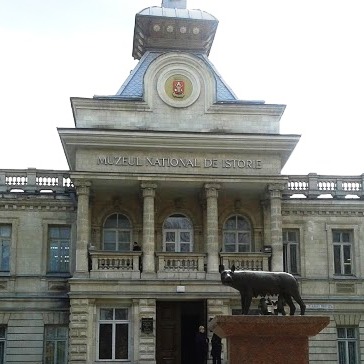
The National Museum of History of Moldova takes place among the most significant museum institutions of the Republic of Moldova, in terms of both its collection and scientific reputation.
The National Museum of History of Moldova takes place among the most significant museum institutions of the Republic of Moldova, in terms of both its collection and scientific reputation.
The National Museum of History of Moldova takes place among the most significant museum institutions of the Republic of Moldova, in terms of both its collection and scientific reputation.





















 31 August 1989 St., 121 A, MD 2012, Chisinau, Republic of Moldova