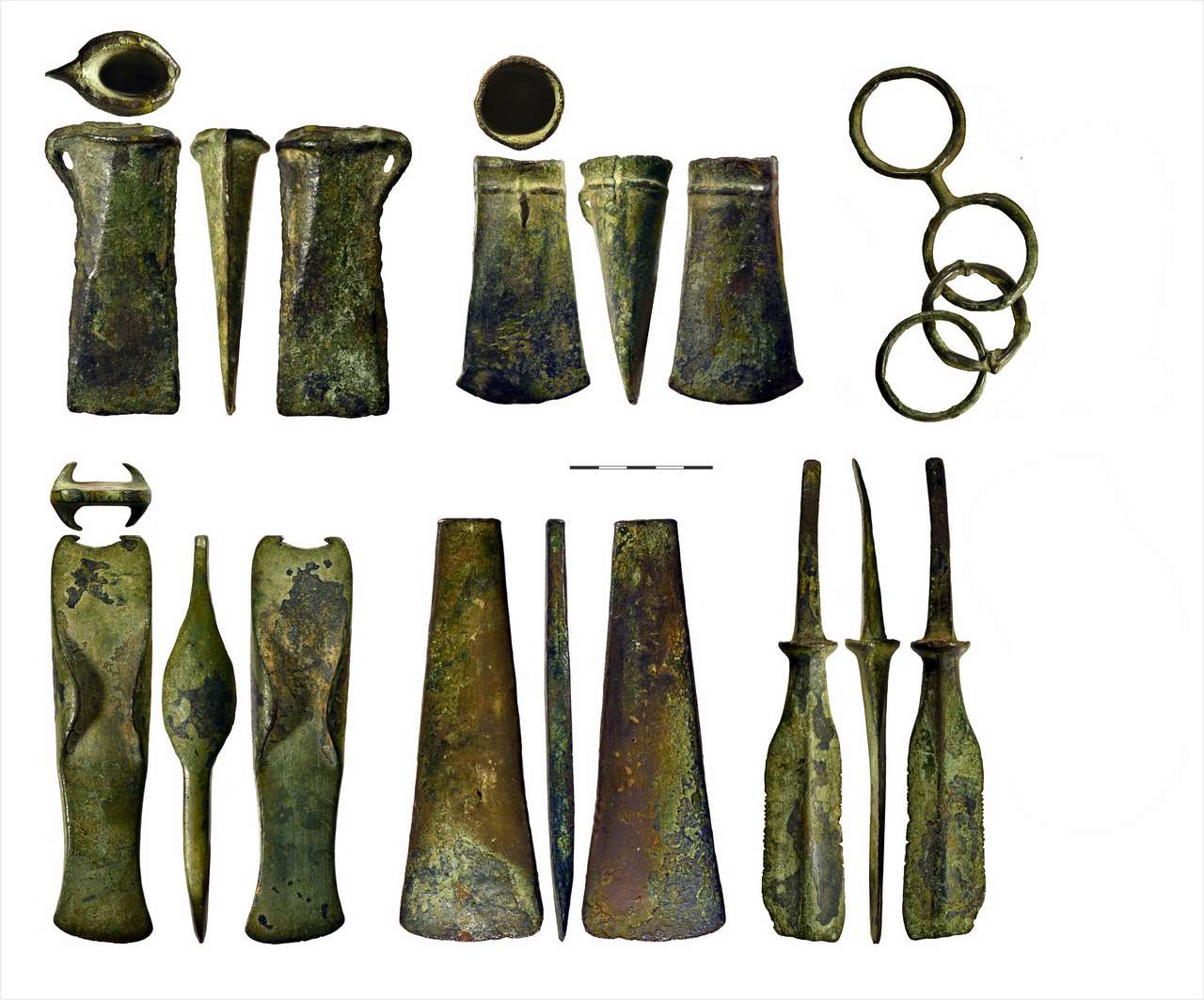
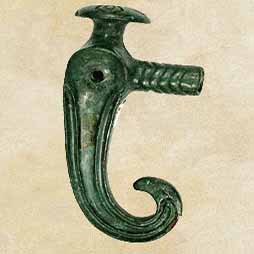
The bronze hoard was discovered on the territory of Mîndrești village, Telenești district, in 1968. It was identified accidentally by a group of students from the village school, and the materials later came to the attention of specialists at the Institute of History of the Academy of Sciences. According to documentary records, the hoard was composed of ten pieces: four socketed axes (celts), a dagger fragment, a sword fragment, a sickle, a winged axe, an adze-axe, and a chain consisting of four links. Currently, of the mentioned assemblage, six objects are preserved in the collections of the National Museum of History of Moldova: two socketed axes (celts), the winged axe, the adze-axe, the dagger fragment, and the chain made of four links.- Socketed axe (celt) with one loop. Dimensions: Length - 10.2 cm; Weight - 186 g. - Socketed axe (celt) with one frontal loop. Dimensions: Length - 8.4 cm; Width: 33-46 mm; Weight - 124 g. - Winged axe. Dimensions: Length - 14.0 cm; Width - 2.5-3.4 cm; Weight - 285 g. - Adze-axe. Dimensions: Length - 14.8 cm; Width - 2.3-5.0 cm; Weight - 286 g. - Dagger fragment. Dimensions: Length - 16.5 cm; Blade length - 9.8 cm; Blade width - 2.8 cm; Weight - 81 g. - Chain formed of four links. Dimensions: Length - 17.1 cm; Link diameter - 3.8; Weight - 32 g.The bronze hoard of Mîndrești is important due to the association of objects that find analogies in the regional repertoire with pieces that show clear analogies in Central Europe and the Carpathian Basin. The assemblage reflects a zone of contact and interaction where metallic forms of different origins and traditions circulated and were integrated into the repertoire of local communities. Chronologically, the bronze hoard of Mîndrești is attributed to the Early Hallstatt period - HaA1, being dated to 1200-1100 BC.
Mircea Mamalaucă, Descoperiri din perioada antichităţii târzii în Podişul Central Moldovenesc. Necropolele de la Bogdăneşti-Fălciu, Pogoneşti şi Polocin. Iaşi: Casa Editorială Demiurg, 2018, 666 p., inclusiv 259 planşe alb-negru şi color, ISBN: 973-152-367-5
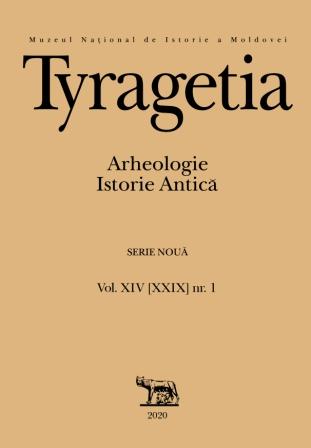
Tyragetia, serie nouă, vol. XIV [XXIX], nr. 1, Arheologie. Istorie Antică, Chişinău, 2020
Vlad Vornic
Octavian Liviu Şovan, Necropola de tip Sântana de Mureș-Černjachov de la Mihălășeni (județul Botoșani), Editura „Cetatea de Scaun", Târgoviște, 2005, 354 p.+390 pl., ISBN 973-7925-51-3
Tyragetia, serie nouă, vol. I [XVI], nr. 1, Arheologie. Istorie Antică
Larisa Ciobanu
Les vestiges de la culture Sântana de Mureș-Černjachov de Sîngerei
Tyragetia, serie nouă, vol. I [XVI], nr. 1, Arheologie. Istorie Antică Chișinău, 2007
Vlad Vornic
Chronology of Sântana de Mureș-Černjachov type necropolis from Brăviceni, Orhei district
Tyragetia, serie nouă, vol. X [XXV], nr. 1, Arheologie. Istorie Antică
Vlad Vornic
Adrian Ioniță, Așezarea din secolele XII-XIII de la Bratei, Sibiu - Alba-Iulia, 2009, 199 pag. + 274 pl., ISBN 978-973-117-210-1
Tyragetia, serie nouă, vol. VI [XXI], nr. 1, Arheologie. Istorie Antică
Vlad Vornic
Vasile Ursachi, Săbăoani. Monografie arheologică, vol. II, Iași, 2010, 211 pag.+252 ilustr., ISBN 978-973-152-189-3
Tyragetia, serie nouă, vol. V [XX], nr. 1, Arheologie. Istorie Antică
The bronze hoard was discovered on the territory of Mîndrești village, Telenești district, in 1968. It was identified accidentally by a group of students from the village school, and the materials later came to the attention of specialists at the Institute of History of the Academy of Sciences...
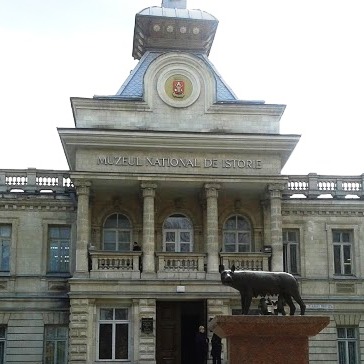
The National Museum of History of Moldova takes place among the most significant museum institutions of the Republic of Moldova, in terms of both its collection and scientific reputation.
The National Museum of History of Moldova takes place among the most significant museum institutions of the Republic of Moldova, in terms of both its collection and scientific reputation.
The National Museum of History of Moldova takes place among the most significant museum institutions of the Republic of Moldova, in terms of both its collection and scientific reputation.


























 31 August 1989 St., 121 A, MD 2012, Chisinau, Republic of Moldova