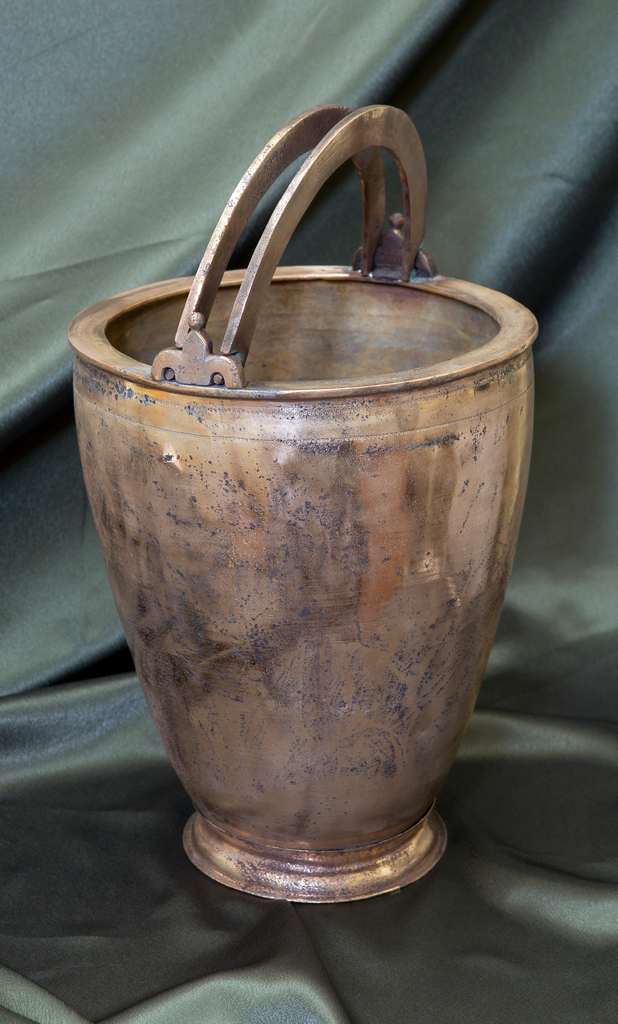
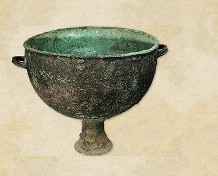
The Roman bronze situla comes from a collection of archaeological artifacts confiscated at customs and transferred to the holdings of the National Museum of History of Moldova in 2009. Its place of discovery remains unknown.
A situla (Latin for "bucket") is a metal vessel-usually made of bronze-shaped like a pail and equipped with two movable handles at the top, traditionally used for mixing wine with water. The handles are attached to the vessel via two decorated ears that are welded to the rim.
The body of the situla is truncated-conical in shape and features two decorative bands with small circular patterns formed by hammering, located just below the rim.
Its base is double-layered: the inner bottom is hemispherical and hammered, while the outer bottom is flat and lathe-made. The outer base is welded to the inner bottom, serving as the vessel's foot-support.
This object was crafted using a combination of casting, hammering, and partial lathe-finishing. Dimensions: Maximum height - 31.7 cm; Maximum diameter - 22.8 cm; Base diameter - 13.5 cm
Situlae of this type originated in the Roman Empire and were later adopted by various ancient peoples, including those from the northwestern Pontic region.
The “Luceafărul” Republican Theatre for Children and Youth: Pages of History
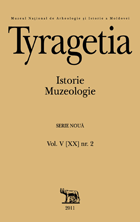
Tyragetia, serie nouă, vol. V [XX], nr. 2, Istorie. Muzeologie
The activity of the “Luceafărul” Theatre since the day of its foundation can be divided into three periods. The golden era of its history was in 1960-1970s when the performances of this theatre were marked by a special talent, inspiration, and civic courage. At this time there were put on еру stage such plays as “Radu Stefan – the first and last” by A. Busuioc, “Minodora” by A. Strambeanu, “Passion Week” by I. Podoleanu, etc. New productions were expected with great impatience and there were long queues at the box-office.
Then there followed a long period of creative crisis that lasted until the early 1990s.
A renovation of the theatre started in the late 1990s, with the coming of a new director Boris Focsa. He put on the stage a series of performances which had been highly appreciated by the public both in country and abroad.
Today in the repertoire of the “Luceafărul” Republican Theatre there are 25 performances, including plays for children. Actors from the first generation (N. Doni, P. Zavtoni, R. Ene, T. Băsescu, Gh. Pârlea, and others) still continue to play here along with the two generations of actors from B. Focșa’s class. In general, it should be noted the creative recovery of this theatre with an excellent troupe which includes such actors as A. Tabarcea, S. Mierla, D. Acriș, Iu. Ursu, V. Isac, R. Mereuță, V. Mereuță, Iu. Bordeianu, and others. List of illustrations: Photo 1. Troupe of the “Luceafărul” Republican Theatre, 1960. Photo 2. Collective of the theatre, 2008.
Vera Stăvilă
Contribution to the study of the activity of the Chișinău orphanage “Children’s home”
Tyragetia, serie nouă, vol. I [XVI], nr. 2, Istorie. Muzeologie Chișinău, 2007
Vera Stăvilă
Female images on Soviet posters from the collections of the National Museum of History of Moldova
Tyragetia, serie nouă, vol. XV [XXX], nr. 2, Istorie. Muzeologie
Vera Stăvilă
Movie posters from the collection of the National Museum of History of Moldova
Tyragetia, serie nouă, vol. VII [XXII], nr. 2, Istorie. Muzeologie
Vera Stăvilă
The National Theater „Vasile Alecsandri” from Bălți: historical retrospective
Tyragetia, serie nouă, vol. IV [XIX], nr. 2, Istorie. Muzeologie
Vera Stăvilă
The history of the Bessarabian Belle Arte School and Society
Tyragetia, serie nouă, vol. II [XVII], nr. 2, Istorie. Muzeologie
The Roman bronze situla comes from a collection of archaeological artifacts confiscated at customs and transferred to the holdings of the National Museum of History of Moldova in 2009. Its place of discovery remains unknown....
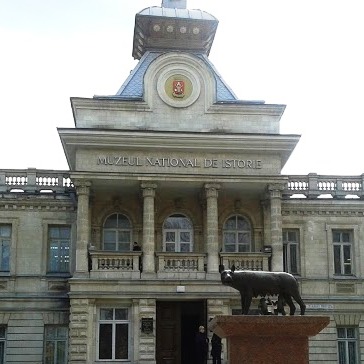
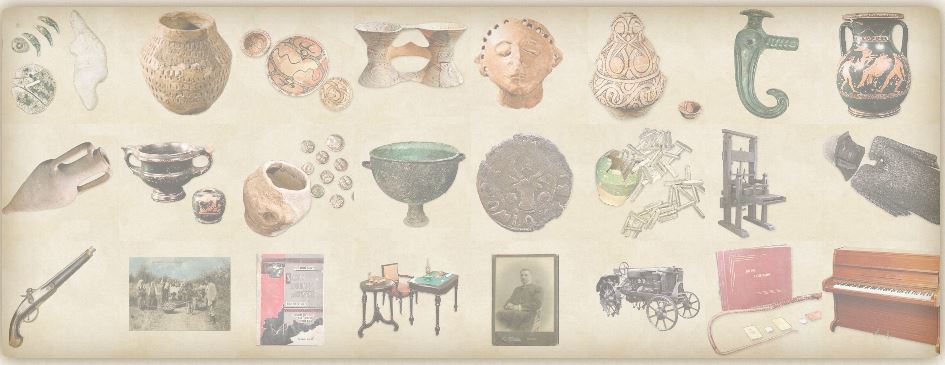
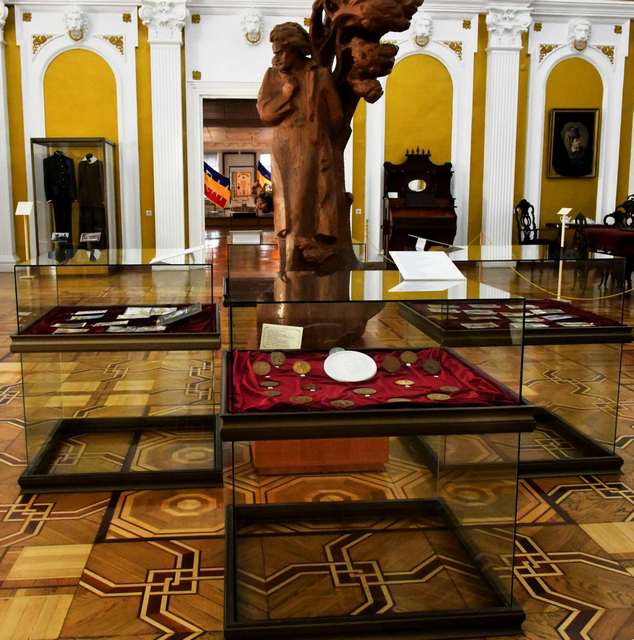
The National Museum of History of Moldova takes place among the most significant museum institutions of the Republic of Moldova, in terms of both its collection and scientific reputation.
The National Museum of History of Moldova takes place among the most significant museum institutions of the Republic of Moldova, in terms of both its collection and scientific reputation.
The National Museum of History of Moldova takes place among the most significant museum institutions of the Republic of Moldova, in terms of both its collection and scientific reputation.















 31 August 1989 St., 121 A, MD 2012, Chisinau, Republic of Moldova