The Chișinău Diocesan Girls' School opened its doors on May 3, 1864, addressing a pressing need: in Bessarabia there were no institutions dedicated to the education of clergy's daughters. According to the 1864 circular, teaching was conducted in the Romanian language, a provision applied throughout the diocese. The school's first headmistress was Anastasia Rizo, of noble origin, invited by Archbishop Antonie.
The curriculum, approved by the Ministry of Public Education and the Chișinău Diocese, combined theoretical subjects with practical training. Students studied religion, reading and writing in Romanian, Slavonic, and Russian, arithmetic and exercises in calculation, world history and geography. The program was complemented by church singing and practical skills such as sewing, embroidery, knitting, as well as household management - baking bread and prosphora, preparing meals and preserves, caring for livestock, and cultivating gardens.
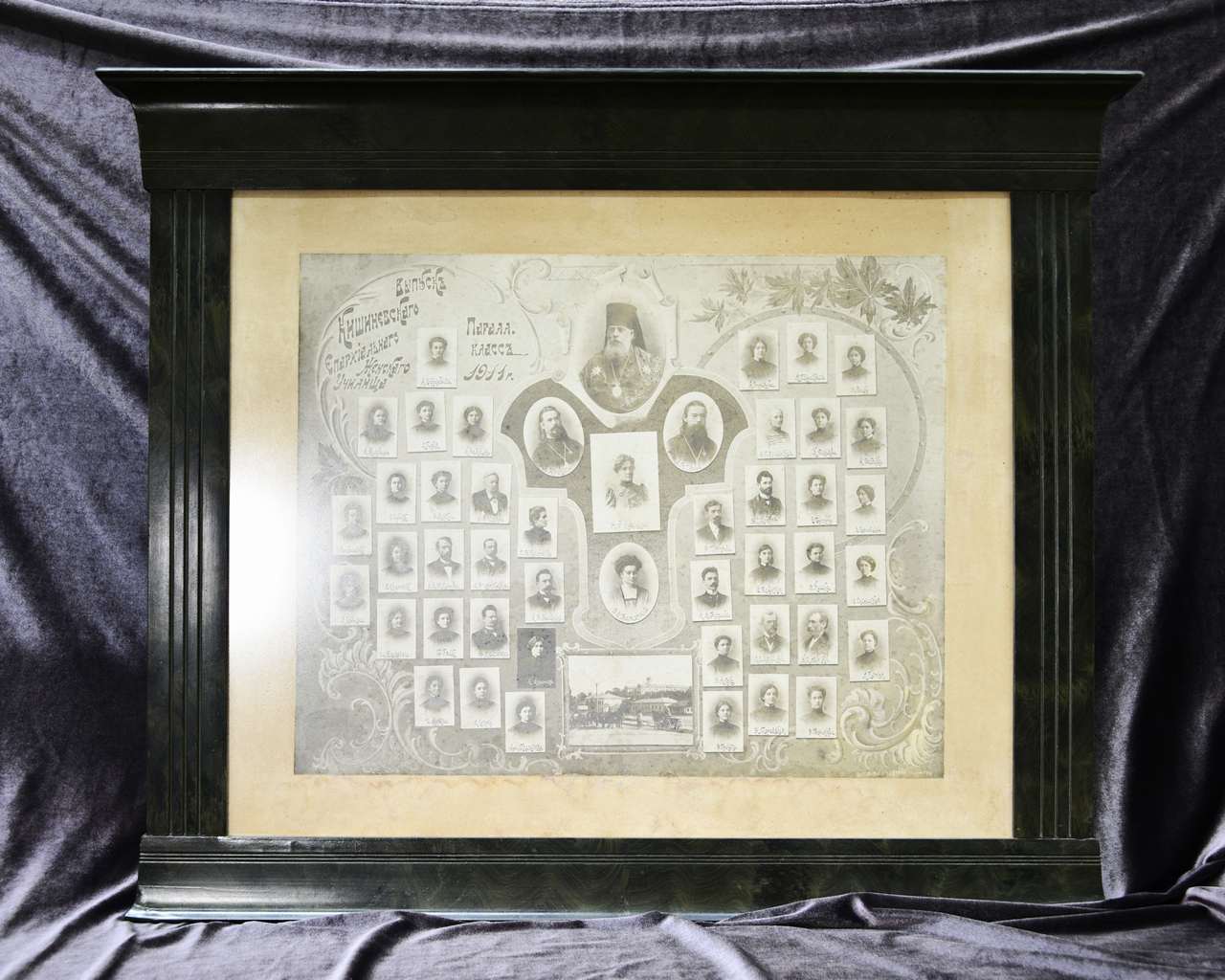
The composite, taken in 1911 at the studio of Z. N. Sumovski in Chișinău, depicts 29 graduates and 13 teachers. At the center are portraits of Bishop Serafim (Ciciagov), headmistress N. R. Mihelson, teacher V. E. Bejerian, and priests F. Ghiliarov and P. Jurikas. Among the teaching staff was Paraskovia Vasilievna Cuciurenko, a calligraphy teacher for 37 years, who in 1911 became senior educator and assistant headmistress. For her dedication, she was awarded the gold medal "For Long Service."
On the reverse of the vignette is a label from the store and workshop of frames, paintings, mirrors, and window glass owned by A. D. Kon'gova, Chișinău, Gogol Street no. 37, near the State Bank.
This graduation composite was donated at the end of 2025 to the National Museum of History of Moldova by the Dadiștian family from Drochia.
Tyragetia, serie nouă, vol. V [XX], nr. 1, Arheologie. Istorie Antică
The article is devoted to variety and character of the Scythian Amazon’s armaments. Archaeological finds of weapons and equipment of militant women is almost identical to the arms from the written and artistic sources. In general, women panoply completely consistent with the armament of the Scythian troops. Amazons preferred missile weapon, and almost did not use melee weapons. Amazons were studying the military art from an early childhood.
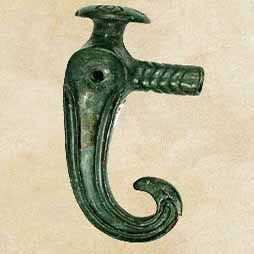
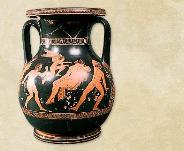
List of illustrations: Fig. 1. Images of armed Amazons: 1-2 - on the golden Calaf from the kurgan Bol’shaja Bliznitsa; 3 - on red-figured vases. Fig. 2. Images of Amazons on red-figured pelikai. Fig. 3. The types of arrowheads from the burials of armed women: 1-2 - kurgan 9 near Staryj Merchyk village, 3-4 - kurgan 6 near Nowoje village; 5 - kurgan 34 from Chertomlyk cemetery; 6 - kurgan 13 of BOF group. 1, 4, 5 - bronze, 2 - iron, 3, 6 - wood. Fig. 4. Weapon from the burial mounds of Amazons: javelin-heads (1, 4) and spear points (2, 5), butt (3), slingshot stones (6). 1-3 - kurgan 13 from Steblev cemetery; 4-6 - kurgan 5 near Zelenoje village. 1-5 - iron, 6 - stone. Fig. 5. Scale armor from kurgan 5 near Zelenoje village. Fig. 6. Details of armor from kurgan 5 near Zelenoje village. Fig. 7. Details of bridle from kurgan 13 near Steblev village.
Елена Фиалко
The armed women of Early Iron Age in the Northern Pontic: social aspects
Tyragetia, serie nouă, vol. VI [XXI], nr. 1, Arheologie. Istorie Antică
Ivan Duminica
The policy of the Russian Empire aimed at the granting of privileges to Bulgarian colonists in Bessarabia in the first half of 19th century
Tyragetia, serie nouă, vol. VI [XXI], nr. 2, Istorie. Muzeologie
The Chișinău Diocesan Girls' School opened its doors on May 3, 1864, addressing a pressing need: in Bessarabia there were no institutions dedicated to the education of clergy's daughters...
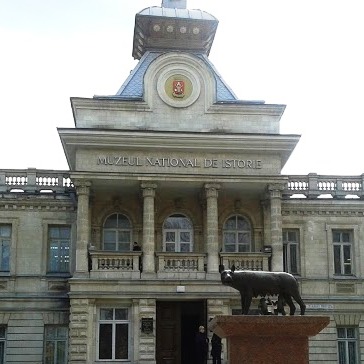
The National Museum of History of Moldova takes place among the most significant museum institutions of the Republic of Moldova, in terms of both its collection and scientific reputation.
The National Museum of History of Moldova takes place among the most significant museum institutions of the Republic of Moldova, in terms of both its collection and scientific reputation.
The National Museum of History of Moldova takes place among the most significant museum institutions of the Republic of Moldova, in terms of both its collection and scientific reputation.



















 31 August 1989 St., 121 A, MD 2012, Chisinau, Republic of Moldova