>>>
The Chișinău Diocesan Girls' School opened its doors on May 3, 1864, addressing a pressing need: in Bessarabia there were no institutions dedicated to the education of clergy's daughters. According to the 1864 circular, teaching was conducted in the Moldovan language, a provision applied throughout the diocese. The school's first headmistress was noblewoman Anastasia Dmitrievna Rizo, invited by Archbishop Antonie.
The curriculum, approved by the Ministry of Public Education and the Chișinău Diocese, combined theoretical subjects with practical training. Students studied religion, reading and writing in Moldovan, Slavonic, and Russian, arithmetic and mental calculation, world history and geography. The program was complemented by church singing and practical skills such as sewing, embroidery, knitting, as well as household management - baking bread and prosphora, preparing meals and preserves, caring for livestock, and cultivating gardens.
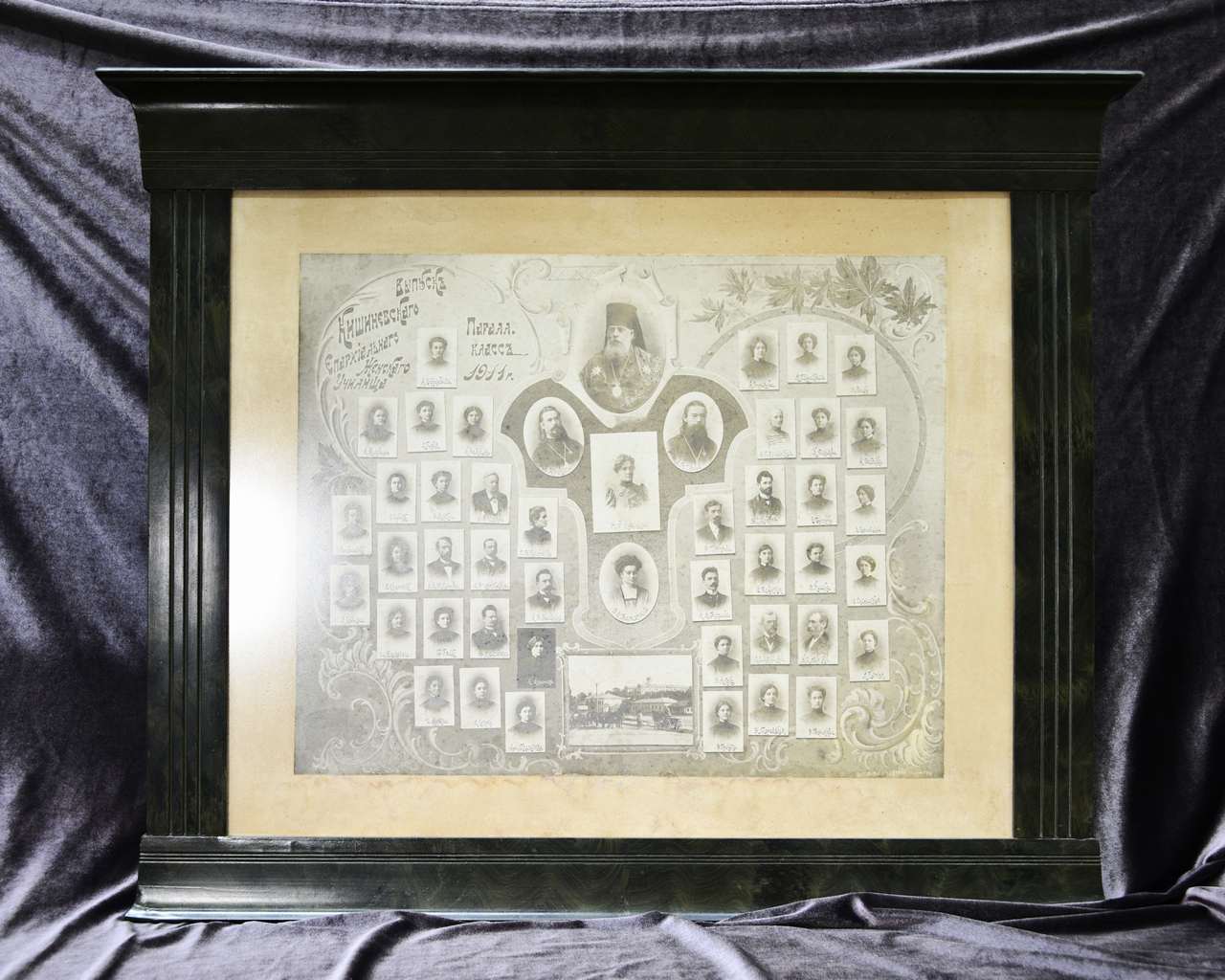
The vignette, created in 1911 at the photographic studio of Z. N. Sumovski in Chișinău, depicts 29 graduates and 13 teachers. At the center are portraits of Bishop Serafim (Ciciagov), headmistress N. R. Mihelson, teacher V. E. Bejerian, and priests F. Ghiliarov and P. Jurikas. A notable figure is Praskovia Vasilievna Cuciurenko, a calligraphy teacher for 37 years, who in 1911 became senior educator and assistant headmistress. For her dedication, she was awarded the gold medal "For Long Service."
By 1911, the school had 648 students across 17 classes. Its library contained 7,414 volumes, including 3,955 for students and 3,459 for teachers. Graduates, often becoming priests' wives or teachers in rural and urban schools, contributed to spreading faith and moral education, strengthening the cultural and spiritual role of the institution.
On the reverse of the vignette is a label reading: "Store and workshop for frames, paintings, mirrors, and window glass, A. D. Kon'gova, Chișinău, Gogol Street no. 37, next to the State Bank."
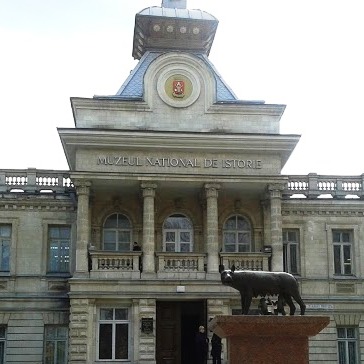
This unique vignette was donated at the end of 2025 to the National Museum of History of Moldova by the Dadiștian family from Drochia.













 31 August 1989 St., 121 A, MD 2012, Chisinau, Republic of Moldova